Monday, July 20, 2020
A Quick Note
Hello Everyone:
This is Blogger and The Candidate Forum with a quick note. Historicpca is taking the week off for a family matter and will be back next week. In the meantime, Yours Truly will re-post of previous posts for you to read. Next week, we will take a look at how to safely re-open schools, more on the president's Garden of American Heroes, and designing for the post-pandemic world.
Thanks and see you next week
Blogger and The Candidate Forum

Wednesday, July 15, 2020
What Will Be The Fate Of Hagia Sophia?
 |
| blog.google |
It is a lovely afternoon and Yours Truly is here with you. Yours Truly is feeling like a stuck needle reminding everyone to #WearAMask. Thanks to American state governments re-opening too quickly and people flipping the double bird at local ordinances requiring face coverings in public, California is among the states having to reverse coarse and re-impose lockdown measures. Blogger loves it when people say that wearing a face covering violates their constitutional rights. Really? Where in the United States Constitution and Bill of Rights does it say a people has the right not to wear a mask? Spoiler alert: nowhere. In fact, federal, state, and local governments are allowed to enact temporary or permanent ordinances that protect public health. This includes wearing a face covering in public. Please stop have tantrums in stores, grow up, and #WearAMask. Thank you. Onward
 |
| Hagia Sophia Istanbul, Turkey swarajyamag.com |
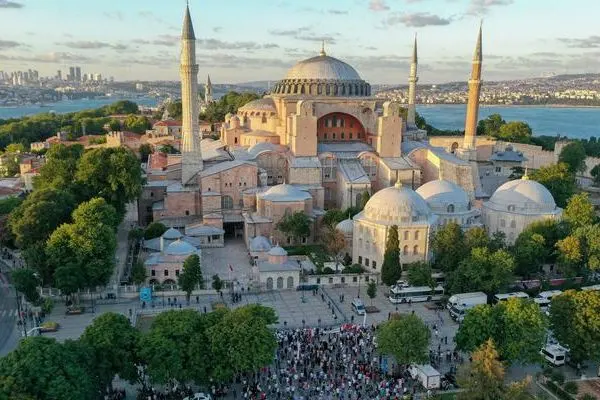
Hagia Sophia is one of the most magnificent Byzantine-era buildings in the world. Walking into the interior, your breath is immediately taken away by the soaring domed ceiling and walls adorned with glittering mosaics. Hagia Sophia is the ideal of the synthesis of Ottoman Byzantine history and the long-enduring symbol of Istanbul. Last Friday, revoked the 1934 decree by the founder of the republic, Mustafa Kemal Ataturk, turning the former religious building into a museum (nytimes.com; July 14, 2020). This decision has many secular Turks and architecture lovers around the world worried that President Recep Tayyip Erdogan is slowly turning his country into a theocracy. Hagia Sophia has a storied history goes back nearly 1,500 years ago in the post-Roman imperial period.
 |
| Hagia Sophia interior bbc.com |
Hagia Sophia (Ayasofya in Turkish) was originally built as a basilica for the Greek Orthodox Christian Church. Emperor Constantius commissioned the construction for the first iteration of the basilica in 360 CE when Istanbul was known for Constantinople.
The first iteration was not quite spectacular as it is today. It featured a more modest wooden roof. The building was burnt down in 404 CE during riots that grew out of political conflict. Emperor Theodosis II rebuilt Hagia Sophia, completed in 415. The second iteration featured five naves and a monumental entrance, covered by a wooden roof (history.com; Jan. 12, 2018; date accessed July 14, 2020). This, too, was burnt during riots against the Emperor Justinian I, who ruled from 27 to 565 CE. Unable to repair the damage, Justinian ordered the basilica's demolition and commissioned Isidoros (Milet) and Anthemios (Tralles) to build a new structure. The third and final iteration of Hagia was completed in 537 CE and remains standing today. The first religious service in the "new" basilica was held on December 27, 537 (Ibid).
 |
| Islamic prayer service out of Hagia Sophia cnn.com |
The next major period of change for Hagia Sophia was begun by the Emperor Fatih Sultan Mehmed, when the Ottomans captured Constantinople in 1453. The Ottomans renamed the city Istanbul. The Ottomans practiced Islam and renovated the basilica into a mosque, covering the original Christian mosaics with Islamic calligraphy designed by Kazasker Mustafa Izzet (Ibid).
The Ottoman Empire ended in 1922 when the title of Ottoman Sultan was formally eliminated. On October 29, 1923, Turkey was declared a republic when Mustafa Kemal Ataturk (1881-1938) established the Republic of Turkey (Ibid). In 1934, Kemal Ataturk declared the basilica a museum that now attracts millions of visitors every year. However since 2013, local Islamic religious leaders have sought to re-open Hagia Sophia for daily and weekly prayer service (Ibid). The Turkish court's ruling, allowing Hagia Sophia to return to a mosque, is part of the recognition of the importance of the Ottoman-era to Turkey's history and the rise of nationalism. Not everyone is so excited about it.
 |
| President Recep Tayyip Erdogan forbes.com |
Following Turkey's first free elections in 1950, the anti-Kemalists began to organize. The founder of the Turkish republic died over a decade before and the power of his memory was slowly fading from view. Portions of Islamic and pan-Turkic romanticists opened a campaign to re-open the Byzantine-era basilica. They argued that "the secular republic, far from having saved Turkey's sovereignty, wounded it in the deepest sense possible: It had sold its soul to Western modernity. The conversion of the Hagia Sophia was the symbol of this humiliation" (Ibid).
 |
| Necip Fazil Kisakurek aa.com.tr |
What the Western world had made us do inside, through its agents among us, neither Crusaders, nor the Moskof [the Soviets] nor Hagia Sophia's salacious coveters, the Greeks, have been able to do... (Ibid)
In that mid-sixties speech, he went on to say,
It shall be open in such a way that all lost meaning, like the bloodied and chained innocent, shall emerge from it weeping, in tatters,... It shall be opened in such a way that its cellars shall be found the files of the evil ones who were thought to have done the nation good, and the good ones who were thought to have done it evil (Ibid)
It is likely that President Erdogan heard the poet's rallying for reconversion as boy, growing up in the working class religious neighborhood of Kasimpasa near the Golden Horn in Istanbul. He also might have been inspired by Nihal Atsiz, a writer who promoted a pan-Turkic identity over that of the Muslims, revered the basilica and considered it an emblem of humiliation. He also might have been exposed to the socialist poetry of Nazim Hikmet, who devoted verses to the Hagia Sophia of his youth (Ibid). During his address to the nation on July 10, he cited Nazil Fazil Kisakurek's Hagia Sophia Conference and other poets. He told his nation that he "wanted the entire nation, not just the Islamists, to make the spiritual journey with him" (nytimes.com; July 14, 2020). The re-conversion has been a source of consternation for Greek Orthodox Church.
 |
| The Holy Eparchial Synod of the Greek Orthodox Church of America greekcitytimes.com |
His Eminence Archbishop Elpidophoros, the president of the Holy Eparchial Synod of the American Greek Orthodox Church issued an encyclical regarding the re-conversion of Hagia Sophia into a mosque. His Eminence wrote,
This egregious and unnecessary action has gravely wounded all Orthodox Christians, indeed all Christians around the world and all people of faith and good will,...
It should be allowed to retain its status quo as a place of encounter for Christian and Muslims, and for all people who desire to behold how faith in God can transform the world... (greekcitytimes.com; July 15, 2020).
Pope Francis expressed his sadness last Sunday, July 12, during improvised remarks. Following the recitation of the Angelus, the pope mentioned that July 12 was Sea Sunday, the day when the Church prays for seafarers. According to an unofficial translation of his remarks provided by the Holy See Press Office, the pope said
And the sea carries me a little farther away in my thoughts: to Istanbul. I think of Hagia Sophia, and I am very saddened (catholicnewsagency.com; July 12, 2020; date accessed July 15, 2020)
The United Nations also expressed its concerned over the re-conversion of Hagia Sophia. Hagia Sophia was inscribed onto the World Heritage List in 1985 and is part of the "Historic Areas of Istanbul" (news.un.org; July 10, 2020; date accessed July 15, 2020). The United Nations released a statement expressing concern over the lack of dialogue around Turkey's decision to implement a change of status. Ernesto Ottone, UNESCO's Assistant-Director General for Culture, emphasized
...It is important to avoid any implementing measure, without prior discussion with UNESCO, that would affect physical access to the site, and the structure of the buildings, the site's moveable property, or the site's management... (en.unesco.org; July 10, 2020; date accessed July 15, 2020)
These measure would be a breach of the rules developed at the 1972 World Heritage Convention.
In the meantime, Hagia Sophia is open for Muslim prayer services. In accordance with religious dictates that forbid iconography, the Christian image are covered with a curtain. It is still unclear whether Turkey intends to close off the main sanctuary or any portion of the complex to visitors. The United Nations World Heritage Organization is monitoring the situation and encouraging the Turkish delegation to open a dialogue over how best to proceed. Let us hope that this magnificent architectural treasure can remain open for the world to fully experience this meeting place of faith.
Monday, July 13, 2020
Racism Is A Public Health Crisis
|
| blog.google |
Welcome to another summer week on The Blog. Yours Truly got a brief scare when she saw that California Governor Gavin Newsom ordered the hair salons and barbershops closed. The good news is it would only be in the counties on the monitor list and for a short period--Blogger hopes. Thank goodness. Really everyone, is that hard to maintain social distance and cover your nose and mouth when you go out? If you want to get back to some version of normal, all you have to do is #WearAMask. Thank you. Onward
Is racism a public health crisis? Yes, says recent article published by The Pew Charitable Trust: "Being black is bad for your health. And pervasive racism is the cause" (pewtrusts.org: June 15, 2020; date accessed July 13, 2020). This is the conclusion the conclusion of multiple public health studies conducted over the past three decades. Dr. George Benjamin, the executive of the American Public Health Association, told the The Pew Trust,
We do know that health inequities at their very core are due to racism,... There's no doubt about that (pewtrusts.org: June 15, 2020).
 |
| publichealthinsider.com |
As a black man, my status, my suit and tie don't protect me (Ibid)
The data tells the grim tale: "Black women are up four times more likely to die of pregnancy related complications than white women. Black men are more than than twice as likely to be killed by police as white men. And the average life expectancy of African Americans is four years lower than the rest of the U.S. population" (pewtrusts.org: June 15, 2020).
These bleak statistics were enough to convince cities and counties in Michigan, Ohio, and Wisconsin to declare racism a public health crisis (Ibid). Supporters believe that the designations are intended to power systemic changes across all sectors of government, such as: criminal justice, education, health care, housing, transportation, budgets, and taxes (Ibid). The ultimate goal is to shrink the chasm in healthcare that separate African and white Americans. Those are the stark facts. The first step in shrinking the chasm is identifying how racist ideas have infiltrated public health then uprooting them.
 |
| pewtrusts.org |
Let us take a step back for a moment and define what is "institutional racism." Institutional racism is a reference "to the ways both state and nonstate institutions discriminate, through policies and practices, on the basis of racialized group membership (ncbi.nlm.nih.gov; Apr. 2018; date accessed July 13, 2020). There are racist arguments that shape the explanations of the healthcare disparities between African and white Americans. "The first argument is the biological inferiority of non-Whites. The second, presently more dominant, hold that defects among Blacks lie not in genetic makeup, but in behavior" (Ibid). Both are are equally heinous theories that have their origins in 18th- and 19th-century medical literature that outlined the inherent inferiority of enslaved people. Shockingly, there was even some question as whether African and White Americans were even part of the same species (Ibid). Essentially, it is the difference between assigning blame because of different genomes and individual behavior.
One example, is the difference in approaches to the opioid epidemic. The astronomic increase in painkiller prescription touched off the current crisis thanks to the pharmaceutical industry's aggressive marketing campaign. The patients who received the medication were depicted as the victims suffering pain from their hardworking lives. The system--i.e. the pharmaceutical companies and medical professionals--as failed, not the people (Ibid). The result was a shift in how opioid addiction was approached; treatment as opposed to incarceration. This sharply contrasted with the perception of African American heroin and crack cocaine addiction is they are criminals. The point here is this "dual narratives--one for Whites that sees poor health driven by difficult life circumstances and one for Blacks that sees personal deficiency--..." (Ibid).
 |
| Douglas County, Nebraska Health Department infographic wowt.com |
| newswire.com |
A recent article in the British medical journal Lancet declared,
Racism is a public health emergency of global concern,... It is the root cause of continued disparities in death and disease between Black and white people in the USA. (washingtonpost.com; July 11, 2020; date accessed July 13, 2020)
An editorial in the New England Journal of Medicine summed up the matter,
Slavery has produced a legacy of racism, injustice, and brutality that runs from 1619 to the present, and that legacy infects medicine as it does all social institutions. (Ibid)
Since the beginning of the pandemic, African Americans have been going down and dying from the virus at higher rates than Whites. The NEJM editorial noted further,
...when physicians describing its manifestations have presented images of dermatologic effects, black skin has not been included. The 'covid toes' have all been pink and white. (washingtonpost.com; July 11, 2020)
African Americans also die younger than their white counterparts and have higher rates of death from a string diseases including heart disease, diabetes, cancer, stroke, and asthma (washingtonpost.com; July 11, 2020).
 |
| publichealthpost.org |
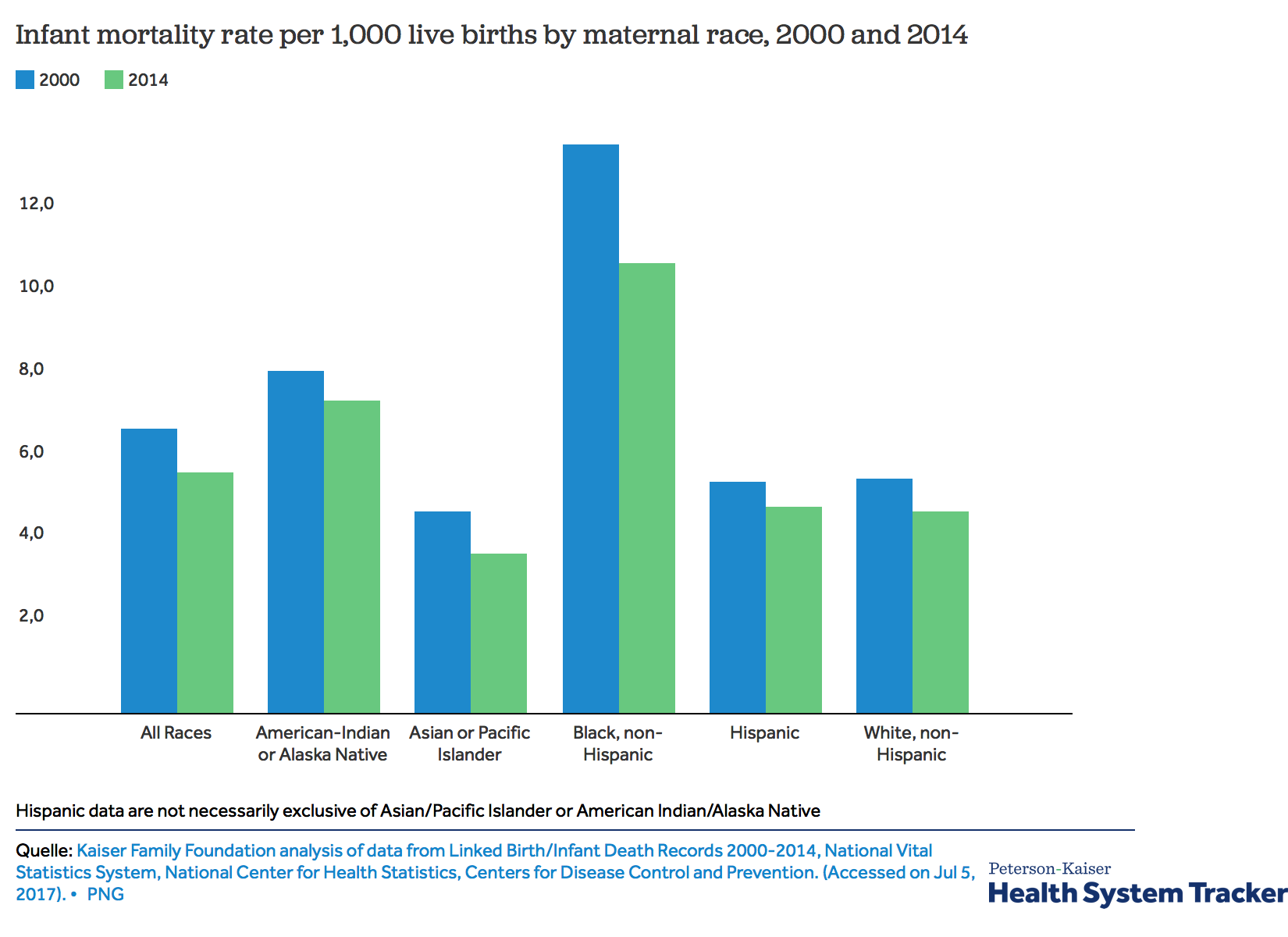
By one measure, African Americans are worse off than they were during slavery. The infant mortality rate--defined as infants who die before their first birthday---is twice the rate than White infants. Specifically: "11.4 deaths per 1,000 live births for blacks compared with 4.9 for whites. Historians estimate that in 1850 it was 1.6 times higher for blacks--340 per 1,000 vs. 217 for whites." (washingtonpost.com; July 11, 2020)
Natalie DiCenzo, an OB/GYN who is about to begin her practice in New Jersey this fall, told The Washington Post, that she hopes to find a way to close the infant mortality gap. "Awareness of racism is necessary for change,..." (Ibid). Dr, DiCenzo said,
I realize that fighting for health equity is often in opposition to what is valued in medicine,...As a white physician treating black patients with a racist health-care system, where only 5 percent of physicians identify as black, I recognize that I have benefited from white privilege, and I now benefit from the power inherent to the white coat. It is my responsibility to do the continuous work of dismantling both, and to check myself daily. (washingtonpost.com; July 11, 2020)
As for covid-19, the Centers for Disease Control say "although black people are dying at a rate of 92.3 per 100,000, patients admitted to the hospital were most likely to be white, and they die at a rate of 45.2 per 100,000." (washingtonpost.com; July 11, 2020) The CDC say, "...racial discrimination puts blacks at risk for a number of reasons, including historic practices such as redlining that segregate them in densely populated areas, where they often must travel to get food or visit a doctor." (washingtonpost.com; July 11, 2020) Specifically,
For many people in racial and ethnic minority groups, living conditions may contribute to underlying health conditions and make it difficult to follow steps to prevent getting sick with COVID-19 or to seek treatment if they do get sick... (washingtonpost.com; July 11, 2020)
The CDC recommends all healthcare providers to follow a standard protocol with all patients and to
[i]dentify and address implicit bias that could hinder patient-provider interactions and communications. (washingtonpost.com; July 11, 2020)
The healthcare system is only as good as the people who work it. The men and women who enter the healthcare professions come with their own ingrained biases that are a product of their education and cultural background. They are not necessarily bad people who deliberately undermine the care of their patients, just people who need to be made aware of the fact that their implicit biases are harming their patients. More than that, we to look at the institutions that impact everyone's health and well-being, and advocate for changes. This is the hard part because public policy changes, for the better, do not happen over night. Hopefully with the attention focused on racial justice, those changes will happen, if we, as a society, make it so.
Subscribe to:
Posts (Atom)