Wednesday, January 13, 2016

Is A Makeover Necessary?

http://www.citylab.com/design/2016/01/rethinking-downtown-la-by-revising-pershing-square/423150/


Pershing Square
Los Angeles, California
laconservancy.org
Hello Everyone:

As promised, today we are going to take another look at Pershing Square in Downtown Los Angeles.  The focus will be a look at the finalists and their park-related projects.  Our guide for today is Kriston Capps's article, "Rethinking Downtown L.A. by Revising Pershing Square," for CityLab.  Mr. Capps writes, "it's not that Pershing Square is awful.  The way some Los Angelenos talk about it, you might think that it as a failed park...Maybe the issue is that Pershing Square hasn't lived up to its potential, while the rest of downtown L.A. is now exceeding it."  Facelifts are pretty commonplace in Los Angeles but is giving a public space a facelift every few decades any way to run a historic park?

PSR media graphic
pershingsquarerenew.com
On September 8, 2015, the non-profit public-private partnership Pershing Square Renew sent out a request for qualification for a design challenge to remake the historic park.  The winner of the design challenge would partner with PSR to re-envision Pershing Square as the "city's town square." (http://www.pershingsquarerenew.com)   The current configuration of the park dates back the 1990s and, as Mr. Capps opines, "...while there are admirable qualities to the postmodern design by Ricard Legoretta and Laurie Olin, too much of the park was given over to defensive design.."

Pershing Square, 1925
blogdowntown.com
According to PSR executive director Eduardo Santana,

Their [the architects] challenge isn't to win awards; it's to win over hearts.  More than anything else, these groups need to focus on the experiences their design will inspire and the memories the Square will create.  

By October, the ten semi-finalists were announced and on December 18, 2015, the four finalist were notified of their selection.  At the time of announcing the ten semi-finalists, founder and present Donna Bojarsky said,

Our semi-finalists are a diverse group with  rich and impressive track records that represent the world's best and brightest in public space design, urban public space design or urban design.  

With all this enthusiasm in mind, let us take another look at the finalists.

Highline
James Corner Field Operations
Manhattan, New York
dozen.com
James Corner Field Operations with Frederick Fisher & Partners: James Corner Field Operations are the designers of Manhattan's Highline and a likely candidate for any park design competition.  His and local architect Frederick Fisher & Partner's entry places emphasis on indigenous ecology and design which includes design references to downtown's cultural and civic terrain.  Mr. Corner has already completed one park project, Tongva Park, in the city of Santa Monica.  He transformed a former parking lot "...into a dynamic topography with lush landscape of rolling hills, meadows and gardens..." (http://www.fieldoperations.com) If James Corner and Frederick Fisher are selected as the winners of the competition, will we see more drought tolerant plantings and spaces that echo the Beaux Arts design vocabulary of Downtown Los Angeles?

Floor works
Agence TER
Geneva, Switzerland
landing.com
Agence TER with SALT Landscape Architects: The only prominent feature of Agence TER and SALT's entry is a "smart canopy" that "spans the length of a block."  This seems a little lacking in comparison to Agence TER's Floorworks in Geneva, Switzerland.  The Paris-based firm created a public garden surrounding a corporate headquarters.  Landezine called it, "...the exterior equivalent of 'Well Works,' a collection of works by contemporary artists including James Turrell, Cindy Sherman and Sol LeWitt..." (http://www.landezine.com)  While a block-length canopy may seem strange, it would not be the first time Agence TER deployed a covering of some sort.  In Floorworks, the firm used Cor-ten steel, "...Laid out in successive strips is folded or distorted according to the topography and structures that need to be enclosed." (Ibid)  Blogger wonders how this would play out in Pershing Square.

Buffalo Bayou Park
SWA
Houston, Texas
design applause.com
SWA with Morphosis: both are local firms that would contribute a "vast tree canopy as well as an artificial designed canopy."  SWA's Houston office recently completed the re-design of Buffalo Bayou Park.  The park is a re-imagined urban waterfront, composed of previously disconnected, somewhat overgrown green spaces.  Patrick Sisson of Curbed reported, "The $58 million project connects 160 acres that border a 2.3-mile stretch of the bayou, providing a new link between two important city thoroughfares..." (http://www.curbed.com)  If the Houston project is any indication, the local SWA office will revisit the historic landscape of Downtown Los Angeles and find a way create a thoroughfare that links Pershing Square with  Olive Street to the east and Sixth Street to the south.

North Carolina Museum of Art Park
Civitas
Raleigh, North Carolina
civets.com
wHY with Civitas: Kriston Capps writes, "L.A. young guns wHY partnered with the more established Denver firm, Civitas, for an entry that nests different kinds of uses within the park through tiered programs."  Civitas was responsible for North Carolina Museum of Art Park in Raleigh.  "The Museum Park art program facilitates collaborations among artists, designers, and environmental scientists inspired by the natural world." (http://www.ncartmuseum.org)  The artists are commissioned to create site-specific works-permeant and temporary-that engage the surrounding landscape, presenting new points of view on the natural world.  The work is intended to explore the human relationship to the environment and the part nature plays in contemporary society. (Ibid)  This presents an exciting possibility for Pershing Square, engaging local artists to create site-specific work that examines the role of nature in the urban environment.

Each of the finalists present an exciting vision for Pershing Square, yet is a makeover really the best way to manage the historic park?  Allow yours truly to clarify, the park is hardly an abandoned lot in the middle of the city.  Unfortunately, it is just underused.  Each of the finalists present innovative design concepts for reinvigorating Pershing Square but it is up to Pershing Square Renew and the City Recreation and Parks Department to create exciting programming that will bring visitors to the historic park and get them to linger.

Tuesday, January 12, 2016

Bold Visions For Pershing Square

http://blog.archpaper.com/2015/12/four-finalists-selected-redesign-pershing-square/#.VoG11bzWpFL


Pershing Square 1925
Los Angeles, California
blogsdowntown.com
Hello Everyone:

Today we move from the community of Silver Lake to Blogger's favorite place in Los Angeles, Downtown.  Downtown Los Angeles continues to attract new businesses and residents with an exciting mix of new development projects and rehabilitated older buildings.  One place slated for redevelopment is Pershing Square, located in the heart of the of the historic district, the City of Los Angeles is hoping to rehabilitate this five-acre plot of land as Los Angeles's version of Central.  In Mimi Zeiger's blog post "Four finalists selected to redesign Pershing Square in Los Angeles," for blogs.archpaper.com, reveals the four finalists selected to participate in the Pershing Square Renew competition. (http://www.pershingsquarerenew.com)  The finalist are SWA with Morphosis, James Corner Field Operations with Frederick Fisher & Partners, Agency TER with SALT Landscape, and wHY with Civitas.  The teams will now develop more fleshed out plans for the park.  Before we look at the four proposals, let us take a quick look at the history of Pershing Square.

Pershing Square postcard
uncanny.net
The five-acre tract of land that makes up Pershing Square was part of original pueblo land, whose ownership dates back to 1781, when Spain granted it to the City of Los Angeles.  In 1866, the lan was designated a public known as La Plaza Abaja (the Lower Plaza). Improvements such as planting cypress and citrus trees were made during the 1870s.  In the 1880s, city engineer Fred Eaton drafted the park's first official layout.  In the early twentieth century, architect John Parkinson redesigned the park in the manner of the Beaux Arts.  In 1918, one week after the end of the First World War, the park was renamed for General John Pershing, the commander of the American forces.  The nearby bars, hotels, the subway terminal bathrooms and the Central Library made the park a cruising site.  Pershing Square more open and tolerant atmosphere made it a popular for gay and bisexual men.  The park was also a focal point for social activist to state their position on issues of the day.  (http://www.laconservancy.org)

Pershing Square
laconservancy.org

Throughout the succeeding decades, a number of design changes were made to the park, notably the addition of underground parking.  To accommodate the parking, the lush landscape that defined the park over the previous eight decades was removed.  Although the changes facilitated the construction of the garage, the removal of the dense foliage acted as a crime deterrent.  The access ramps to the garage effectively cut off the park from the surrounding area,  This caused the park to fall into disrepair during the 1960s and 1970s.  In 1984, the Summer Olympics provided a great opportunity to give Pershing Square a much need facelift (this is Los Angeles).  The current configuration of the park is the result of a design collaboration between architect Ricardo Legorretta, landscape architect Lauri Olin, and artist Barbara McCarran.  This incarnation makes reference to the city's history-orange groves, a stylized earthquake fault line (again, an L.A. thing), and a fountain that alludes to the aqueducts that bring water to Los Angeles.  (Ibid)  With this rich history in mind, we now take a look at the four finalists's proposal for Pershing Square.

Above and below: SWA with Morphosis
Courtesy of Pershing Square Renew
pershingsquarerenew.nationbuilder.com


Our first finalist are the firms SWA and 
Morphosis.  The architecture studios have identified four strategies for their reconfigured park: "...ecology (indigenous trees and drought-tolerant water element), mobility (a slimmed down road along Olive Street and more efficient Metro connection), programming (market and a day/evening event space), sustainability (better stationery concession, food vendor, and retail space)."


James Corner Field Operations with Frederick Fisher & Partners
Courtesy of Pershing Square Renew
archdaily.com


The next entrant is James Corner Field Operations with Frederick Fisher & Partners.  Their concept board presents a more organic flow between the park and the surrounding neighborhood as well as the cultural life of the Arts District.  This concept engages Pershing Square, the streets and sidewalks.


Agence TER with SALT Landscape Architects
Courtesy of Pershing Square Renew
archdaily.com


Our third finalist is Agence TER with SALT Landscape Architects.  The team presented a "boldly understate proposal."  They imagine Pershing Square as "a giant lawn with several atmospheric gardens: a foggy garden, a scent garden, a dry garden, a wind garden, and an edible garden."  Services would be concealed under a large canopy.


wHY with Civitas Landscape Architecture Group
Courtesy of Pershing Square Renew
pershingsquarerenew.nationbuilder.com

Our final competitor is wHY with Civitas Landscape Architecture Group.  Ms. Zeiger observes that the collaborator's concept board was "...also slim on details."  Their proposal echoes the other teams proposals, with the addition of an education component to the programming and digital connectivity loftily titled "Syncing Urban Hardware and Software."  What that specifically means is anyone's guess.


The next step in the process will be the more fleshed out plans over the first quarter of 2016, leading to another round of jury presentations in March.  There is no specific timeline for construction-the proposed funding is $2 million pledged by the Department of Recreation and Parks and the MacFarlene Partners.  Each of the proposal are bold and innovative.  They each present a contemporary vision for Pershing Square that marks a radical departure from John Parkinson's original Beaux Arts plan.  Perhaps this is the kind of bold public architecture Los Angeles needs.  Tomorrow we'll take a further look at the future of Pershing Square.  


Monday, January 11, 2016

The New Santa Monica?

http://www.laweekly.com/news/the-year-silver-lake-became-santa-monica-6396310


David Bowie
in.moviehas.xyz
Hello Everyone:

Before yours truly gets started on today's subject, Blogger just wanted to take a minute to observe the passing of David Bowie.  David Bowie was more than a rock star, he transcended it to become a cultural icon.  His presence was felt in every element of pop culture.  It is hard to imagine world without the Star Man.  Some people should never get sick and die.  David Bowie will live on forever.  He slipped off this mortal coil and entered the realm of the Immortals.


Silver Lake Reservoir
Silver Lake, California
blogs.kcrw.com
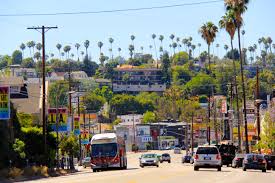
Today's post on the community of Silver Lake, California was inspired by the work of Karla and James Murray.  The Murrays are photographers who documented the disappearing family-owned shops in New York City.  They published the pictures in the book Storefronts (http://www.amazon.com).  With this in mind, Blogger looks to Hillel Aron and his recently L.A. Weekly article, "The Year Silver Lake Became Santa Monica," to guide us through the changing landscape of this Los Angeles community.  Mr. Aron focuses on the family-owned businesses that have given way to more high-end commercial and retail enterprises.  One could say that this is just progress but for Mr. Aron, the loss of these small businesses represent the end of what drew him and others to this community in the first place.

Sunset Boulevard through Silver Lake
mapio.com
Silver Lake's obituary could read like this: this past June, the Department of Water and Power began to slowly drain the Silver Lake Reservoir.  In 2011, the annual Sunset Junction street fair was suddenly canceled; years before that, the once free summer festival began to charge admission.  In 2012, Forbes Magazine declared Silver Lake "the hippest neighborhood in America."  Mr. Aron has lived in the community since 2002 and witnessed the changes that have taken place,  He writes "Yet 2015 feels like a watershed year for Silver Lake, which not only lost the water for which it is named (albeit temporarily), but two important, long-times fixtures: Algeria and Casbah Cafe."

Alegria
Silver Lake, Los Angeles, California
grub street.com
 Alegria was a Mexican restaurant that closed in July 2015 after 22 years in business.  Less than a month later, the more upscale Trois Familia occupied its space, in a rather unattractive strip mall that is home to the ubiquitous nail salon, Baskin-Robbins Ice Cream, K & C Donuts, and a Subway sandwich shop.  The Casbah abruptly closed about a month ago after the landlord raised the rent 140 percent.  The coffee shop had been in business for 20 years, holding its own on a block that would later become home to a trendy coffee emporium.  Mr. Aron writes, "It had a very nice atmosphere, OK coffee, not very good cookies.  I had no particular fondness for the Casbah but its sudden demise struck me as a telling moment for Silver Lake..."  You can read the owner's sad farewell note by clicking the link http://www.laweekly.com/news/the-year-silver-lake-became-santa-monica-6396310

Casbah Cafe
Silver Lake, Los Angeles, California
ohthepeopleyoumeet.com
The Casbah did not necessarily fall prey to the trendy coffee emporium.  Many family-owned coffee shops have served and thrived in each others's shadows.  However, both establishments represent competing philosophies.  The trendy coffee emporiums is a chain, and part of a corporation.

Yours truly has frequently said that places are organic, not static.  Blogger does not believe that neighborhoods should remain encased in amber-i.e. the way they were the day you moved in.  Yours truly also agrees with Mr. Aron's statement, "I dislike the argument that any time a white person moves into a lowish income neighborhood, it's gentrification."  Neighborhoods are fantastic when they feature a diverse collection of people and places.  The ever quotable Jane Jacobs said this over fifty years ago in her seminal book Death and Life of The Great American Cities (1961).  How wonderful is it to be able to enjoy $1.25 taco and a $5.00 cappuccino? Hillel Aron opines, "When a neighborhood starts to become unable to support businesses like the Casbah and Algeria, it becomes just another upscale neighborhood.  Silver Lake has become Santa Monica."

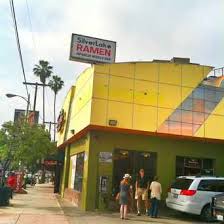
Silver Lake Ramen
Silver Lake, Los Angeles, California
walkscore.com

When Hillel Aron first moved to Silver Lake, he was able to find a studio apartment renting for the unheard of $480 a month, located at the top of Sunset Junction.  Now, the community is one two places, Downtown Los Angeles being the other, east of La Brea Avenue where rent for a one-bedroom is extremely overpriced. (http://www.zumper.com)  The prices are not likely to fall because of the flood of luxury units.  Mr. Aron reports, "Silver Lake's average rental price would actually be even higher than it is-if not for a ton of affordable old rentals occupied  by longtime residents..."  There are other signs of Silver Lake's Westside-ification.

The developers Frost/Chaddock have proposed a plan to build three very large apartment buildings, one of which would be located on the iconic Sunset Junction corner of Sanborrn.  This plan is moving forward despite neighborhood activists dashed hopes that the Silver Lake Music Conservancy would swoop in to save the day and buy the land from the developers.  The deal fell through in January 2015 and the Conservancy is moving to nearby Los Feliz.

Tang's Donuts and Sandwiches (abandoned)
Silver Lake, Los Angeles, California
web urbanist.com
  Perhaps the most ominous sign of going upscale is the announcement of a coming Whole Foods.  Really, a Whole Foods 365, an effort by the organic grocery giant to brand itself to younger less affluent consumers.  This spawned a fruitless petition to make the new market, an old school, more expensive Whole Foods (if that is possible).  Needless to say, it died on the vine and the Whole Foods 365 will occupy the space that once hosted a Ralph's Supermarket.  While we are on the subject of food, Mr. Aron is still mourning the loss of Tang's Donuts.


Vista Movie Theater
Silver Lake, Los Angeles, California
cinemasightlines.com
There are still plenty of wonderful small, family-owned businesses left in Silver Lake.  However, looking east of Millie's Cafe, there are signs of encroaching upscale commercial and retail establishments.  It has become increasingly apparent that this once haven for artists and performers has become too expensive to live and unable to maintain the diversity of businesses that once made it attractive to newcomers.  A sign of the times, in 2014 the Silver Lake Neighborhood Council voted in favor of a decree that "Silver Lake is not on the Eastside of Los Angeles."  Seriously.

Millie's Coffee Shop
Silver Lake, Los Angeles, California
foodgps.com


Resolutions

http://www.citylab.com


"No"
themouthymermaid.com
Hello Everyone:

El Niño has landed in Southern California.  The rain has not deterred your intrepid blogger from spending time in the blogosphere.

The New Year is a time for making resolutions.  Lose weight, exercise more, stop smoking, eat better and so on.  The editors at CityLab hope you will also resolve to finally retire all those dated terms and stubborn myths that persisted throughout the previous year.  To help you out, our editors have compiled a list of "Stubborn Myths and Dated Terms We'd Like to Retire in 2016."  It may not help you stop smoking but it will make better use of words and phrases that have entered our vocabulary.

"Uber for Everything"
twitter.com
"Uber for X:"  Thanks to Uber's early success in capturing our need for on demand services, Linda Poon was not at all surprised to see startups mimic Uber's business model.  We have become very demanding; insisting grocery delivery, haircuts, cleaning services, and dog walking services when we want it.  Sounds fantastic, right?  Absolutely.  The only problem with Uber's business model was outsourcing its labor to independent contractors in order to keep the costs low, something the company still needs to work out.  Blogger will admit to checking out Uber once or twice and was pleasantly surprised at how its car fare measured against a traditional cab ride.  Linda Poon sums it up, "At CityLab, we're all for entrepreneurial spirit, but we'd love to write about some startup in the new year that offer something more than just an 'Uber for X' copycat."

Charles Dickens Museum
London, England
travesty.com
"A Tale of Two Cities:" Baltimore and Ferguson, not Tales of Two Cities.  Brentin Mock writes, "This dichotomous lens may have been applicable in the time of Dickens...,but anyone who used this term as a lens to understand a place in 2015 was not looking carefully."  The contemporary urban landscape is not nearly as fractured along race or income.  Reducing tragedies like Freddie Gray and Michael Brown to binaries of shared experiences denies the bigger picture.  Mr. Mock writes, "A queer black woman has a different city experience than a straight black woman; a Mexican-American construction worker has a different experience than a Cuban-American police officer."  Therefore, the phrase "A Tale of Two Cities" to describe any story obliterates a plethora of unique points of view.  Time to bury this phrase.

Alphabet Book For Hipster Babies
babble.com
 "Artisanal:" Yes, please consign this one to the vocabulary rubbish bin immediately.  If there was ever an over used, vaguely defined word it is artisanal.  This word was used to describe anything from very tasty sea salted caramels to the macaroni art my youngest nephew made in preschool (He is in fourth grade now).  Jessica Leigh Hester complains, "This word has been casually tossed around to refer to anything that borders on twee; it's lost its status as something that nods to a skilled trade or impressive feat."  Here, here.  Let yours truly be quite blunt about the matter.  Unless you are promoting something made by an actual skilled artisan or something genuinely unique like a life-sized Statue of Liberty made entirely from sea-salt caramels, for pity sake please use another adjective.  Pass the caramels.


The "Walkie-Talkie" Tower
London, England
standard.co.uk
"Eyesore:" yours truly admits to using this word to describe disgust over badly designed spaces and places like the image on the left.  The word also drives Mark Byrnes up a tree, "This word drives me crazy because it's so lazy.  It's used often to express disgust over inadequate infrastructure or buildings that appear to be mere expressions of an architect's ego."  Again, see image on the left.  The next time you feel this word on the tip of your tongue, ask yourself, "Is it dangerous?"  Is it neglected?  Design taste is subjective as are reasons for liking or disliking a structure.  One person's masterpiece is another person's blot upon the landscape.  Therefore, when you express your intense dislike for a place or space, unless it is falling down, please refrain from using the word eyesore.

"Wider Roads-Less Traffic:" makes sense.  Build more roads leads to less traffic congestion.  This is a myth that Eric Jaffe would like to see consigned to eternity.  The logic for this enduring myth is deceptively simple, "If there are 100 cars packed into one highway lane, then building a second should mean there's 50 cars in each."  However, transportation researchers have repeatedly concluded that "...when this new lane gets added the number of cars does''t stay the same.  On the contrary, people who stopped driving out of frustration with traffic now attack the road with enthusiasm unknown to mankind."  While residents of heavily congested metropolitan area may re-enact scenes from Mad Max: Fury Road, the experts refer to this as "induced demand."  Simply stated, "...building more road eventually...leads to more traffic, not less."  Unfortunately, the best way to deal with the situation is grit your teeth, hope your phone has a full battery, and plenty of good music.

Highland Town Parking Day 2013
Baltimore, Maryland
baltimorearts.org

"Creative Placemaking:" in a certain context-i.e. parks, plazas, and other public places-creative placemaking is a good thing.  However, Kriston Capps complains, "The term itself, however, has got to go.  It's an abysmally passive phrase that swaps out artists for nameless planning bureaucrats."  It describes public art without identifying the arts or the work.  "It's a way of framing the power of public art, and calling for investment in public art, without,..., talking about art."  Too often the phrase sounds more like a process: "art is useful insofar as it placemakes."  "Creative Placemaking" become so common that the National Endowment for the Arts embraced it a few years ago.  Since then, it has become apparent that this framework obscures the fact that artist should be involved in making public spaces, not as subcontractors.

A denier
terradaily.com

"Climate Change Doubter:" Human beings can be such sensitive creatures.  When John Metcalfe first started writing about the weather for a Virginia television station, he used the phrase "climate-change denier" to refer to someone who is skeptical about global warming.  He was quickly advised by the station meteorologist to change it because people might find it offensive.  Mr. Metcalfe writes, "Now the term seems to be falling out of favor, to judge from a revision in the AP Stylebook...The AP would have use 'climate-change doubters' or 'those who reject mainstream climate science'..."  Yet "doubter" seems awkward because it refers to a those who argue against climate from a a non-scientific point of view.  They are not dubious about it, they just refuse to acknowledge it.  Therefore, let us consign "skeptic" and "doubter" to the dust heap and return to a more precise word-"denier."

"Hipster Island"
newyorker.tumblr.com"
"Hipster:" if you want to make Sommer Mathis exhaust her lexicon of expletives and mutter incoherently about the how life is not worth living, file a story using the word "Hipster."  Once and for all, what is a hipster?  What do they look like?  Where do they live?  Silver Lake?  Downtown Los Angeles?  What do they eat?  This term lost its usefulness at least a decade ago.  As Ms. Mathis so succinctly puts it, "Either we're all hipsters now, or no one is."

"Illegal:" frequently used in debates over immigration in 2015 and, blogger believes, in 2016 as the Presidential election cycle goes into full swing.  this is a problematic term on so many levels.  Tanvi Misra tells us, "'Illegal' or 'illegal aliens' remained generously...employed in 2015 to refer to immigrant who entered the U.S. without authorization."  In 1970, this was the preferred, less problematic term immigration activists used, according to National Public Radio's Adrian Florido.  Forty-five years later, the phrase has taken on the weight of the prejudices wielded by those who still insist on using the term.  The upside here is that activists, media organizations, Supreme Court justices, and political leaders are all in favor of burying "illegal," in reference to immigrants, for good.

The kids are alright
Matt Bors
mattbors.com
"Millennials:" How do you describe a typically white, upper-middle-class urbanite from a prestigious university more preoccupied with which tech startup to accept a job offer than where the next meal is coming from?  A millennial.  How else would you describe someone born in the eighties and nineties?  This is a convenient way for planners to gauge how much housing and many jobs await the newly graduated young adults.  However, Julian Spector writes, "...the term 'millennials' has proven uniquely capable of absorbing all kinds of meanings beyond a strict temporal boundary."  One can only hope that in the coming year we can move beyond clever euphemisms and catch phrases to describe the generational change and cultural values in a more substantive manner.

"Resilience:" we live in uncertain times that require a certain amount of inner fortitude, an ability to "keep calm and carry on."  Laura Bliss writes, "In these uncertain times, governments, corporations, non-profits, and their leaders all claim 'resilience' as a central goal."  Just exactly, how does one go about about making resilience a central goal?  This is a vaguely defined concept at best; an evasion of accountability at worst.  Ms. Bliss points out, "To judge groups of people by their 'resilience also risks ignoring insufferable conditions under which they may have already been living."  Maintaining the human condition requires an honest, specific plan by those charged with protecting individuals and places.  Therefore, claiming that "resilience" is the central goal without a real action plan is pointless.

Word
hercampus.com

"Wage Gap:" two little words that inadequately sum up a comprehensive term for workplace inequality.  It is Aria Bendix's wish for the New Year that these two words "...encourage a more nuanced understanding of this concept (and how it extends beyond gender) in order to craft more effective policies."

"Sharing Economy:" let yours truly start off by making clear that blogger is not a sharer.  Thus, yours truly welcomed the news that the Associated Press finally banned the use of the term "ride-sharing" in reference to companies such as Uber and Lyft.  Vicky Gan was also thrilled with the news.  Uber, Instacart, Wag (dog walking), and Rinse (laundry service) are not about sharing.  They are about the bottom line.  In 2015, Uber launched its plans for platform domination by integrating itself with other apps, like food delivery.  Ms. Gans writes that Airbnb "...caught flak for its ill-advised ad campaign against regulation in San Francisco."  The word "sharing" implies some sense of altruism.  Regardless if you are consumer of these services or independent contractor with them, be honest with yourself, it is not about sharing, it is about the bottom line.


Tuesday, January 5, 2016

The Preservation Loss Of 2015

http://curbed.com/archives/2015/12/17/preservation-lost-in-2015-hotel-okura-orange-county-government-center.php


Orange County Government Center
Paul Rudolph
Goshen, New York
archpaper.com
Hello Everyone:

The beginning of the year seems like an appropriate to look back the best of the previous year, while looking forward.  This is the time of the year when architects, planners, and preservationists love to make lists of what they deem are the best their respective professions had to offer.  Patrick Sission of Curbed reminds us that now, as 2015 is a faded memory and 2016 is still fresh, is a great time look at the "10 Important Buildings We Lost in 2015."  Of course, shiny new designs excite us in the same way as opening birthday presents do.  The sights, sounds, smells, and feel of new construction is enough to get even the most dour architect or design giddy.  However, Mr. Sisson reminds us that despite all joy, "...the building's ultimate impact on the environment is still unknown.  Landmarks or great structures that are destroyed leave mystery; the understanding of how they fit into the community make their destruction that much more unpleasant."  In the spirit of year end lists, Curbed asked this blog's two favorite organizations: DoCoMoMo and the National Trust for Historic Preservation to identify some of the most painful preservation losses of 2015. (http://curbed.com)

Lewis & Clark Branch of the St. Louis Library
Frederick Dunn, 1963
Moline Acres, Missouri
modern-std.com
The first painful preservation loss on our list is the Lewis & Clark Branch of the St. Louis Library in Moline Acres, Missouri.  This modernist gem was designed by Frederick Dunn in 1963.  The library gained notoriety for the Emil Frei stained glass by Robert Harmon, which resemble paintings on the brick surface of the building.  The St. Louis-based preservation advocacy group, Modern STL (http://www.modern-stl.com) tried to save The Library building from being replaced, "...suggesting an addition instead of a tear down..."  However, despite three years of campaigning, the building was demolished to make room for a replacement that opened this past autumn.  These is sliver of a silver lining, some of the Robert Harmon stained glass has been repurposed in the new structure.

Birmingham Central Library
John Madin, 1974
Birmingham, England
citymetric.com
  The next building on our list takes us to Birmingham, England.  The Birmingham Central Library, fondly known as the Ziggurat, was designed by local architect John Madin in 1974 and is "...seemingly the definition of peak Brutalism..."  The late grey block-like concrete structure was associated by some to be symptomatic of what ailed the Midlands.  Yet, this library was beloved and one of the largest in Europe, boasting "...30-plus miles of shelving as well as a Modernist symbol in the city's well-developed public square."  Sad to report it was torn down to make way for another commercial development and re-route traffic, part of a greater plan to replace many of the surrounding public buildings that energized the city square with more commercial development.  Mr. Sisson writes, "At one point, Richard Rogers was enlisted to design an equally monumental replacement, but a change in city government led to significant downsizing of the nw library. (http://www.birminghammail.co.uk)

Brotherhood House
William Lecaze
New York City, New York
nytimes.com
The Brotherhood House, together with the Birmingham Central Library and the Lewis And Clark Branch demonstrate the absolute necessity for the preservation of the recent past.  As buildings from the sixties and seventies begin to show their age, it becomes vital to identify excellent examples of the late modern period and the Brotherhood Building by William Lecaze is one such lost example.  The six-story limestone-and-granite structure in Manhattan's Garment District is probably better known to fans of the television series Project Runway. The Brotherhood House was home to the David M. Schwartz Fashion Education Center of the Parson School of Design.  However, that was not the original purpose of the building.  The building was originally intended to be a socially conscious community center, which included a synagogue, and hosted speeches by Robert Kennedy and other luminaries of the sixties..  Currently, it is being converted into a high-end hotel.

Park Avenue Hotel
Louis Kamper
Detroit, Michigan
en.wikipedia.org
Next on the list is the Park Avenue Hotel in Detroit, Michigan.  While the forthcoming Red Wings Arena has hockey fans buzzing with excitement, this sparking example of progressive stadium comes at a cost.  The cost was the demolition of the historic Park Avenue Hotel and the Eddystone were designed by local architect Louis Kamper, who also did the Book-Cadillac.  The hotels were bought by the billionaire Red Wings owners, the Illitch family, who agreed to rehabilitate the Eddystone in exchange for permission to raze the Park Avenue.  The Eddystone is currently being converted into a condominium development and the Park Avenue was imploded last July.


Portland Gas and Coke Building
Portland, Oregon
chatterbox.typad.com
We now move from the recent past to a relic of the early twentieth century Gothic Revival.  The Portland Gas and Coke Building, in Portland, Oregon, once stood overlooking the Willamette River, a spooky reminder of the city's industrial past.  This haunting beauty met the wrecking ball late this year after preservation efforts failed to garner widespread support.  The massive building, abandoned in the fifties, was used to convert coal and oil into gasoline; gave a glimpse into Portland's working class history.  Patrick Sisson writes, "The lack of documentation about the structure only speaks to the mystery that seemed to draw admirers; according to local architecture critic Brian Libby (http:///chatterbox.typepad.com), one of Portland's most beloved old buildings has reached the end of its lifespan.

Harry Sythe Cumming House
Baltimore, Maryland
curbed.com
The city of Baltimore, Maryland has been in the news a lot this year and for all the wrong reasons.  This lovely city with its treasure trove of historic architecture has had its reputation as "charm city" take quite a beating lately.  One example of a lost architectural gem is the Harry Sythe Cummings House.  Blogger knows you all are wondering "who is Harry Sythe Cummings and why should we care about his house?"  Harry Sythe Cummings was the first African-American council member, elected in 1890.  His house was not just a place to hang his hat but, more important, it served as an early gathering point for the Baltimore chapter of the National Association for the Advancement of Colored People, giving the nickname the Freedom House.  Unfortunately, the home was just outside-"...on the north side of Lanvale Street, as opposed to the south side"-if would have been protected as a contributor to the Marble Hill Historic District.

Belleview-Biltmore Hotel
Clearwater, Florida
preservation nation.org
One of the truisms about historic preservation is that not every older building is historic nor is it safe from the wrecking ball.  This is the case for the former "White Queen of the Gulf," the Bellevue-Biltmore Hotel in Clearwater, Florida.  The building, once the host of presidents, European royalty, and titans of industry, was listed by the National Trust on its 2005 list of "11 Most Endangered Historic Places." (http://www.preservationnation.org)  The hotel was built entirely out of Florida pine and accented with Tiffany glass was the largest wooden structure developed by railroad magnate Henry Plant.  Sad but true, the limited protection laws failed to keep this lovely reminder of the golden era of  Gulf hotels  from falling victim to developers with plans to teardown the grand lady and turn the 820,000-square-foot property into condominiums and townhomes.

Greystone Park Psychiatric Hospital
Morris Plains, New Jersey
blogs.cislead.com
The Greystone Park Psychiatric Hospital in Morris Plains, New Jersey was an example of progressive mental healthcare in an era when psychiatric hospitals were anything but progressive.  The hospital was built at the turn to the twentieth century as part of initiative to reform the treatment of the mentally ill in the United States.  It was conceived as an entirely self-sufficient campus, complete with its own fire department, post office, and work farm.  At one point, it housed 5,000 patients including folk singer Woody Guthrie.  However, the building fell into disrepair and despite efforts by the National Trust, local preservation groups, the New Jersey state treasury officials, the building was demolished in early 2015.


Orange County Government Center
Paul Rudolph
Goshen, New York
archpaper.com
Brutalism or, if you prefer, Heroic architecture is a genre that may finally be getting its due.  As Great Britain begins to consider the history of Brutalist architecture, the new found interest in the recent past was enough to save the Orange County Government Building by Paul Rudolph.  Granted it is not the most attractive building in the world. It resembles a set of blocks, piled one on top of the other.  Yet, this gray concrete building was the subject of white hot preservationist interest and an intense court case.  While many have waxed prosaic about the this gem, perhaps Zaha Hadid said it best when she told the New York Times, in June 2015, Rudolph's work is pure, but the beauty is in its austerity.  (http://www.nytimes.com/interactive) 

Hotel Okra
Yoshiko Taniguchi and Hideo Kosaka
Tokyo, Japan
japantimes.co.jp
The finally building on our list it the Hotel Okura, in Tokyo, Japan,  by Yoshiko Taniguchi and Hideo Kosaka.  The hotel was closed this past August for massive renovations, which hope to be completed by the 2020 Summer Olympic Games.  The Hotel Okra was the dream collaboration between the lead architects and a team of craftsmen that offered a new spin on Japanese styles that went beyond nostalgia, creating "...both a summation of centuries of culture as well as a bold, forward-thinking statement of modernity."  Patrick Sisson opines, "Demolishing the building to make way for a new high-end hotel for the 2020 Olympics seems shortsighted; if the goal is to show off Japanese culture to the rest of the world, this suave hotel, host to movies= stars and world leaders for decades, surely the original design was an cultural ambassador worth saving."  (http://curbed.com)

Monday, January 4, 2016

Benefitting Cities

http://www.citylab.com/work.2015.how-the-arts-add-to-city-economies/4211191


Point of pointe shoes
put.org
Hello and Happy New Year Everyone:

Yours truly hopes you all had a lovely and safe New Years.  Nothing but best wishes for all of you

We start off 2016 with a look at how the arts benefit urban economies.  Arts institutions, such as dance companies, museums and galleries not only bring people to the cites can spur innovation.  Richard Florida, in his recent article for CityLab "How the Arts Add to Urban Economies," clearly explained this connection.  Despite those who say that arts institutions only benefit the wealthier cities, a new study published in Economic Development Quarterly, The Association Between Professional Performing Arts and Knowledge Class Growth, suggests that "arts do in fact add to urban economies overall." (edu.sagepub.com).  To understand how this works, the study authors: Arthur C. Nelson, Casey J. Dawkins, Joanna P. Ganning, Katherine G. Kitterell, and Reid Ewing, used a unique set of information focused on professional performing arts organizations with annual budget of more than $2 million.

American Balalaika Orchestra
aborchestra.org
The study uses the data to analyze the change in knowledge-class workers (similar to the creative class) between 2000 and 2010 in about 350 American metropolitan regions.  Mr. Florida reports,

Its statistical analysis controls for a wide variety of other factors that might be thought to affect the growth in knowledge or creative class employment, including overall employment change, population, density, housing values, the share of college grads, race, the share of the population that is foreign-born, and natural amenities like climate and terrain...

The Broad Museum
Los Angeles, California
lattices.com
The study produced substantial evidence to suggest that performing arts organization greatly contribute to the increase of knowledge class workers and to urban economies.  The statistic support the findings: cities with one type of arts and cultural institution "...saw a 1.1 percent increase in knowledge-class employment" during the ten year study period.  Cities with two kinds of these institutions experienced a "1.5 percent increase;" those with three varieties of arts and cultural institutions had a "2.2 percent increase."  Study observes that while these may seem like modest growth, it adds up over time.  During the study period, "...the 118 metros with at least one performing arts organization generated a whopping $60 billion in annual income and more than half a million additional knowledge-class jobs created over that time frame."

Knowledge Class Jobs Attracted (thousands)
Martin Prosperity Institute
citylab.com

Knowledge Class Income Attracted (millions)
Martin Prosperity Institute
citylab.com
 Isabelle Ritchie, a colleague of Mr. Florida at the Martin Prosperity Institute, generated a pair of maps demonstrating "...the change in knowledge-class jobs and income for all 118 metros with one or more performing arts organizations."  The maps on the left show that metropolitan areas in California, the East Coast, and parts of the Midwest had some th greatest gains in knowledge-class workers and income.

If we look at the 28 metropolitan areas with three or more arts and cultural institutions, listed in the table below left.  (edu.sagepub.com)   What we find is that the New York-New Jersey-Pennsylvania Tri-State area attracted the largest share of knowledge-class employment (64,100) and income ($5.7 billion).  The Los Angeles-Long Beach-Santa Ana metropolitan area came in second "...with 41,700 new knowledge-class jobs and over $3 billion in income."  Chicago and Washington D.C. produced in excess of"... $2 billion in knowledge-class income, while cities like Atlanta, Dallas, Houston, Miami, Philadelphia, and San Francisco each generated one $1billion."  The number for San Francisco is a little surprising given its excellent variety of arts and cultural institutions.

Smaller metropolitans, with one or two arts and cultural institutions, also showed measurable gains: "Austin, Nashville, Cincinnati, Providence, San Antonio, and Sacramento each generated more that $200 million in
Incremental Jobs and Income Linked to the Presence of
Three Types of Major Performing Arts Organizations
(edu.sagepub.com)
newsflow24.com
knowledge-class income from 2000-2010."  The study also examined the economic impact of arts and cultural institutions on three medium-sized metropolitans:
San Antonio, Texas; Oklahoma City, Oklahoma, and Salt Lake City, Utah.

The San Antonio Symphony has become a vital economic asset.  Richard Florida writes, "Of the 245,000 knowledge-class jobs that San Antonio gained between 200 and 2010, around 2,700 of them can largely be attributed to the symphony.  The study also finds that the symphony helped to generate $222 million in annual employment income during this time, as well as nearly a third of a billion in annual economic impart.

Miki Thunder of the Oklahoma City Ballet
okcballet.com
Both the Oklahoma City Symphony and Ballet each added about 2,500 of the region's 165,000 knowledge-class jobs.  The study estimated that each institution helped stimulate around $150 million in yearly employment income and $225 million in annual economic impact.  To further underscore the point, Mr. Florida writes, "And the Utah Symphony, Utah Opera, Ballet West in Salt Lake City together  added around 3,600 knowledge-class jobs (out of 170,000) between 2000 and 2010."  The study also estimated that the annual employment income from these smaller arts and cultural markets was about $230 million, "...while the annual economic impact was the same in San Antonio-about a third of a billion dollars."

What The Association Between Professional Performing Arts and Knowledge Class Growth authors: Arthur C. Nelson, Casey J. Dawkins, Joanna P. Ganning, Katherine G. Kitterell, and Reid Ewing have demonstrated is while these statistics may not be the direct result of arts and cultural institutions, they are vehicles for "broader creative and cultural climate of a city or metro area." It does demonstrate that the tangible link between arts, talent, and economic growth is complex and additional research will be required to analyze the long term affect.  Be that as it may, The Association Between Professional Performing Arts and Knowledge Class Growth does provide good clear evidence that arts and cultural institutions really do enhance the ability of all metropolitan areas, regardless of size, to attract talent and increase their economies.