Monday, October 13, 2014

No Such Thing As Arm Chair History

http://blog.preservationleadershipforum.org/2014/10/02/old-places-learning/#.VDxK0TP9Yw


Fairfax High School (yours truly went here)
Los Angeles, California
fairfax1963.com
Hello Everyone:

After a frustrating few minutes trying to send a writing sample to a prospective employer, yours truly can finally focus on bringing you another installment of our friend Tom Mayes's blog in the Preservation Leadership Forum, "Why Do Old Places Matter?"  Today, the subject is learning.  The first thing that comes to mind when someone says learning is school. Schools are the traditional places of learning but Mr. Mayes posits, "People learn from old places, and they learn information that is not accessible to them in any other way."  What he is referring to is, obviously, old places.  As a child, Mr. Mayes recalls visiting historic sites in his hometown of Salem, North Carolina as a school boy; remembering a "...woman singing Moravian song a cappella in a vaulted and plastered room, and the taste of sugar cake served at the Moravian love feast afterward."  The experience of being that room, listening to that song, and the taste of that cake left with a sense of the historic tradition religious diversity, tolerance, and freedom in the United States.  Historic places provide that sensual (as in senses) experience that enhance our understanding and ability to remember these often complex ideas.

Old Pedestrian Bridge
Old Salem, North Carolina
visitnc.com
Old places, such as the ones in Old Salem, have a specific educational purpose complete with interpretative programs specifically intended to impart a history lesson, using the site as a teaching tool. (See the National Park Service program for "Teaching with Historic Places," which provides lesson plans for teachers)  School trips are wonderful ways to impart lessons not just on history but on also on different cultures and their traditions.  In California, fourth grade students learn about the state's rich history; as part of the lesson, they are taken to one of the twenty-one missions up and down the state.  I remember being taken to Mission San Gabriel as a fourth grader.  While I do not remember anything from that trip or the one I made to Mission San Juan Capistrano, as a high school student, I do remember walking through the grounds, imagining what it was like in the eighteenth century.

Mission San Gabriel Arcángel
Los Angeles, Ca
en.wikipedia.org
Yours truly agrees with Mr. Mayes's point, "...history can be understood at the real place where history actually happened in a way that it can't be understood through documents and books alone."  Places and objects allow a person to experience the event that occurred their through the senses, something that a document or virtual tour cannot do.  Education is one of the traditional roles of historic preservation, supported by policy.  This traditional and oft-undervalued activity continues to be a primary reason why we value and save our old places. (see National Council on Public History, the American Association for State and Local History)  Citing Callie Hawkings, associate director of Programs at President Lincoln's Cottage and Soldier's Home National Monument,

President Lincoln's Cottage and Soldier's Home National Monument
Washington D.C.
nps.gov
Educator at historic sites put considerable time and effort into planning programs that reinforce local and national learning standards.  These standard-based programs demonstrate to classroom teachers that time spent out of the classroom is time well spent.  Most importantly, though, this type of informal learning environment helps cultivate in students a deep appreciation of how the past informs the present and shapes the future beyond what any textbook could achieve. (Hawkins, Callie, e-mail to Tom Mayes, September 22, 2013)

Tom Mayes reports, "In addition to traditional educational programs, there are also less obvious ways that we learn at and through old places.  According to the website for the National Council on Public History,

...Those who don't always remember their high school and college history classes fondly are often the same people who spend their holidays, vacations, and their spare time seeking out history by choice: making pilgrimages to battlefields and memorials, visiting museums, watching television documentaries, volunteering with historical societies, participating in a community history project, and researching family histories. (http://www.ncph.org)

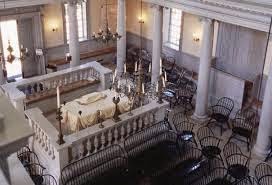
Touro Synagogue
Newport, Rhode Island
rhodeislandhistory.com
Old places are than history lessons, they can serve as forums for related topics.  For example, the Touro Synagogue offers a lesson on religious tolerance.  At fourth President of the United States James Madison's home at Montpelier, in Virginia, we can learn about the principles embodied in the Constitution.  The Lower-East Side Tenement Museum in New York City is a classroom for learning about the immigrant experience.  Finally, mid-twentieth century modern architect Philip Johnson's Glass House in New Canaan, Connecticut is a beautiful case study for architecture and design.  As Mr. Mayes observes, "And we don't just learn about these issues as something in the past, something only about history, but about the way these issues are being discussed, developed, debated, and prodded into the future today."  In fact, without being fully cognizant of it, we absorb information on the way people lived in historic places, what events transpired their, and what were their affect.  History can be pretty sneaky that way.

The Madonna Inn
San Luis Obispo, California
madonnainn.com
About seven years ago, I was driving down to Los Angeles from San Jose, California for Winter break.  As I was pulling into the hotel parking lot, I noticed a sign for the Madonna Inn which, as luck would have it, was right around the corner.  Before I left the next morning, I took a self-guided tour of this historic hotel.  The Madonna Inn has been around since the nineteen fifties and walking around, checking out some of the whacky themed rooms, I could begin to imagine all the motorists stay over for a night.  The honeymooners staying in the "Honeymoon" suite, sleeping on the heart-shaped bed (really).  As kitschy as it is, it is a testament to California's restless spirit.  The idea of traveling the open road, free as the breeze.

The Rabinsky House
Tel Aviv, Israel
en.wikipedia.org
 Although we've mostly looked at places that accessible    to the public that are specifically geared to learning,    however, there are places not open to the public that  still serve an educational purpose.  The first place that  comes to mind is the White City in Tel Aviv, Israel.  It  is not a city in the literally sense, rather, it is a collection  of apartment buildings designed by European and  Israeli architects in the nineteen twenties and thirties in  central Tel Aviv.  These apartment buildings are still  inhabited by singles and families but they offer a  stunning lesson in how architecture is used to create an  identity for a fledgling nation.  In one respect, the  choice of Bauhaus inspired design was no accident.  Many of the architects responsible for these apartment  buildings studied at the Bauhaus.  Another way to understand it, the choice of Bauhaus-inspired architecture can be viewed as a conscious attempt to visually present a modern nation coming into being.

I could find other examples, facts, and ideas about how people can learn from old places.  The good news is the lessons learned from old places is translating into new and constructive ways.  Thanks to the internet, mobile apps, and good old Wikipedia, we can learn about old places and their impact on their surrounding communities with a tap of a finger.  However, if you want to truly learn about an old place, you have to experience it for yourself.  There is no such thing as arm chair histoy.  

Thursday, October 9, 2014

I Love Being an L.A. Urbanist

http://communitybuilders.net/urbanism-in-los-angeles


Downtown Los Angeles
urbanone.com
Hello Everyone:

Those of you who have been regular readers of this blog have figured out that yours truly is a Los Angeles native.  As a native of the City of Angels, I have had to endure, on occasion, all the myths and stereotypes about the city I live in and its people.  One of the most enduring not so wonderful images of Los Angeles is a "...sprawling metropolis, suffering constant automobile gridlock."  While this is true to extent, the Southern California region has major challenges; housing affordability to environmental to name two.  However, C.J. Gabbe happily reports in his article, Eight reasons it's exciting to be an urbanist in Los Angeles today" for http://communitybuilders.net, "...after living in L.A. for the past two years...planning at UCLA, I've also been impresses with the planning and development innovation coming from the region."  Los Angeles is starting to play catch up by expanding transit options and creating walkable communities.  Personally speaking, if the informational pamphlet I recently downloaded from the Los Angeles Department of Planning is any indication, Los Angeles is definitely the place to be if you are an urbanist.  Mr. Gabbe lists eight reasons why this is true.

CicLAvia Boyle Heights
la.streetblog.org
Regular CicLAvia festival events

CicLAvia events are a fun and exciting way to encourage the growing bicycle and pedestrian culture.  When eighties new wave band Missing Persons sang "Nobody Walks in L.A," they had no idea they would be so wrong thirty-two years later.  CicLAvia temporarily transforms the streets of Los Angeles into a car-free zone for the pleasure of everyone. This event has become so popular "...that up to 180,000 Angelenos flock to iconic boulevards from a new perspective.


The Roosevelt Apartments
adowntownnes.com
 Sparking adaptive reuse by eliminating  parking requirements

For the longest time, Downtown Los Angeles' older buildings stood mostly unused and neglected; making them prime candidates for reuse.  However, one major obstacle that stood in the way of full adaptive reuse implementation was parking.  Parking is a huge issue not just in DTLA but all over the city.  Civic officials realized parking regulations were inhibiting the preservation and re-adaptation of older buildings. In 1999, the Adaptive Reuse Ordinance was passed by City Council.  This ordinance allowed developers to convert older buildings without prohibitive parking requirements.  The result was more than sixty building have been spared from demolition and have become a vital part of DTLA's increasing vibrant neighborhood.

Los Angeles River
thelariver.com
Reclaiming the Los Angeles River

Yes, the Los Angeles River does exist and no, it is not an endless concrete slab.  Los Angeles has great plans for this fifty-one mile River. The City envisions the River as a continuous lushly landscaped "industrialized wonderland," hospitable to walkers, runners, bicyclists, kayakers.

Sunset Plaza Triangle
losangelesurdezine.com
City of Los Angeles People Street Program

Some habits are hard break and weaning Angelenos off their cars is a formidable task.  Be that as it may, Los Angeles is following the lead of other cities in accelerating its efforts to turn an auto-centric city into a more pedestrian-friendly one.  C.J. Gabbe reports, "L.A.'s People St. program specifically transforming rights-of-way into people-friendly plazas, parklets, and bike corrals."  Through the People St program, "Communities can transform underused areas of L.A.'s largest public asset-our 7,500 miles of city streets-into active, vibrant, and accessible public space with People St, a program of the City of Los Angeles Department of Transportation..." (http://peoplest.lacity.org)  The program is based on partnerships between the communities and the City of Los Angeles.  The projects are conceived of and driven by the communities, brought into existence through the People St. Community Partners who are required to actively take part in building neighborhood support for a project, identifying an appropriate site, do outreach, fund raise and provide long-term management, maintenance, and project operations. (Ibid)

Parking along 7th Street in Downtown L.A.
lastreetblog.org
Variable parking prices based on demand

A typical first question Angelenos ask when going anywhere is "is there any parking?"  Besides actually finding a space, the other major parking-related issue is the cost.  No one wants to pay a fortune just to park somewhere for any amount of time.  One way to deal with the sometimes outrageous cost of parking is through variable pricing, the idea of UCLA Luskin School of Public Affairs Professor Donald Shoup.  It should be noted, in the interest of full disclosure, C,J. Gabbe is a doctoral student at UCLA Luskin School of Public Affairs.  Professor Shoup has studied parking at great length, focusing on the key connection between "...transportation and land use, with important consequences for cities, the economy, and the environment." (http://luskin.ucla.edu/donald-shoup)  To wit, LA Express Park™ is a website that melds technology with on demand-bsed parking pricing to create an innovative parking strategy.(http://www.laexpresspark.org)  LA Express Park™is currently active in Downtown Los Angeles but will be coming soon to Hollywood and Westwood Village.

Larchmont Boulevard
en.wikipedia.org 
Earmarking parking meter revenues for local improvements

While we are on the subject of parking, does anyone ever wonder where all the revenue collected from parking meters ever goes to?  Over twenty years ago, the City of Pasadena, California implemented a meter revenue sharing program which designates the revenue collected from the meters toward streetscape and neighborhood improvements.


Los Angeles Sprawl
lasmogtown.com

Technical assistance for implementing smart growth

Southern California is a growing region. Managing that growth in a prudent manner has become a serious issue for the Southern California Association of Governments.  To study how Southern California grows SCAG has developed a program, Compass Blueprint, which is designed to

...inform the development of the Regional Transportation Plan and Sustainable Communities Strategy, assists local government planning efforts, and is driven by four key principles: 
Mobility-Getting where want to go
Livability-Creating positive communities
Prosperity-Long-term health for the region
Sustainability-Ensuring that today's decisions do not compromise future generations
http://www.compassblueprint.org

C.J. Gabbe estimates that if the Los Angeles metropolitan area successfully enacts the Sustainable Communities Strategy (http:/rtpscs.scag.ca.gov), then per capita, green house gas emissions will decrease eight percent by 2020.

Downtown Los Angeles streetscape painting
yasminediaz.com
Engaging the public around zoning 

Zoning codes are a necessary evil.  They are what keep landfills from being opened next to schools.  Like any regulatory policy, zoning codes become outdated or no longer workable. Los Angeles is no exception to this and is not afraid to that its zoning codes no longer work. The City's zoning codes are the product of piecemeal additions over several decades.  Mr. Gabbe reports, "Today the city is the midst of a complete code overhaul..."  The overhaul re:code LA is "a comprehensive revision of LA's outdated zoning code.  First adopted in 1946, the current Code has grown from a simple 84-page pamphlet to an unwieldy 600+ page book that inadequately realizes a 21st Century vision of a better Los Angeles for all residents." (http://recode.la)

These are just some of the reasons to get excited about being an urbanist in Los Angeles.  The Los Angeles Department of City Planning has many exciting programs that will move the city forward into the future.  Los Angeles does not have to be a bleak dystopia, envisioned in Ridley Scott's Blade Runner.  It can be a place of innovative thinking and action.  To be fair, there are serious challenges to the future envisioned by the current city government but change is possible.  The challenges of the present can be made into opportunities for the future.  

Tuesday, October 7, 2014

I Love These Storefronts.

http://www.businessinsider.com.au/james-and-karla-murrays-photos-of-new-yorks-disappearing-storefronts-20144#comments


Sootta Newspapers and Tobacco
sallanscorner.wordpress.com
Hello Everyone:

Small businesses help define and give character to an urban neighborhood.  They are vital parts of an ever changing urban landscape; the management and staff often are extended members of everyone's family. About ten years ago, photographers James and Karla Murray set out to document the laid-joli New York City storefront that, for better or worse, have been the face of the city for the majority of the previous century.  The results of their survey are presented in Harrison Jacobs's article, "New York's Storefronts Have Completely Transformed In Just A Decade," for http://www.businessinsider.com.  The photographs are a valentine to the end of an era when these mom and pop stores were the life blood of a neighborhood.

ZigZag Records
designyutrust.com
 During New York City Mayor Michael Bloomberg's  tenure, Manhattan  and the surrounding boroughs  underwent a dramatic  change under the Mayor's policies  that favored new  development through tax incentives  and changes in  zoning  laws. https://www.newyork.com/articles/estate/how- bloomberg-changed-new-york-real-estate-99465/)  The    new codes permitted luxury high-rises in the trendy    neighborhood of Williamsburg and the East Village.  From the time Mayor Bloomberg took office in 2001,  over 40,000 buildings have gone up in all five boroughs.  The mom and pop stores that were the character defining  features of a neighborhood fell victim to new  development and soaring rents.  Two of the casualties of Mayor Bloomberg's tax incentive policies and changes in
CBGB & OMFUG
cbgb.com
zoning codes were famed clubs Mars Bar and CBGB.

Recently, James and Karla Murray set out to photograph the storefronts they first documented ten years ago to see what remained and what did not. What they discovered was nearly two-thirds of the businesses the first time, had disappeared.  the Murrays shared some of their photographs in the original article with Mr. Jacobs and you can see them at their blog and website http://jamesandkarlamurray.blogspot.com. The original photographs were assembled in a book, Store Front: The Disappearing Face of New York (available on Amazon).  In their original survey, the Murrays also interviewed the store owners regarding their establishments.  Many of the store owners shared, "that they feared losing their businesses due to rent increases."  Too often, the landlords pushed out the enterprises with the intention of converting the property into a high-end residential development.  Sometimes, the deal would fall through, leaving a vacant storefront.

Jay Dee Bakery
James and Karla Murray
showroomandemporium.blogspot.com
Harrison Jacobs lists some examples of small businesses that pushed out by soaring rents and replaced by high-end mixed-use developments.  The Mars Bar in the East Village was shuttered in 2011, razed and replaced by a luxury condominium with a planned TD Bank on the ground floor.  The original 2nd Avenue Deli, also in the East Village, was closed in 2006 after the rent jumped from $24,000 per month to $33,000 per month.  While yours truly cannot claim to know anything about commercial property rents, just looking at the afore stated rents for the venerable deli is enough to make one's head spin.  Most of the businesses were pushed out via attrition-they simply could not afford the rent increases. The flip side of this situation is that the businesses owners who were able to maintain their storefront, did so because they already owned the property.

Lenox Lounge
James and Karla Murray
jamesandkarlamurray.blogspot.com
High apartment rents have been another source of eviction through attrition for small business owners. Unfortunately, it the same sad story, skyrocketing residential rents have pushed out the neighborhood's long-term residents, killing the business's loyal customers.  One example is the Lenox Lounge in Harlem which closed its doors on December 31, 2012 after a dispute over the lease.  The punk rock music landmark CBGB in the East Village shut down in 2006, after the building owner claimed the club owed $91,000 in back rent.  Since then, the place where Patti Smith and the Talking Heads used to play was taken over by a John Varvatos store.  Over in TriBeCa, Ralph's Discount City was forced out of business in 2007, when the property commenced luxury condominium conversion.  Citing the Murray, "The Murrays say that the closing of the businesses picked up speed with the recession in 2007,"

Yonah Shimmel Knish Bakery
James and Karla Murray
prod12oz.com
The iconic art bar, Max Fish, closed in July 2013 due to a rent increase.  Mr. Jacobs reports, "At the time of the closing, the rent was at $16,000 and was due to increase again."  There is a silver lining here, there is a new location planned for, wait for it, Brooklyn.  Mr. Jacobs continues, "The Murrays say the biggest issue is that the new stores don't necessarily have any connection to the neighborhood [sic] or its inhabitants."  Yours truly agrees with that statement.  Karla Murray says, "There's a loss of character to the neighborhood [sic]."  Yours truly would like to add that the neighborhood risks becoming another collection of bland boring boxes.  Even the new stores: franchised clothing and electronic stores, banks and drugstores are not always successful.

Joe's Pizza
scottspizzatours.com
Joe's Pizza had to shutter its restaurant in the East Village when the rent soared from a very manageable $900 per month to a stratospheric $15,000 per month. Another silver lining, the pizzeria reopened in a new on location on 14th Street.  Times Square mainstay McHale's Bar remained at its location for sixty-two years before the landlord pushed it out to make way for the Platinum NYC condominium tower.

The storefronts featured in James and Karla Murray's book, Store Front: The Disappearing Face of New York, represent a microcosm of disappearing mom and pop businesses across the United States.  Whether they are in big cities, like the ones featured here or in a small town, they represent a vital part of their neighborhood that cannot be replaced by anonymous bland boring boxes.  These bland boring boxes have no connection to their host neighborhood.  They may make pretenses of establishing a connection but they cannot replace a Joe's Pizza or a Yonah Shimmel Knish Bakery.  These small businesses provides an irreplaceable essence to a neighborhood.  A very big thank you to James and Karla Murray for their valentine to the storefronts of New York City.

Monday, October 6, 2014

Why Aren't We There Yet? Affordable Housing In The Future

http://www.placemakers.com/2014/07/28/are-we-there-yet-affordability-in the-new-normal


Typical American suburbia
utne.com
Hello Everyone:

"Are we there? Are we there? Are we there?"  This plaintive cry is familiar to parents around the world during long car trips.  Fortunately, we are not going to take about unending family road trips.  Instead, with the help of Ben Brown, we are going to discuss housing affordability in the 'New Normal.'  'New normal,' what is that?  Mr. Brown's article, "Are We There Yet? Affordability in the 'New Normal'" for http://www.placemakers.com considers the housing market in the last several years, following the collapse of the home mortgage industry or as Chuck Marohn refers to as the "growth Ponzi scheme."  We all drank the proverbial Kool-Aid, bought houses or refinanced our current homes to pay for that pool or second story, putting off the inevitable repayment process as long as possible, the reality came crashing in leaving a trail of foreclosed houses and blighted neighborhoods in its wake. This financial and personal disaster left many wondering, "what now?"

Blighted Baltimore, Maryland
npr.org
What now, five years after the Great Recession supposedly ended?  What now is we are just beginning to make sense of the long term affects of the home mortgage industry collapse.  What is already apparent is, "The ways in which we've designed, financed, constructed and regulated land use development need some serious tweaking if we're to align the ambitions of families and business in the new era with the infrastructure of community to their success."  However, Mr. Brown points out, "The trouble is, investing so much of our energy and so many of our resources in fine-tuning the Ponzi scheme has left us bummed and broke."  Unfortunately, there is no miracle cure or easy way to go back to the way things were, happy and prosperous, before the cold hard slap of reality.

Blighted Buffalo, New York
buffalo.ynn.com
Where do we begin to make things right?  Ben Brown suggests "correcting the Ponzi-era thinking that affordable housing is all about slashing housing costs. Raising affordability by lowering the quality of design, construction, materials and location is a race to the bottom."  Absolutely true, affordable housing can be well-built, beautiful, and functional.  He further suggests that we do away with making home ownership the sole mechanism of affordable housing. The problem, as Mr. Brown sees it, is "subprime lending practices, the global securitization of bad paper and all the other strategies to everyone with a pulse into a home they might not be able to afford worked those angles to the max."  This, as it turned out, was really, really bad idea.  While home ownership is certainly a worthy goal but in the post-Great Recession world, home ownership should be grounded in be able "To make living and working in a highly desirable community within reach of the broadest possible range of incomes."

Youngstown, Ohio
city-daa.com
How do we begin to address housing affordability?  This task requires comprehensive strategies, including those specific to neighborhood locations, transportation options, energy costs, zoning and building codes, and anything affecting household budgets.  What Mr. Brown is implying is that if money can be saved in any of these categories, it can translate into money saved in mortgage or rent payment.  Thus, he asks "...why calibrate community affordability exclusively on the basis of price per square foot?"  There is a sense of urgency regarding this issue.  Housing affordability is related to the issue of income inequality.  Richard Florida continuously emphasizes "the gap between demand and supply of housing at the right points and in the right places:

Richard Florida
mocoloco.com
Indeed, what we're currently going through is not a typical housing cycle, but what I've termed a 'great reset.'  The reset includes increased demand for housing in large dynamic metros-especially knowledge-based ones-slack demand in older metros and exurban locations, and increased demand for locations at or near the urban core and walkable suburbs serviced by transit.

By "reset," Mr. Florida includes "a shift from homeownership especially in highly priced, dynamic markets on the East and West coasts.  The rate of homeownership has been falling since the crisis, and in some of the densest and pricier metros, it's already below 60 percent."

Thus, instead of mourning the death of the great American Dream of owning your own home, perhaps it is time to rethink it.  As Mr. Florida puts it:

This shift from homeownership to rentals can be a good thing.  My own research indicates that metros with the highest rates of homeownership (say, in excess of 60 to 80 percent) also the most sluggish rates of innovation, productivity and economic growth, while metros in the range of 55 to 60 percent homeownership have faster rates of innovation and growth.  A balance between renters and homeowners, then seems to provide the flexibility of housing types needed to support dynamic economies.


Rowhouses
globalhiphopbattles.com
To phrase it in more comprehensive matter, "affordability is an issue for not only those whom we tend to see as customers for affordability programs and projects-the poorest among us.  It's about expanding choice for the majority, including those with middle class status and membership in the two largest generations in history, Boomer and Millennials." There has been plenty written and said about the impact of Baby Boomers (people born between 1946 and 1964) deciding to down size into condominiums and apartments or live out their days in their homes.  Ben Brown speculates that aging in the suburbs, in the post-Great Recession era, will be tough given the potential impact of the younger generation on the supply and demand for housing.

What we are seeing is a glimpse into the future.  Demographic shifts and residual economic pressure from the recession will, most definitely challenge communities to accommodate the "great reset" that Mr. Florida predicts.  This is further complicated by the inaction in the hall of Congress and capitals which means it is highly unlikely we are going to experience sweeping new policies together with billions of dollars in new funding for infrastructure and planning.  In short, no miracle cure is forthcoming anytime soon. Municipal governments, businesses, and citizens are left with the job of developing and executing low-budget strategies to deal with housing affordability that responsive, comprehensive, and replicable.  Where do we start?

Doe Mill
Chico, California
bettercities.net
In the July post of the popular "Better Cities & Towns" (http://www.bettercities.net), Rob Steuteville focused attention to a multi-family project in Chico, California by Anderson Kim Architecture + Urban Design and developed by Tovey Geizentanner of Chico Green line Partners.  The development is a four building, twenty-two unit residential project that occupies a Traditional Neighborhood Development called Doe Mill and has been in process for the last fifteen years. Anderson Kim are well regarded among the New Urbanist circles who drew attention to the site planning and architectural details their peers admire.  However, what drew Mr. Steuteville to the project was its context: suburban sprawl a distance from Chico's walkable downtown.

Why Chico, the most populous city in the northern Sacramento Valley?  According to Ben Brown, Mr. Steutville argues that what makes this particular city a worthy example:

is its strategic opportunity.  Demand will drive development in Doe Mill's direction.  By getting a lot of other stuff right-including aligning affordable scale with design worthy of high-end, mixed-use infill in town-the designers and developers established a standard for future growth along the same corridor:  
 
              Rather than contributing to the sprawling character of this area, these buildings help set a                  new pattern.  The retrofit of our suburbs will be an important land use and planning task in                the coming years, and the completion of Doe Mill gives Chico an example of how to do                       better.

Doe Mill parcel map
bettercities.net
Doe Mill is also a case study of what is required in the post-Great Recession era, in order to accomplish what John Anderson, a partner at Chico Green Line, refers to as "ROBD, Return on Brain Damage."  That does not sound too nice.  Actually, according to Mr. Anderson, "For the local or regional developer,..., there are already enough regulatory, financial and project management obstacles to threaten solvency.  Best to pick places and projects that match developers' capacities and leave the complex resource-draining projects to big firms with the staffs and overhead margins to compensate for the headaches."  This makes sense, local and regional developers working and smaller less resource-draining projects would be a better more efficient way to create a range of affordable housing in a particular community without the mind-numbing complexities of a large-scale development project.

Townhouse apartments complex in Doe Mill
Chico, California
townhousecenter.com
 Another reason to be selective about  neighborhood development opportunities outside  the urban cores is "...opportunities most often  present themselves in places that make up the  majority of America's landscape from historic  streetcar suburbs all the way to the totally  sprawled-out, totally car-dependent developments  that still count as urbanized areas in the U.S.  Census"  If we harken back to the Richard Florida statement near the top of the post, we can read it as smaller outlying cities and towns, like Chico, offer the greatest opportunities for new affordable housing development that more heavily developed areas do not.

Part of the strategy of creating an affordable community at Doe Mill is the expansion of walkable mixed use and transportation options to the suburbs.  Another component is the addition of residential affordability, such as rental affordability, in more up-scale neighborhoods where the attraction of amenities like transportation and walkability have driven housing costs out the realm of possibility for low- and middle-income families.  Yet in the more desirable urban neighborhoods, the challenge of affordability has more to do with managing costs and what Mr. Anderson describes "as the brain damage-of politics and permitting."  The more attractive infill site, the more likely the resistance from well-organized, politically connected groups who would rather the property remain undeveloped so as to limit the ROBD for property owners and developers rendering the whole enterprise impractical.

Cover for Pocket Neighborhoods
amazon.com
The key to successful small scale development, according to Ross Chapin the author of Pocket Neighborhoods Creating Small Scale Community in a Large Scale World, is standout design.  Mr. Chapin pioneered small scale development, "pocket neighborhood" development in the Pacific Northwest  and is an expert in demonstrating "...how well-planned and  executed clusters of small-scale housing can not only  overcome resistance to density and predispositions about the  inherent value of bigness, they can command a premium in a  local real estate market."  How is this possible?  While  sterling design is a requirement, it is not enough to achieve  successful infill affordability.  Ask the the people affect by Hurricane Katerina in 2005.

The devastating hurricane produced an immediate need to suspend business as usual in the worst hit areas of Mississippi
and Louisiana.  The Katerina Cottages and their impact on FEMA's one-off experiment with alternatives to their trailers at http://www.fema.gov./pdf/about/programs/ahpp_al_study.pdf
and Louisiana.  The Katerina Cottages and their impact on FEMA's one-off experiment with alternatives to their trailers at .  From this came Cottage Square in Ocean Springs, Mississippi, the brain child of architect Bruce B. Tolar. Cottage Square was an adjacent community of, first, rental cottages, the single-family residences elevated above the flood zone in Pass Christian, Mississippi.  This lovely neighborhood totaled seventy units, in close-in locations where residents could get by without cars if they chose to do so.

Cottage Square
Bruce B. Tolar
Ocean Springs, Mississippi
placemekers.com
 Currently, Mr. Tolar is a design consultant in the post-  Hurricane Sandy communities of New Jersey, growing a  support network that had enabled exemplars of appealing,  affordable infill development that is likely to stand for a  way to refine and expand housing strategies in the future.  To expand beyond the Cottage Square model, Mr. Tolar  teamed up with a regional non-profit Mercy Housing and  Human Development, and a New Jersey based developer.  Each brought a skill set and connections to plot a course through the financial, regulatory, design and construction challenges that could individually overwhelm the partners. At present, Mr. Tolar is working with a national non-profit Next Step to take the public-private lessons learned at the New Jersey Shore and apply it on a larger scale.

Ben Brown speculates and yours truly concurs, that a public- private maybe the way to get real estate development consciously uncoupled from outdated ways of doing business and future.  It will be a slow and painful transition, especially in places where affordable housing is in great demand.  In this day and age, there is no denying the fact that housing affordability is one of the obstacles to income equality and overall economic recovery.  What happens next will have broad implications for the future.


Tuesday, September 30, 2014

A Tale of Three Libraries

http://archplanbaltimore.blogspot.com/2014/07/three-libraries-seattle-sttugart-and.html


Cover for Fahrenheit 451
Ray Bradbury
en.wikipedia.org
Hello Everyone:

After a rather very frustrating hour or so trying to deal with technical glitches, yours truly can finally sit, relax, and write.  Today we look at a tale of three libraries: Seattle, Stuttgart, Germany, and San Diego.  Our guide to this tale of three cities who believe that "new of the libraries' death is greatly exaggerated" is Klaus Philipsen and his July post on his blog http://archplanbaltimore.blogspot.com, "Three Libraries-Seattle, Stuttgart, and San Diego."  The literary doomsayers regularly predict that as libraries grow, the physical book will go the way of Tyrannosaurus Rex. Mr. Philipsen ponders, "Will they, like the Dinosaurs, collapse under their enormous weight and go extinct due to their insatiable feeding needs or are these big bold libraries an example of adaptation, proof that the book itself may not be dead and the physical place for knowledge is thriving?"  Citing the American Library Association "Libraries Transforming Communities" initiative goals:

LTC will help libraries become more reflective of and connected to their communities and achieve a domino effect of positive results, including stronger relationships with local civic agencies, non-profits, funders and corporations, and greater community investment in civility, collaboration, education, health and well-being.  ALA also hopes to shift public discourse away from past themes about libraries in crisis and talk of libraries as agents of  positive community change. (http://www.ala.org/transforminglibraries/libraries-transforming-communities)

Richard J. Riordan Central Branch
Los Angeles, California
examiner.com
As a user of the Los Angeles Public Library, I often find myself getting a little excited wandering the stacks checking out all the titles.  Libraries are fantastic places to spend time and let your imagination wander freely.  Mr. Philipsen has selected three libraries in the cities of Seattle, Stuttgart, and San Diego as case studies for how architects see the future of these institutions and respond to the challenge with spectacular new buildings, in unique ways.  Mr. Philipsen notes, "While the Seattle library became famous the world over, the ones in Stuttgart and San Diego have mostly captured local attention."  Mr. Philipsen takes a critical approach to examining all three as public projects and what a library might look like in the future.  Shall we take a tour of these three incarnations of the modern libraries?  Let us see if these bright shining institutions, dedicated to disseminating knowledge, are indeed hallowed halls of books dinosaurs feasting on bloated local pride or accurate reflections of an era described as the 'age of knowledge.

*Klaus Philipsen has omitted discussions of resilience and energy from his review because he could gain access to the necessary information.  Suffice to say the Seattle and San Diego Libraries are LEED rated silver, based on German energy codes, the same is true of the Stuttgart Library.

Seattle Central Library
Rem Koolhaas and Joshua Prince-Radus OMA
en.wikipedia.org

The reinvented library OMA in Seattle

The "oldest" the trio of featured libraries is the 412, 250 square foot Seattle Library, opened in 2004 at a cost of $169.2 million.  It is located in downtown Seattle, occupying an entire city block.  The library was designed by Rem Koolhaas and Joshua Prince-Radus of OMA and trumpeted globally as a "trailblazer for innovation in library design."  No doubt, this is a very one-of-a-kind place.  The latte Herbert Muschamp, former architecture critic for the New York Times, wrote, "In more than 30 years of writing about architecture, this is the most exciting new building it has been my honor to review." (http://www.nytimes.com/...architecture-the-library-that-puts-on-fishnets-and-hits...)  Wow, such high praise from the New York Times.  Mr. Muschamps describes his first impression as "...pure bling bling: an urban montage of starburst images without a special lens." (Ibid)  He further calls it

...a big rock candy mountain of a building, twinkling in the middle of office buildings...The library's exterior is an angular composition of folded planes.  Walls are of glass, supported by a diagonal grid of light blue metal that covers almost the entire surface.  At first glance, the irregular angles, folds and shapes seem arbitrary.  The building's structure is hard to discern, and the overall grid pattern looks like a pensive exaggeration of the abstract geometries used by mid-20th-century architects for decorative relief. (Ibid)


Interior of Seattle Central Library
Rem Koolhaas and Joshua Prince-Radus OMA
en.wikipedia.org
Such superlatives makes one almost think that the dearly departed Herbert Muschamps was on OMA's payroll. He later elaborates,

It is pointless, with this project, to separate formal and social organization.  How people use a space is no less a matter of form than the most abstract visual composition.  As such, a building program can be subject to aesthetic articulation. (Ibid)

Klaus Philipsen quotes Rem Koolhaas's explanation to the Seattle Times regarding the standard book subject divisions: "humanities," "art," and so forth as "sad," adding:

...the point was to create a kind of single, undivided sequence, because we felt that one of the points of a library was that there are accidents and you find yourself in areas where you didn't expect to be and where you kind of look at books that are necessarily the the kind o books that you're aiming for.

Been there, done that.

Seattle Central Library Book Spiral
classicalbookworm.wordpress.com
Klaus Philipsen tells us the "Key to understanding OMA's library design is the departure from the standard floors for various departments for various departments in favor specialized platforms, mixing areas and a continuous book spiral."  Further, in quoting OMA's own project description, Mr. Philipsen writes,

While flexibility in the library is conventionally translated into the creation of the generic floors without a segregation of programs, the Seattle Central Library cultivates a far more refined approach by organizing itself into spatial programs, each dedicated to, and equipped for, specific duties.  Tailored flexibility remains possible within each compartment without the threat of one section hindering the others.  This was achieved by the "combing" and consolidation of the library's programs and media, thereafter identifying programmatic clusters-five of stability, and four of instability.  Each platform is thus created as one cluster that is architecturally defined and equipped for maximum, dedicated performance.  Because each platform is designed for a unique purpose, their size, flexibility, circulation, palette, structure, and MEP vary.  The spaces in between the platforms function as trading floor where librarians inform and stimulate and where the interface between the different platforms is organized i.e. spaces for work, interaction, and play. (http://www.oma.eu/projects/2004/seattle-central-library)

The more I look at this schematic drawing, the more I think Le Corbusier's sketch for the domino principle, just a thought.  Mr. Philipsen reminds us that this library is not just about spatial organization, it is also about public access.  Mr. Koolhaas paid particular attention to the interior public spaces.  Mr. Philipsen cites the example of the main entrance which leads to the visitor into the lobby, described by Herbert Muschamp as, "Compared to the Central Library's soaring atrium lobby, the entrance pyramid at the Louvre looks like a gadget from the Sharper Image catalog." (http://www.nytimes.com/...architecture-the-library-that-puts-on-fishnets-and-hits...) I hope the French did not read that comment.  Mr. Philipsen speculates, "One would imagine that the Seattle library system would have used the success of this building as the bases for its 2011 strategic plan which focuses on passion, access, community empowerment and partnerships; but that plan hardly mentions architecture as a tool to achieve these goals."  In turn OMA has demonstrated that a library can be just about service.

Stuttgart Book Tower
Stuttgart, Germany
reddit.com
The pure form and Wesentlichkeit: Yi in Stuttgart

At first glance, this rather imposing edifice does not look the friendly neighborhood library.  The Stuttgart Library was designed by South Korean architect Eun Young Yi at a cost of $107 million for 345,000 square feet.  The library design development is born out of "the intellectual archetype of form inwards" instead of a program.  The Library references (slight pun intended) ancient models such as The Pantheon and supposedly an eighteenth century sketch by Étienne-Louis Boullée for his Newton Centotaph (or his design for a Parisian library, Klaus Philipsen is uncertain).  Mr. Philipsen refers to this project as "an exercise in rigor and one might say rigidity" as Mr. Yi attempts translate architectural essence (Wesentlichkeit in German) from history into modernity.

Interior atrium Stuttgart Book Tower
pinterest.com
This sanctuary for books  includes a sacred-like interior atrium that appears almost empty.  The atrium is light by an oculus from above and decorated with a small water feature in the floor.  The Library is not so much a a shrine to bibliophiles as it is a shrine to purity and abstraction of the cube-the square and the rectangle as places for introspection.  On the first floor, the books appear as objects in trays attached to conveyor belts, a function that forms the main attraction in a "...shallow function zone enveloping the naked core volume on all four sides."  If a patron opts to use the stairs to look for a particular volume, then said patron will undertake a five-story hike around the atrium.  The better choice, in this case, might be the elevator tucked away in the rear part of the building through which, a patron can enter one of the top five floors dedicated to the traditional library subject divisions with a widening second atrium near the skylight.  The upper atrium, stacked on top of the lower one to form a double atrium, presents the top of the oculus and apparently, the library itself.  Here, according to Mr. Philipsen, thing look a little more happy.  There is some daylight courtesy of the receding floors and less angularity.  However, the wrapping function zone, which was perfectly logical in the contemplative zone below, now appears confusing , separating the gridded façade; occasionally seen beyond the orderly stacks.  This area was given the grim moniker "book prison" by the critical public.

The Stuttgart "book prison"
archplanbaltimore.blogspot.com
Even when the patron reaches the observation deck which presents glorious views of Stuttgart, Germany, the grim sobriquet is not quickly forgotten thanks to the heavy-handed use of steel grates that cover every surface in sight.  Some joy is found in the small cafe with full-size glass windows on both sides, presents scene of the town or the atrium.  Translating from Mr. Yi's own words, written in German, Mr. Philipsen writes, "he describes the library as a center of modern society, a monolith that can be unpeeled from the inside like an onion in which the lower empty cube is a 'negative monolith, an absolute geometrical and ordered white space for introspection' and the upper flared cube for opening to the word (knowledge)." (see http://wwwyiarchitects.com)

Eun Young Yi's Borg-like cube occupies space in a new quarter of Stuttgart, still being built, rising out of a former train yard of the nearby central station.  Despite the fact that the "Europa quarter" is not complete, at least to date, Mr. Philipsen dismisses it as "sadly sterile and suburban, so there is little hope that the surroundings will mitigate the rigor of  Yi's book austerity cube any time soon."  Meanwhile the nighttime appearance of the cube, aglow in purple, suggests something someone would want see during the day.

San Diego Central Library
San Diego, California
sandiego.gov
Exuberance: Quigley in San Diego

The last stop on our bibliophile tour is the just completed San Diego Central Library, a completely different place than our previous examples.  The Central Library is the product of a single citizen architect, Rob Wellington Quigley, FAIA, who dedicated more than ten years of his life to making this library a reality in his hometown.  Costing $184.9 million and measuring 492, 495 square feet (75,000 of it used by a public high school), in Mr. Philipsen's assessment, it ranks up there with the Seattle Central Library.  However, unlike OMA which wanted to reinvent the library, Mr. Quigley wanted to create an object of civic pride and was extra careful to design what the people wanted.  No "book prisons" for San Diego.  According to one local paper,

to a community center, it's more like a village.  There's an outdoor square bordered by a cafe and a 350-seat auditorium with concert hall-worthy acoustics.  Patrons are encouraged to check out a small office for intense studying-or lease the upstairs terrace for a rally (500 adults can stand here) or wedding receptions (there's room for 200 diners).  Poke around and you'll find a sculpture garden, an art gallery, a shop with museum-quality items.  Admire the views from the ninth floor and don't forget to inspect the dome which is really eight overlapping metallic sails.  The architect, Rob Wellington Quigley want it to look unfinished.

"Always in a state of becoming," Hubbard said, "just as we are human beings."

Interior of San Diego Central Library
sddt.com
At previous stop in Stuttgart, we witnessed an example of severe restraint of form, in San Diego, we have the exact opposite.  Whichever way you look at it, it boasts not only a collage of materials but also a riot of shapes, topped off by a giant dome (supposedly eight feet larger than the Capitol Dome) that cannot unify this jumble of form and material.  Exterior stairs without railings attached to the glass façade between the upper floors, imply a sense of connection; a Romeo and Juliet balcony protruding into the main reading; program auditoria for every conceivable taste; a rare book library next to the roof-top library board room.  Perhaps the most telling space is the sacred-like large reading room beneath the dome four floors high.  Mr. Philipsen tell us, "...unlike the the interior cube of the Stuttgart library this space isn't meant for introspection through withdrawal.  By contrast, this space bombards the user with impressions, particularly the fantastic views toward the Coronado Bridge and parts of downtown..."  Truthfully, the interior does not look conducive to independent work or study. The cacophony of form and material are too distracting to make any library related activity possible.

Atrium of LAPL Central Branch addition
Los Angeles, California
pfeifferpartners.com
Three libraries, three cultures and three ways to worship books and knowledge

The title of this section suggests that books and knowledge are worthy of religious-like worship.  We live in an era where knowledge attainment is instantaneous, rendering books obsolete.  Why read a book when it is available online?  Our library tour demonstrated that the physical book form is not dead and the library, as a building typology, a place of knowledge and exchange for everyone, is still valid.  What each example has shown us is that there is more than one way to showcase books.  They also present case studies in the difference between the design competition process and community inclusion from the beginning.  Well articulated in Seattle and consistent in Stuttgart, community inclusion from the beginning in San Diego resulted in a building not well loved by the architectural purist but is a delight to its users.

Whether it is the library that put on its "fishnet stockings and hit the disco" in Seattle, the Borg cube monolith in Stuttgart, or the joyful noise in San Diego, each are
Original atrium of LAPL Central Branch
bestvalueschools.com
contributing to the redefinition of libraries in the millennium.  Your truly is far more partial to the architectural gem that is the Los Angeles Public Library Central Branch.