Tuesday, May 7, 2019

The Lessons Of Manzanar


Hello Everyone:

May Gray, a Southern California phenomena.  Weather notwithstanding, Blogger has found a warm place to write.

Image result for Manzanar
Manzanar War Relocation Camp
Inyo County, California
en.wikipedia.org

Today we continue on the subject of important sites with problematic history.  The focus of the post is Manzanar War Relocation Camp.  Japan's surprise attack on Pearl Harbor Naval Base on December 1941, irrevocably altered the lives of 120,000 people of Japanese ancestry, two-thirds of whom were American citizens.  In February 1942, President Franklin D. Roosevelt issued Executive Order 9066 authorizing the Secretary of War to create Military Areas and resettle anyone who might pose a threat to the war effort.  Without due process, all Japanese American men, women, and children residing on the West Coast were given a few days to dispose of their property and assets before forced relocation to camps in the interior parts of Washington, California, Oregon, and Arizona for an indeterminate stay (nps.gov; date accessed May 7, 2019).  Manzanar was one of those camps.

50th Annual Manzanar Pilgrimage
April 27, 2019
manzanarcommittee.org

Manzanar War Relocation Camp has become a place that transcended its reason of existence.  Since 1969, Japanese Americans have traveled to pay their respects to the ancestors who were interned during World War II and a growing number of Japanese who come to express their remorse for their nation's actions and hope to rebuild connections between the communities.  This year is the 50th Annual Pilgrimage and activists hope to re-contextualize the camp as a symbol for broader themes of democracy and civil rights.

  Manzanar is the first and best-known of these camps.  During the afternoon program, a multi-cultural group of speakers: Muslims targeted by hate speech and travel bans; Latinos torn from their families at the border; African Americans harmed by racial profiling; and Native Americans struggling for access to their land (latimes.com; Apr. 27, 2019; date accessed May 7, 2019)

Image result for Manzanar annual pilgrimage
Speakers at the 50th Annual Manzanar Pilgrimage
pomona.edu

Bruce Embrey, the son of the activist who started the pilgrimage, urged the gathering to remain vigilant against the growing threat of white nationalism and the president's harsh rhetoric about invasions of migrants and cruel border policies (Ibid).  He told The Times,

Manzanar should not just be a symbol of what is wrong with our nation,... Manzanar should become a monument to our cor values of democracy and civil rights.  Our message is simple: Speak out, demand equal justice under the law for everyone no matter who they are or where they come from... (Ibid)

Mr. Embrey is the son of Sue Kunitomi Embrey, one of the first camp survivors to break the silence and speak about her wartime experiences.

Nihad Awad, the founder of the Council on American-Islamic Relations told the audience "that he made sure his young children read books about American history, including  the wartime incarceration" (Ibid).  His daughter learned the lessons in an astonishing way: Following 9/11, she packed a suitcase, expecting a knock on the door and be taken away in a similar manner as Japanese American citizens were forced from their homes.

Image result for Manzanar annual pilgrimage
Monument to Console the Souls of the Dead
japantimes.co.jp

An attack on one community is an attack on all of us (Ibid), declared Mr. Awad to the thunderous approval of the audience.

It was that declaration of unity that brought Gwen Humphries and Elizabeth Walker to Victor Valley for the 50th Annual Manzanar Pilgrimage on April 27, 2019.  Ms. Humphries told The Times,

Given the political climate right now and the issues with people of color and from different countries, I think it's important we remember how harrowing discrimination is and how it affected a huge population of American citizens who were put in a concentration camp environment just because of race...(Ibid)

Warren Furutani, a former state assembly member, told the assembly that he and another student activist, Victor Shibata, were inspired by protests of the farm workers on Sacramento and poor people's march on Washington D.C. during the sixties.  In a quest for a social justice issue to serve a foundation for a march, Mr. Furutani reached out to elders, asking about the camps, which at the time they were silent.  After realizing that 220-mile from Los Angeles to the Owens Valley was not feasible, Mr. Shibata suggested a pilgrimage to acknowledge the spiritual landmark that Manzanar had become.

Image result for Manzanar annual pilgrimage
A woman placing a flower at the memorial
latimes.com

The moment marking the healing that has taken place between the Japanese and Japanese-American communities, Japanese consul general of San Francisco Tomochika Uyama offered greetings in Japanese and English.  Manzanar pilgrimage organizer Traci Kato-Kiriyama exclaimed How beautiful to hear Japanese spoken here! (latimes.com; Apr. 27, 2019).

Ms. Kato-Kiriyama shared with the crowd "that the painful incarceration had led some of her family members to shun Japanese culture and language.  She said, I had people in my family who did not want to speak Japanese or study it ever again (Ibid)

Her family's reaction was not unusual.  FBI agents stormed in and arrested community leaders without a shred of evidence.  Two months after that, President Roosevelt issued Executive Order 9066, authorizing the forced relocation and internment.  Eventually, the internees were given "loyalty" questionnaires, asking them to choose between Japan and the United States (Ibid).

Image result for Nisei
Second generation Japanese Americans Nisei
discovernikkei.org

The chaotic events led to what USC history lecturer Susan Kamei calls hyperassimilation (Ibid), "as many Japanese Americans sought to distance themselves from Japan and prove their American bona fides" (Ibid).  Activities encouraged by immigrant parent--language studies, dance, martial arts--fell away in subsequent generations.  The wartime trauma faded over time but the two communities are re-establishing their connections.

Kyoto University professor and expert on Japanese American studies told The Los Angeles Times,  "...recently there have been a number of TV documentaries and dramas focusing on the incarceration and Japanese American soldiers during WWII" (Ibid).

The Japanese Chamber of Commerce of Northern California and the Japan Business Association of Southern California  sent representatives of leading Japanese corporation to the pilgrimage.  One of the attendees was Kiichi Nakajima, the vice president and Southwest regional manager of Japan Airlines Company in Los Angeles.  Mr. Nakajima confessed he never learned about the incarceration growing up in Japan and was stunned by it.  As he viewed the exhibits in Manazar National Historic Site visitor center, he was visibly taken by an illustration of young men beating on each during a camp riot.  He noted,

A lot of people must have had so much stress,.... It is very sad and painful for me (Ibid)
Image result for Manzanar garden
Manzanar's Japanese Garden
najga.org


Shimpei Ishii, the deputy director of the nonprofit Japan Foundation, was taken with the way workers transformed the desert into lush vegetable and flower fields, even creating a Japanese garden with a pond and brige.  Mr. Ishii was touched by the way the internees carried on with every day life under such unbearable conditions.

Writer Masako Miki, a native of Kobe who, like Mr. Nakajima, never learned this history, hopes that the Annual Manzanar Pilgrimage will raise awareness for social justice in Japanese corporate leaders and take back home. As the annual gathering drew to a close, the banner carriers for each of the 10 camps led a procession to the former cemetery.  Against the spectacular backdrop of the Sierra Nevada, clergy persons of various faiths offered blessings, prayers, and chants before the "Monument to Console the Souls of the Dead."

The Slave Insurrection Trail in Southampton County, Virginia and Annual Manzanar Pilgrimage are places with complicated histories.  They tell the stories of an American that some people would rather forget.  An America that enslaved and incarcerated men, women, and children because of their skin color and nationality.  What complicates their histories is they are reminders of America's darkest moments, nevertheless, they carry lessons for the present and future that have yet to be fully understood.  Perhaps one day, they will.  For now we can make sure The Slave Insurrection Trail and Manzanar continue to tell their tales by taking the time to learn their histories. 


Monday, May 6, 2019

Making Peace With The Ghosts Of The Past


Hello Everyone:

A glorious start to the new week.  Blogger wishes to extend a big congratulations to the Royal Highness, Prince Harry and Meghan Markle, the Duke and Duchess of Sussex on the birth of their son.  Blogger is especially thrilled because the Duchess is a fellow L.A. Woman.  Much love and happiness for the future.  Onward.

Image result for Nat Turner
Painting of Nat Turner's Rebellion
theweeklychallenge.com
Who wants to hear a ghost story?  Children, growing up in rural Southampton County, Virginia are told that mists creeping across the landscape might be the spirits of dearly depart who met a bloody, brutal, untimely demise during the Nat Turner Rebellion.  The old folks tell curious children not to explore abandoned houses, whose rotting floors and ceilings are said to be stained with their blood.  The fields of Southampton County are haunted.  A bit of history first.

The Nat Turner Rebellion was the largest slave revolt in American history.  Nat Turner was a slave and minister, who believed that he was chosen by God to lead his people out of slavery.  On August 21, 1831, he began an uprising by killing his owner Joseph Travis and his family.  With a small group of followers, he set off across the countryside hoping to rally more slaves to his cause and plans to capture the county armory at Jerusalem, Virginia.  The rebellion was crushed in a stand off at the armory and Nat Turner and his followers were captured and hanged. (history.com; date accessed May 6, 2019).  The legacy of the rebellion lingers over the sandy soil and cypress swamps along the Virginia-North Carolina border but the physical traces are fading into oblivion.

Image result for Nat Turner cabin
Nat Turner's Insurrection Trail
uploads.knightlab.com

Norfolk State University historian Cassandra Newby-Alexander told The Washington Post, A lot of the sites that tell the story have been destroyed (washingtonpost.com; Apr. 30, 2019; date accessed May 6, 2019).  Neglect and denial have tended to obliterate the presence if African Americans... as well as eliminating our history of slavery (Ibid).

History is Virginia's prime tourism engine.  It is the essence of the state's identity.  "Until recently, Virginia's celebration of its grand past glossed over the stain of slavery that marks every statute, parchment and Flemish bond facade" (Ibid).  This situation is changing as the state commemorates the 400th anniversary of the first documented arrival of Africans brought to the English colony.  Monticello, the home of the third President Thomas Jefferson, offers a detailed narrative of enslaved life.  A museum will present an Civil War exhibition that will include perspectives of the enslaved in Richmond.  However, around the state, the physical reminders of slavery remain undesignated.

Image result for lumpkin's jail
Etchings of Lumpkin's Jail
Richmond, Virginia
virginiahumanities.org
   
The landmarks are rapidly deteriorating and their significance resides in the memories and stories left behind.  For example, Petersburg's 1854 Southside Depot is one of the few antebellum train stations in the South, where the enslaved were both workers and cargo.  It remains empty.

Scholars are working quickly to identify slave cabins across the state before they disappear.  In Richmond, civic leaders argue of the exact location of the notorious Lumpkin's Jail, where slaves were held and where the city's slave market--one of the most active in the region--without disturbing the upscale restaurant and condominiums around it.

Image result for petersburg southside depot: virginia 1854
Petersburg Southside Depot
Richmond, Virginia
richmond.com

Justin Reid, the director of African American Programs for Virginia Humanities, told The Post,

What we choose to preserve is really a reflection of what we care about... When our cultural landscape is devoid of these site, we're sending the message that this history is less important, and the people connected to these sites are less important (Ibid).

Virginia Humanities is coordinating a statewide initiative to acknowledge slavery's legacy.  That tension is acutely felt in Southampton County, along racial lines, where that history is associated with a particular pain.  Depending on who you speak to or what you read, Nat Turner is either a villain or a hero in American history.
Image result for birth of a nation movie poster
Birth of a Nation (2016) movie poster
imdb.com


The bloody events of Nat Turner's Rebellion and the history of what led up to it and what happened afterwards, have left the all-white Southampton County historical society in a quandary over how to handle the gruesome legacy.  What is certain is over the past decade, interest surrounding the story has grown--in part thanks to Nate Parker's controversial but engrossing 2016 movie The Birth of a Nation.  "Work is underway to establish slave-insurrection-history trails: a walking route in Courtland and a driving tour through through the southwest corner of the county where the rebellion took place" (Ibid).  Most of the information resides with Rick Francis, a white county circuit court clerk, whose ancestors were either victims of or narrowly escaped the rebellion.

Mr. Francis took reporters for The Washington Post on tour of Nat Turner's Rebellion, beginning in Cross Keys, a blank looking crossroads with open farmland as far as the eye can see.  "In the summer of 1831, some 1,400 white people gathered here, put out of the surrounding farms in fear of Turner and the armed rebels" (Ibid).  Militias converged from around the state and North Carolina.  When some of Nat Turner's men were arrested, they were held in a small cell in one of the buildings.  The buildings are gone, not a single brick is left to mark the place.

Image result for nat turner trail: map
Map of Nat Turner Rebellion Trail
pinterest.com


Over the course of the afternoon, driving around the remote parts of Southampton County near Boykins Village.  Rick Francis recounts a story of terror, violence, and colorful family members.  One of those family members was an enslaved man, Will Francis, the most fearsome killer in the Turner band.  Will Francis was owned by one of Rick Francis's ancestors.  He recounted to The Post reporters,

He trimmed my family tree...I mean that guy was a killing machine.

However, Rick Francis admits, while Nat Turner was religious fanatic, Will Francis was motivated solely by freedom (washingtonpost.com; Apr. 30, 2019).


Image result for Home of Rebecca Vaughan: Southampton, Va
Home of Rebecca Vaughan
en.wikipedia.org

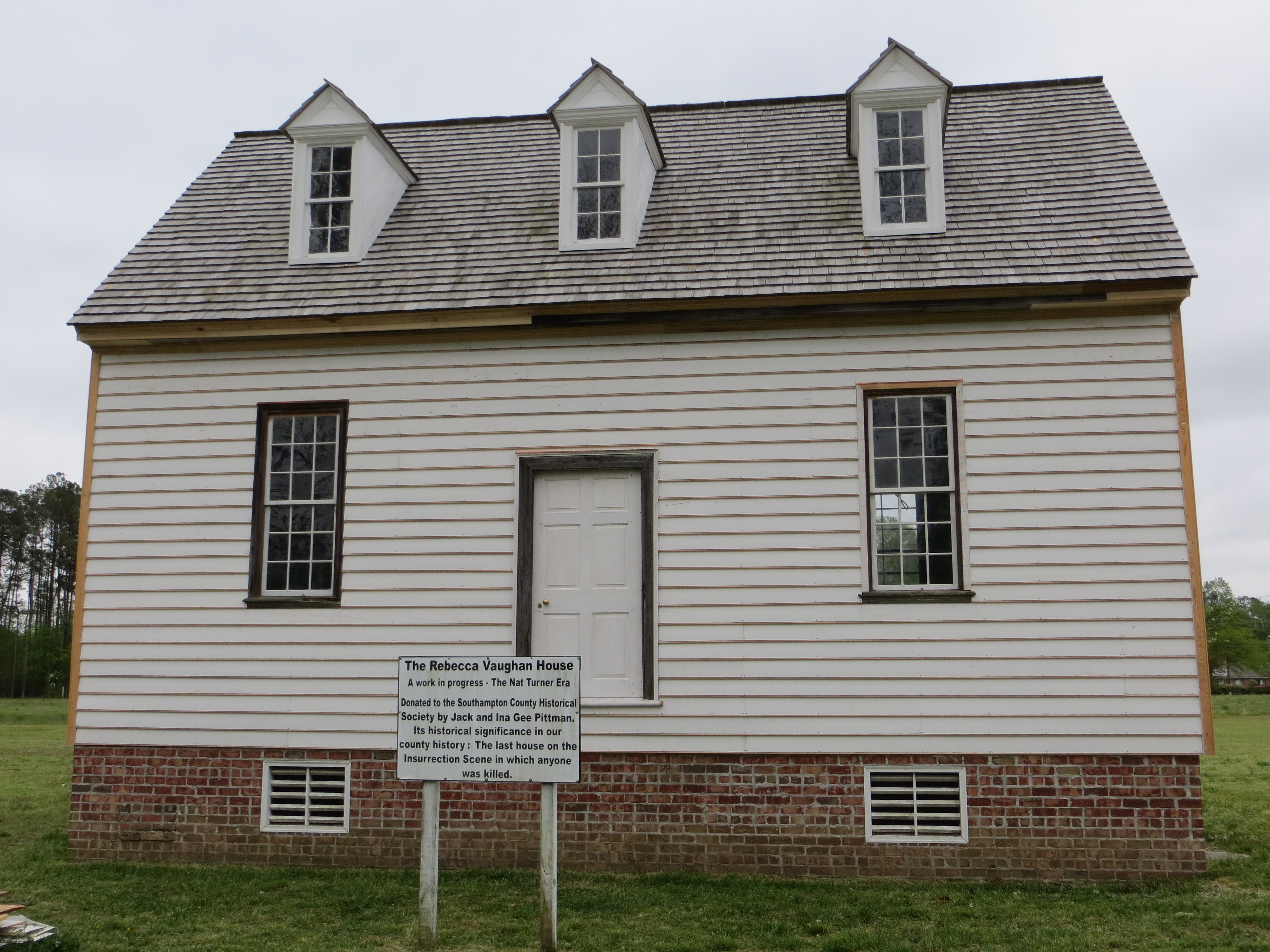
Many of the homes, including that of Joseph Travis and his wife, were still standing as late as the seventies before time and weather took their toll.  Many of the property owners cannot afford to rebuild the homes, clearing the rubble instead.  One of the houses, that of the final victim Rebecca Vaughan, was relocated to a site in Courtland across from the county agricultural museum.  It was restored by the county but stands vacant.

The tree where Nat Turner was hanged fell but Rick Francis estimates the location to in the yard of an old foursquare house on Bride Street (Ibid).  A short distance away from the site on High Street is the ditch where Nat Turner's decapitated torso was said to have been thrown.  Mr. Francis attests that human remains have been found in the ditch (Ibid).

The county courthouse took down the Confederate flag in 2015, but a monument still remains on one side of the complex.  In the records room, Mr. Francis maintains a tiny museum dedicated to the rebellion, exhibiting newspaper clippings and artifacts.

The biggest prize, Nat Turner's sword, is locked away in a courthouse storeroom in a padded case.  Mr. Francis had to take a pistol with him when he went to retrieve it.  The Southampton County Historical Society has resisted putting it on display.  They are concerned that people will not take the tour is they see this most tangible and definable object presented front and center.  Their uneasiness might be in presenting such a historically fraught object.

Nat Turner is also a complicated figure for African Americans who grew up in Southampton County.  Bruce Turner told The Post reporters that the older members of his family spoke in hushed tones of a family connect to the Nat mess (Ibid).  After years of research, Mr. Turner believes that Nat Turner was his three-time great grandfather.  The more he learned about his ancestor, the prouder he was.  Mr. Turner said,

I wasn't sure what he did was right or wrong,... Today I admire and honor Nat.  I think what he did was correct. (Ibid)

Bruce Turner added that it was important to understand the rebellion through the lens of freedom fighters.  The houses, the landscape of Southampton County all evoke that history now that he knows the full story.  Mr. Turner said,

The houses that were down there... we used to call those haunted houses,.... And were told something terrible happened there. (Ibid)

The hanging tree still stood during Mr. Turner's childhood and the Vaughan house was left abandoned.  He continued,

I was always told, oh you don't want to go in there, there's blood spattered up on the walls, and stuff like that.  I went in there.  I only saw some spots.  But they could've been mold,... (Ibid)


Why preserve the sites where the largest slave rebellion in American history took place?  The answer is historic preservation is not always about the places of happy and victorious moments.  Preservation of the dark places contributes to a fuller understanding of history, allowing us to confront the past deeds, learn from them, and move forward into a better future.   

Wednesday, May 1, 2019

Blogger Candidate Forum; Where Do The Migrants Come From?


Hello Everyone:

It is a lovely, not too cold, Wednesday afternoon and time for the weekly edition of Blogger Candidate Forum.  First up, some news from Capitol Hill.  Attorney General William Barr testified before Congress today on his assessment of the Special Counsel's final report on Russian interference in the 2016 election.  It was more like what he did not say, as in, not give any specifics about how he arrived at his conclusions about conspiracy to undermine an election and obstruction of justice.  AG Barr's four page summary (npr.org; Mar. 24, 2019; date accessed May 1, 2019) lacked context, something Robert Mueller pointed out in his response to the summary (int.nyt.com; Mar. 27, 2019; date accessed May 1, 2019).  Mr. Mueller also wrote that AG Barr mischaracterized the findings of the investigation and failed to incorporate the summaries written by his team.  The Democratic senators questioning the attorney seriously rebuked him, a one point accusing him of acting more like the president's personal attorney rather than the United States' top law enforcement officer.  As of close of business,  Mr. Barr refused to return tomorrow for a second round.  In the meantime, the social media is a blaze with calls for Mr. Barr's resignation or impeachment.  Things are about to get even more interesting because Mr. Mueller is scheduled to testify before Congress.  Fasten your seat belts and hold on tight, this ride is extremely wild.  Shall we move.

Image result for migrants at border
Migrants arriving at the southern U.S. border
redice.tv

Central Americans are arriving at the southern United States border in record numbers, pushing unauthorized entries to a 12-year high (washingtonpost.com; Apr. 13, 2019; date accessed May. 2019).  What differentiates this wave of migrants from previous ones is, unlike the majority of migrants from Mexico who settle in Texas or California, the newest group are families and individuals who spread out across the country to reunite with family members.  This left the Trump administration scrambling for some sort of way to discourage the men, women, and children from trying to cross the border.

Image result for family separation at border
A child facing Customs and Border Patrol agents
theguardian.com

One proposal was the zero tolerance policy.  The president's "Zero Tolerance" Immigration Policy was implemented on May 7, 2018 by the Department of Justice as a way to discourage illegal migration into the United States.  Under this policy, anyone illegally entering the United States, asylum seekers or those with children, would be criminally prosecuted, no exception.  One of the consequences of this policy was the separation of children from their parents or guardians (fas.org; Feb. 26, 2019; date accessed May 1, 2019).  To date, many of the children remain in federal custody or have been released into sponsor homes while the Department of Homeland Security scrambles to reunite them with their parents.  Meanwhile, no one knows where the migrants have gone once they have been released from federal detention.

Image result for Annunciation House
The Annunciation House
El Paso, Texas
upi.com

The federal government has not released information regarding where the migrants have settled.  However, The Washington Post has obtained data on the nationality and destination of a small sample of migrants: "1,545 migrants who passed through a shelter run by El Paso nonprofit Annunciation House in February, about 2 percent of the total number migrants who crossed into the country that month" (washingtonpost.com; Apr. 13, 2019).

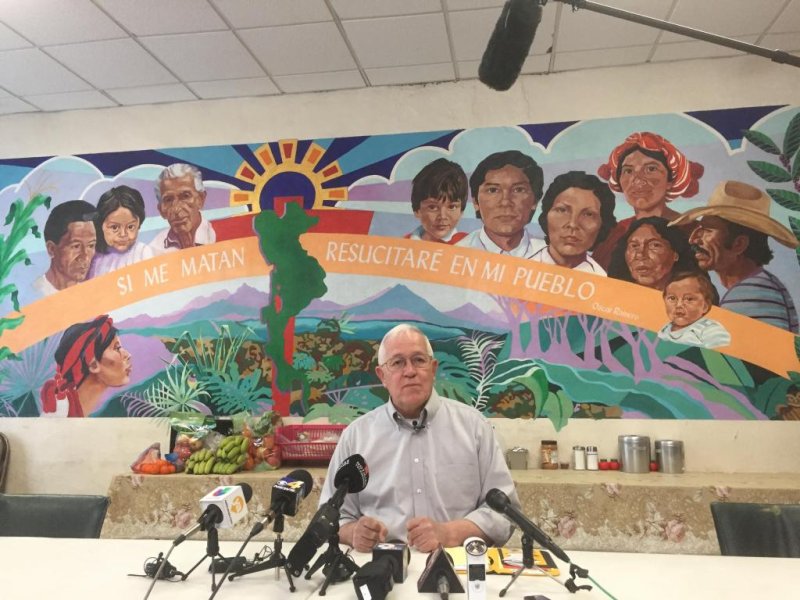
The Annunciation House (Ibid: Apr. 1, 2019) has arranged with federal authorities to take those released from immigration custody into local shelters and assist them in making travel arrangements to their destination within the United States.

Recently, the Trump administration announced a plan to transfer migrants to "sanctuary cities" (Ibid; Apr. 11, 2019)--municipalities with limited cooperation with Immigration Customs Enforcement--then release them in retaliation against Democratic lawmakers who blocked federal funding from more detention beds.  Although lawmakers say there is no concrete plan in place to make it happen, Mr. President naturally tweeted that he was seriously considering putting this idea in motion.

Image result for Annunciation House
A map of where migrants settle in the United States
annunciationhouse.org
washingtonpost.com

  The Post reviewed the data provided by the Annunciation House--migrants' country of origin and their final destination after release from detention--show that the migrants typically settle in cities and towns in 42 states, including places not thought of as sanctuary cities (Ibid).  The majority of the migrants went to states in the Southeast and Midwest, states that were not migrant destinations in previous generations (Ibid).  In all the heated discussion over immigration, we tend to forget that we are talking about individual human beings, not some monolithic entity.  Men, women, and children who had a life in their country of origin.  We can guess as to the reasons his brings to mind but do we know where do the migrants came from?

The migrants who arrive at the Annunciation House represent a dozen countries, including four that make up 95 percent of the monthly total: Guatemala, Honduras, Cuba, and El Salvador.  Others arrive from Mexico, Nicaragua, Brazil, and Ecuador.  A small number come from Russia, Iraq, and Venezuela (Ibid).  Let us focus on the number of migrants from the Northern Triangle countries.

Image result for Map of Northern Triangle Countries
Map of Northern Triangle Countries
fas.org
Guatemala (706)

In recent month, Guatemala has overtaken Mexico as the primary source of unauthorized migrant entries at the border.  "Emigration levels are highest from the country's impoverished highlands, where years of droughts and meager harvests have pushed the region's highest malnutrition rates even higher" (Ibid).  The Guatemalan migrant networks are the most developed in Central America, creating phony documents and a lending system to pay "coyotes" who know how to negotiate the route, using express buses to deliver the migrants to the U.S. border. (Ibid)

Honduras (104)

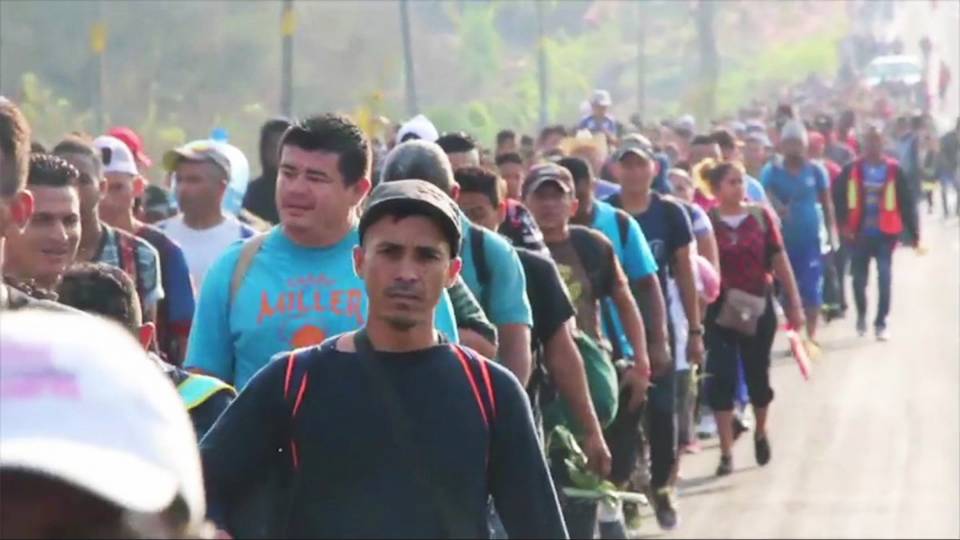
Honduras is the second-largest source, behind Guatemala, of migrants to the United States.  The caravan groups that have been the source of the president's ire are overwhelmingly made up of Honduran migrants escaping political violence, gangs, and persistent rural poverty (Ibid).

Salvadorans (104)

The number of migrants from El Salvador used to be comparable to the number of migrants from Honduras and Guatemala but have dropped in recent years.  The reason for fewer migrants is improving American humanitarian aid support programs in El Salvador have contributed to improvements in public safety and employment opportunities, reducing the flow migrants.  "U.S. officials have praised the efforts of USAID as a model that should be extended to the rest of the region, which is known as the Northern Triangle." (Ibid)