Wednesday, May 10, 2017

Blogger Candidate Forum: This Is What Winning Looks Like

https://www.citylab.com/pollitics/politics/2017/04/sanctuary-cities-are-winning/524298/?utm_source=nl__link1_042617


Former FBI Director James Comey
fbi.gov
Hello Everyone:

It is time for the latest edition of Blogger Candidate Forum.  The last 24 hours have been eventful, have they not?  Yours truly is referring to seemingly sudden dismissal of Federal Bureau of Investigation Director James Comey by President Donald Trump. Former director Comey's firing comes days after the FBI asked for additional funds for the agency's ongoing investigation into possible collusion between the Trump campaign and Russia.  This also comes not long after POTUS praised Mr. Comey for the way he handled the Clinton email scandal.  POTUS's reason for dismissing Mr. Comey was the way the former director handled the Clinton investigation and the agency lost confidence in Mr. Comey, thus unable to lead the bureau effectively.  Are any of you buying this?  Blogger does not think so.  The whole thing reeks of feces.  Over the last 24 hours, the i-word (impeachment) has been uttered frequently and loudly as has the call for a special prosecutor.  This has real potential to backfire on POTUS bigly and badly.  A special prosecutor is going to be necessary because whoever is appointed to replace Mr. Comey cannot maintain any form objectivity because he or she will be beholden to President Trump.  What will happen next?  Who knows?  Now on to today's topic.

San Francisco City Attorney Dennis Herrera responds to a federal judge's order
Photograph by Eric Risberg/AP
citylab.com
Today we return to the subject of sanctuary cities.  Recently, federal Judge William Orrick recently blocked POTUS's ill-conceived executive order that sought to withhold federal funds from self-proclaimed sanctuary cities: cities that curtail cooperation with Immigration and Customs Enforcement in some form or fashion.  Tanvi Misra writes in her CityLab article "Sanctuary Cities Are Winning," "In essence, U.S. District Judge William Orrick of the United States District Court for the Northern District of California ruled that the executive order is overtly broad and constitutionally fraught."

César Cuauhtémoc García Hernández, associate professor at the University Denver's Sturm College of Law, told CityLab

The bottom line is that the federal court has dealt a major setback to President Trump's attack on sanctuary cities...I imagine that the federal government will appeal but, for now, the Trump Administration cannot go forward with its hope of punishing cities and counties for limiting their cooperation wit ICE.


Rep Rafael Anchia (D-Dallas) speaking against the "anti-sanctuary cities" bill
Photograph by Eric Gay/AP
citylab.com
Just last week, Texas Governor Greg Abbot signed a law banning sanctuary cities and threatening civic officials with jail time if they did not comply. (http://www.nytimes.com; date accessed May 10, 2017) The new law signaled Texas's hard conservative tack.  The state's legislative body was drifting further right.  Its historic relationship with the Latino residents was thrown into flux.  Texas is a state with the second-largest Latino population in the nation.  The new law threatens law enforcement officials with jail time and termination if they do not cooperation with federal immigration authorities.  It also permits police officers, including university police, to question the immigration status of any person they had detained or arrested, including routine traffic stops.  (Ibid)  The point here is that the Trump campaign emboldened an extremely hard stance toward anyone with a Spanish surname, regardless of citizenship status.  Also, it is an indication of the random nature of the way that ill-conceived executive order was put forth.

Attorney General Jeff Sessions with White House Press Secretary Sean Spicer
Photograph by Andrew Harnik/AP
scpr.org
The controversial executive order was based on federal statue-U.S. Code 1373-"that forbids local governments from withholding information about immigration status of an individual from federal authorities."  San Francisco Dennis Herrera filed a lawsuit right after he signed it, citing, "that the 10th Amendment limits the power of the federal government to 'commandeer' states and localities-a claim backed up by many legal experts."  Neighboring Santa Clara County followed.

The decision rendered by Judge Orrick affirms the jurisdictions case that the executive order is tantamount to a loaded gun pointed at their heads.  The decision reads,

..[it] threatens to deny sanctuary jurisdictions all federal grants, hundred of million of  dollars on which the Counties rely...The threat is unconstitutionally coercive.

The ruling also questions the limits of the president's control of the federal purse strings:

The Constitution vests the spending powers in Congress, not the President, so the order cannot constitutionally place new conditions on federal funds...


POTUS holding up the Executive Order
Photograph by Pablo Martinez Monsivals/The Associated Press
seattletimes.com

While POTUS and Attorney General Jeff Sessions have publicly expounded on punishing sanctuary cities by withholding billions of dollars in federal grants, however during the hearing, the administrations lawyers tried to argue a more narrow interpretation.  The lawyers argued that "it would only apply only to a limited number of Department of Homeland Security and Department of Justice grants."  Judge Orrick, in his infinite wisdom, dismissed this argument. He wrote that the lawyers interpretations renders the Order toothless, and very different from thewording  President Trump signed off on.  Vanderbilt University immigration scholar Peter Mancina elaborated in a series of tweets:

...For starters, this is big.  He is saying that the fed's lawyer's interpretation of the EO being narrow is too far from the text of the EO p14...

...I guess what I'm saying is that the judge is all out rejecting the fed attorney's contention that the EO is narrow & only applies to DOJ/DHS...

...Also he cites Trump's statements that sanctuary city defending was a "weapon"-Trump's words coming back to haunt him.. (p23)....

...This amounts to the judge calling bullshit on the US attorneys.  It not a narrow EO-it's a broad, vindictive, intentionally coercive EO...

Seattle Mayor Mike Murray announcing a lawsuit against the Trump administration
Photograph by Mike Mill McKnight/Cascade Public Media
citylab.com
Judge William Orrick's decision comes just days after AG Sessions sent out letters to nine cities, requesting proof on their compliance with U.S.C. 1373.   Tanvi Misra writes, "One of San Francisco's arguments was that this statute itself is unconstitutional, but the judge didn't address that specifically."  While, yes, technically the federal government and strip funds, they cannot do so in the haphazard manner as stated in the order, at the caprice of the president.  Ilya Somin, a law professor at George Mason, explained in The Washington Post,

In this case, none of the federal grants given to sanctuary cities were conditioned by Congress on compliance wtth Section 1373 or any other form of cooperation with federal efforts to deport undocumented immigrants.  The president cannot impose such conditions on his own... (http://www.washingtonpost.com; date accessed May 10, 2017)

This order, the equally odious one banning the entry of nationals from six Muslim majority countries and pausing the entry of refugees, share a key trait" "They're both unable to veil the administrations's legally dubious intentions in court."  Legally dubious intentions would not be the phrase Blogger would use: more like morally repugnant intentions.  This is why, for municipalities opposing President Donald Trump on immigration, the first 100 days have led to a series of victories.  Based on Judge Orrick's reading, "their case is good enough that they're likely to retain that winning streak."  That, is what winning looks like.

Tuesday, May 9, 2017

Love Your Late Modern

http://www.architecturalrecord.com/external_headlines?story?regio...es_premium=1&defie_caption-1&mc_cid=78d3f3856&mc_eid=63d2bb*ceb


LaLa Land movie poster
en.wikipedia.org
Hello Everyone:

Welcome to a new week on the blog.  Yesterday, yours truly finally saw LaLa Land and liked it.  Blogger especially liked the how the director, Damian Chazelle, effectively used Los Angeles landmarks as supporting players.  Blogger was so taken with the movie and a fantastic conversation with FOB (Friend of Blogger) Daniel Sirignano (play itagaindan.wordpress.com) that it inspired a post on saving Los Angeles's late modernist landmarks from a date with the wrecking ball.

The article, written by Mimi Zeiger, "Can Preservationists Save L.A. Late Modernist Landmarks From the Wrecking Ball?" originally appeared in L.A. Weekly and was picked up by Architectural Record.  To be clear, AR did not report, edit, or fact check the article.  It is a timely article because some of the landmarks have reached or are reaching the 50-year-old threshold that preservationists set for enough time to properly evaluate a building or place.  Sit back, relax, and enjoy this survey of Los Angeles's late modernist landmarks.  Hopefully you will be inspired to appreciate these buildings and similar ones where you live.

Los Angeles International Airport Theme Building
Paul R. Williams, William L. Pereira, Charles Luckman, and Welton Becket
Los Angeles, California
waterandpower.org
Wedged in the middle of Los Angeles International Airport's cacophonous traffic and packed-beyond-capacity parking lot , the iconic spaceship Theme blissfully rises above the chaos.  The Theme Building was designed by William L. Pereira and Charles Luckman (with Paul R. Williams and Welton Becket) is one of the last original buildings of the airport masterplan, opened in 1961. "Its architects envisioned it as the centerpiece of the airport, a jet-setting gateway to the futurist city of Los Angeles."  Today you have to play shuttle bus chicken to reach it, and the retro-cool cocktail bar and restaurant shuttered doors in 2013.   In 1993, the L.A. City Council declared it a Historic-Cultural  Monument, which protects from demolition or substantial alterations, "it's an essential piece of architectural history."

Norm's Coffee Shop on La Cienega
Armet & Davis
Los Angeles, California
beverlypress.com
The Theme Building is situated within the narrative of a period of expressive architecture sometime referred to a "Googie" or "Populuxe"-"commercial styles meant to capture in streamlined form L.A.'s aerospace ambitions"  Norm's Coffee Shop on La Cienega Boulevard  by Armet & Davis, saved from demolition in 2016, is an example of this style.  The coffee shop features comet-like shapes that evoke a sense of midcentury optimism.

The promise of a brighter future did not exactly materialize.  Some of the buildings from the late-fifties, early sixties-that once heralded the coming urban utopia-now have prove their contemporary relevance or face the wrecking ball.  Rapid growth across Los Angeles-from the proposed Los Angeles County of Museum redesign, extended Metro rail lines, to science fiction-like proposals for larger denser developments-suggests that now, more than ever, we need to preserve the architectural past.

Pann's Restaurant
Los Angeles, California
customrodder.forumaclif.org
Los Angeles is full of architecture that has a story to tell about "LaLa Land"-not all of it happy.  After all, buildings are documents of a city; like fashion, styles change; some things remain classics while others come and go.  Architecture is also a mirror of the period it lives in: its. ideas, hopes, and aspirations.

"Midcentury architecture in L.A. reflects many great ideas, but should all midcentury buildings be preserved?"  This is the conundrum faced by preservationists and architecture aficionados.  Matthew Weiner's series Mad Men proved that the Hollywood is love with the sleek modern homes nestled in the hill as the perfect hideout for villains and socialites-but what about their unattractive siblings?  Those buildings that do not quite fit into the Mad Men narrative?  The Theme Building and the Pereira & Luckman LAX master plan is part of the late modern narrative-"a period after the famous designs by Silver Lake-based [sic] Austrian architect Richard Neutra and the Eames Office-that begins at midcentury and stretched into the 1970s, when it quietly died."

Parker Center
Welton Becket
Los Angeles, California
dornsife.use.edu
Adrian Scott Fine, advocacy director for our friend at the Los Angeles Conservancy (http://www.laconservancy.org) said,

In many ways the midcentury moderna buildings and places from the 1950s to the 1970s best tell the story of Los Angeles during its greatest period of growth and prosperity.

The L.A. Conservancy was founded in 1978 to protect the city's architectural heritage and is now calling attention to later modern designs, including the soon-to-be demolished the 1955 Parker Center by Welton Becket and the original Los Angeles County Museum of Art campus by Pereira Associates.


Capitol Records Building
Welton Becket & Associates
Hollywood, California
en.wikipedia.org
Mr. Fine continues,

At a time when the city was essentially coming into its own, each one imparts an important aspect of how Los Angeles was rapidly growing, from one of the most modern and advanced police headquarters in the nation to city's first real cultural arts museum.

Part of the Pereira legacy is in danger of disappearing-his original  LACMA campus is slated for demolition to make way or the latest Peter Zumthor museum iteration.  Other buildings also face an uncertain future: "the brown behemoth addition to the L.A. Times offices and Echo Park's grand but now derelict hilltop Metropolitan Water District building."  Beatle fans pay attention, Welton Becket & Associates elegant Capitol Records building is also facing an uncertain future.  Whatever your thoughts are on Parker Center and what it stands for, you cannot help feeling a little sentimental for the space-age minimalist cube that is Parker Center.

Throughout Los Angeles, building by some of the city's most important firm also existential threats.  Rejected and out dated, can late modernism get any love?

Lucille Ball-Desi Arnaz Residence
Paul R. Williams
Photograph by Julius Shulman
Palm Springs, California
paulwilliamsproject.org
Beauty and the brutalist

Beauty and the Brutalist beast.  Well, maybe not so beastly thanks to renewed (good, bad, and indifferent) in late-modern architects and their work.  In December 2016, the American Institute of Architects finally awarded Paul Revere Williams the 2017 AIA Gold Medal.  Blogger says finally because Mr. Williams, who passed away in 1980, is the first African-American architect to receive this prestigious award.  He work included the Theme Building, homes for Frank Sinatra and Lucille Ball.  "But why did it take 37 years for Williams' late-modern designs to be recognized?"

Good question.  Susan Macdonald, project director of the Getty Conservation Institute's Conserving Modern Architecture Initiative has the answer: it is a question of subjective public taste.  Public taste is a fickle and cyclical beast.  "There's a time lapse between an architectural fall from grace and renewed recognition.  Ms. MacDonald explained,

Typically, people start to see place as heritage some 30 to 40 years after their construction...First are the aficionados and professionals such as architects, historians and preservation organizations.


The Dude abides Sheats-Goldstein Residence
John Lautner
forbes.com
One of the obstacles to giving these buildings some love is it can be hard for the public to recognize a building as historic.  The Dude abides by the fact that the Sheats-Goldstein Residence, designed in the early sixties by Frank Lloyd Wright disciple John Lautner, is landmark worthy.  "Not only is the home architecturally unique with its temple like [sic] concrete walls, sharp edges and pointed roof..."  Last year, owner James Goldstein, donated it to LACMA, ensuring its long-term preservation.  "No one can deny the importance of GCI's most recent conservation of the Eames House-where Charles and Ray Eames put their minimalist philosophies to work-the beautifully brutalist Salk Institute as significant contributions to modern heritage."  What about the less sexy office tower or civic buildings?

Department of Water and Power Building
Albert C. Martin and Associates
Los Angeles, California
waterandpower.org

Painter Danny Heller (http://www.dannyhellerart.com) argues that those unsexy buildings are equally inspiring.  Mr. Heller was raised in the San Fernando Valley, surround by generic postwar sprawl.  His highly detailed oil paintings are an homage to midcentury architecture-the icons and quotidian.  He said,

Painting helped me describe the beauty of modernism by teaching me how to really observe...I always hope that in some small way, my artwork can expose [the era] more to the masses.

Mr. Heller is particularly enamored by the landmark Department of Water and Power headquarters in downtown L.A.-the John Ferraro Building-by A.C. Martin & Associates.  The painter perfectly rendered reflect pools and louvered elevations are repeated in several of Mr. Heller's work.  "He emphasizes the drama and the beauty of the stark structure."  He continued,

I think folks who find modernism ugly just don't understand it- they see it as plain, simple, uninspired...If people learned more about it and saw these buildings at the time of their conception, they would realize how revolutionary they were are and are.


Los Angeles County Museum of Art postcard 1968
William Pereira and Associates
Los Angeles, California
laconservancy.org

Pereira in peril

Let us consider one of Los Angeles's more prolific architects William L. Pereira.  Was his work revolutionary?  Discuss.  The late Mr. Pereira designed the master plan for Irvine Ranch and the iconic Transamerica tower in San Francisco.  He was also the subject of a cover article for Time in 1963-part visionary, part insider.

William Pereira was born and trained in Chicago, he came West to work as an art designer for Paramount Pictures.  In the late forties, he and his classmate, Charles Luckman, established the firm Pererira & Luckman.  The office has designed some classic Los Angeles buildings: the Theme Building and CBS Television City, in the Fairfax District.  Later, Mr. Pereira spun off a successful solo practice, which he ran until his death in 1985.

CBS Televison City
William Pereira & Charles Luckman
Los Angeles, California
laconservancy.org
  Quoting from his obituary in the Los Angeles Times, To design plans to satisfy the future.  His oeuvre address a time beyond his period of significance.  Despite his ambitions, many of his buildings have either been consigned to the dustbin of history or are threatened.

Perhaps none more so than the his LACMA campus.  Right from the start, the Pereira design stirred up controversy.  The design was welcomed by the public in 1965.  Painter Ed Ruscha's The Los Angeles County Museum on Fire (1965-68) best encapsulates the architect's original concept of a museum in the park (without the flames: three pavilions arranged in a U-shape, joined together by outdoor plazas.  The campus appeared to float on a large lagoon.  The pools have always been a problem-tar leaked into them and inflammable gas was rise to the surface.  By the seventies the pools were drained.


Current iteration of the Los Angeles County Museum of Art
Peter Zumthor
Rendering by Atelier Peter Zumthor
architecturalrecord.com
In its fifty years of existent, LACMA's critics have routinely stressed that the choice of the late-Mr. Pereira as architect was a compromised between the museum's board of director and Chicago-based modern master Ludwig Mies van Rohe; New York-based Edward Durrell Stone, known for a more exuberant approach to design.

Looming on the horizon is a brand $600 million new museum campus by Swiss architect Peter Zumthor, that would replace the much loved Pereira building and the less loved hardy Holzman Pfeiffer 1986 addition lining Wilshire Boulevard.  Museum director Michael Govan has been repeatedly asked to defend his decision to demolish the older structures.  Mr. Govan ticked off a list of issues: narrow galleries and leaky pools to the $300 million required to bring the old structure up to earthquake code.  Mr Govan recalled,

The cutest one I heard was that women would get wet walking the stairs...The fountains were placed too close to the stairs.  So, when the wind blew they'd be baptized by the visit.

Really, Mr. Govan?  This sounds a wee bit sexist, do you not think?
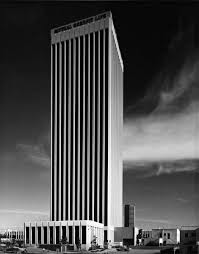

Mutual Benefit Life building, 1971
Gin Wong
Los Angeles, California
skyscraperpage.com
Mr. Govan maintains that the original galleries have reached their expiration date and the elimination the pools represents a loss of the main design device.  He admitted,

If the Pereira buildings were still intact, we could try to do something.

He went on to suggest that the Mutual Benefit Life building by William Pereira associate Gin Wong as more preservation-worthy.   The 1971 high rise stands 32-stories, circled by open plazas and landscaping.  Since 2005, the building is owned by the Ratkovich Company, the interiors have undergone renovations; a few years ago, the developer announced a new entry plaza designed by Greg Lynn.  The plans have been stalled since 2010 however it is possible that infill and more redevelopment will continue.

Architecture is organic-it changes over time-carefully considered additions or renovations is absolutely crucial to its long term survival.  "Sensitive adaption for new uses can be a passive preservation technique, while heavy-handed retrofits, often done in the name of current taste or revised function, can doom a building."  Scott Johnson of Johnson Fain, which acquired William Pereira's office in 1987 and carries on his legacy, takes a more pragmatic view,

If a building is an important architectural and/or cultural landmark, and if enough of it remains that it can be brought back to physical presence either in part or in totality, then, yes, a historic modern building should be saved...Repurposing occupancy is usually the more difficult task and, in many ways, the important one.  We don't need our cities to become shuttered museums of times past.


Metropolitan Water District headquarters
William Pereira, 1961-63
Los Angeles, California
blogs.kcrw.com
Such was the case with once gorgeous Metropolitan Water District headquarters on Sunset Boulevard near Echo Park.  Built by Pereira & Associates between 1961 and 1963, "the three-building campus has seen significant alterations to its structures and landscape, including the removal of the entry pavilion and he addition of a high-rise in 1971."  Photographs from sixties show fanciful water features and ponds, in tribute to the complex's client.  However, when Holy Hill Community Church took over the complex and built a new sanctuary building in the nineties, the original pools were drained and covered over.  The current owners, Palisades Capital Partners, wants to raze the complex (except for the recently renovated condominium tower) to build a mixed-use residential project.  Preservationists hoped that project would be designated a city Historic-Cultural Landmark but the Cultural Heritage Commission denied it this past autumn.  Too much damage done.

Ken Bernstein, manager and city planner in the Los Angeles Office of Historic Resources, said,

The challenge with some of these buildings is they've suffered from deferred maintenance or inappropriate additions...The complex was too compromised due to renovations and add-ons in the 1990s to be designated a Historic-Cultural Monument.

Architect-historian Alan Hess has a a different point of view.  Mr. Hess believes that "the project is distinct in its architectural style and celebration of water, and therefore worth preserving.  Specifically,

[It's] one of the very best examples of Pereira's expression of a new modernism for a new city-it's not Bauhaus, not International Style.
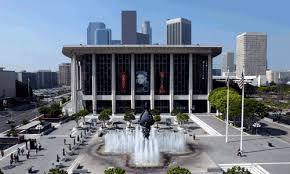

The Dorothy Chandler Pavilion at the Music Center
Los Angeles, California
musiccenter.org
Resuscitation downtown

Right now Mr. Hess is at work on his latest book, with architect Pierluigi Serraino, on a broad survey of California modern architecture from the turn of the twentieth century to the mid-seventies.  The deep dive affords Mr. Hess the space to reflect on how William Pereira's offices and other corporate offices such as: Welton Becket, Charles Luckman, and Victor Gruen shaped Los Angeles.  Consider the classics: the Music Center, the Forum in Inglewood, and CBS Television City.  Mr. Hess said,

Pereira was inventing new building types, as well as giving them architectural expression...CBS was designed in 1950 for television, a brand-new industry.  It's still in use today, almost 70 years later.


Times Mirror Square from the intersection of 2nd Street and Broadway
Los Angeles, Ca
urbanize.la
If Angelenos still love CBS Television City with its elegant streamlined black-and-white Los Angeles Times, Times Mirror Square and explained,

façades, William Pereira's later work has no such affection.  Mr. Hess pointed to the the architect's 1973 structure for the

People are saying it's ugly, it's garbage, it's a bunker.

The building was a six-story addition to the art-deco headquarters designed by Gordon B. Kaufmann.  It is a hulking brown structure that fills up its block on Broadway and First Street in Downtown Los Angeles.  The one-time home to the Times-Mirror corporate offices, it is now vacant and the object of redevelopment by the Vancouver-based Onni Group, which would knock down the building while preserving the Kaufmann edifices.

Gordon Kaufmann's Times building with the addition
Los Angeles, California
ladowntownnews.com

Alan Hess begs to differ on the building's history, not focus on its abstract geometry and dark color scheme.  "In its time, it was a major commission from one of the most powerful clients in California, located across the street from City Hall."  The glass and stone, not concrete, is a reference to Brutalism, the postwar style that frequently draws public scorn.  The vintage interiors are now used as film backdrops.  "Maybe those shoots represent the beginning of changing public tastes."

The current spate of movies and television shows set in the sixties and seventies indicate that this period style is back in vogue.  This trend is making its way to new proposals for megastructures in the Arts District by Swiss architects Herzong & de Meuron and Copenhagen- and New York-based Bjarke Ingels Group both feature feature chunky exposed concrete construction and block-like forms that reference the areas industrial past and current Brutalist trends.

 Parker Center: Former Los Angeles Police Department Headquarters
Welton Becket & Associates, 1955
Los Angeles, California
la.curbed.com

The Times Mirror Square is not the only piece of late modernism under threat, just a short distance away, the controversial Parker Center is at the epicenter of a redevelopment plan.  The former Los Angeles Police Department Headquarters was built in 1955 by Welton Becket & Associates.  The eight-story midcentury modern building has a strong presences in L.A.'s political and cultural consciousness-as a supporting player in the television series Dragnet to site of protests following the verdict in the criminal trial of the four officers accused of beating Rodney King.  In November 2015, the Cultural Heritage Commission placed the building in nomination as a Historic-Cultural Monument however, the City Council denied landmark Parker Center landmark status, voting in favor to knock it down and replace it with a proposed 28-story building.

Parker Center by Danny Heller
laweekly.com

Painter Danny Heller made the former LAPD Headquarters the subject of several of his images.  "His brushstrokes capture the blunt elegance of the building, as well as the trio of palms out front."  Mr. Heller said "the structure has a special place in his heart, and he's been working with the Los Angeles Conservancy to help save it.  He said,

There's a long, turbulent history there, but I think it's important to preserve some of these buildings that might remind us of both the good- and bad- times.

L.A. Conservancy's Adrian Scott Fine said the "organization recognizes that ours is a city of constant evolution, so architecture of one generation may not always serve the purposes of the next."  However, new development and preservation do not travel down parallel courses.  He said,

many of these midcentury buildings and  landmarks are located on highly visible and  valuable sites, posing an addition threat and challenge, as some see them as being in the way and ripe for redevelopment and perhaps greater density...There are 'win-win' opportunities to integrate new development with the preservation and reuse of modern buildings.

The Century Plaza Hotel
Minor Yamasaki
Los Angeles, California
la.curbed.com

Mr. Fine points to a couple of successful examples: the incorporation of Welton Becket's Cinerama Dome into the Hollywood Arclight complex and the preservation of Minor Yamasaki's Century Plaza Hotel on the same site as twin high-rises.

Sometimes the most unlikely candidates for preservation can succeed too.  This past winter the LA2050 organization awarded a group of self-professed artists, urban planners, and civic leaders a $100,000 grant to restore the Triforium, a "six-story, 60-ton public artwork by Joseph Young, which stands in Fletcher boron Square at the north end of downtown's Los Angeles Mall."  The "polyphonoptic" kinetic sculpture feature 1,494 multi-colored Murano glass cubes that are designed to light in accordance to music from a glass bell carillon.  This tech-inspired work was ahead of its time-"the lighting effect were glitchy and its computer eventually failed."  Hopefully the grant will reboot the sculpture back to life.

Adrian Scott Fine added

Many Angelenos drive by these places and may take for granted but often do not know why they look the way they do, who commissioned them, what happened there or why they matter.

Public curiosity and interest is the first in keeping these unloved pieces of Los Angeles's late modern history from a date with the wrecking ball.


Wednesday, May 3, 2017

Blogger Candidate Forum: Doing Away With Dodd-Frank

http://www.citylab.com/housing/2017/02/trump-can-re-create-the-h...ing-crisis-that-got-him-elected/515640/?utm__source=nl__link3_020617


President Trump cutting up Dodd-Frank reforms
hangthebankers.om
Hello Everyone:

Time for the weekly edition of Blogger Candidate Forum.  Before we get going on the Dodd-Frank Financial Reforms, a shout out to Housing and Urban Development Secretary Ben Carson.  According to the good doctor, "low-income Americans should have access to affordable housing-just nothing too 'comfortable.'" (http://www.thinkprogress.org; date accessed May 3, 2017)  This clueless comment came last-week, during a tour of facilities for low-income residents in Ohio.  Expanding on this empty headed comment, Dr. Carson told the New York Times, "...compassion means not giving people a comfortable setting that would make somebody want say: I'll just stay here.  They will take care me..."  This tone deaf comment was uttered right after the head of a supportive housing center for recovering addicts.  Apparently, the good doctor has not figured out that research shows that providing housing is a viable way to reduce homelessness.  Insert eye roll.  Alright, onto Dodd-Frank Financial Reform.

Foreclosure banner
Photograph by Shannon Stapleton/Reuters
citylab.com
Shortly after meeting with Wall Street executives in February, President Donald Trump signed an order to begin dismantling the Dodd-Frank Financial Reform, enacted after financial crisis to prevent the same thing from happening again.  Kriston Capps writes in his CityLab article, "Trump Can Now Re-Create the Housing Crisis That Got Him Elected," The end of Dodd-Frank could return the nation's financial system to the Wild West days that prevailed before 2008-the the lending environment that precipitated the Great Recession."

The irony of POTUS's action is during the campaign, he castigate Wall Street actors at the epicenter of the foreclosures crisis.  He even went as far as to call JP Morgan Chase CEO Jamie Dimon the worst banker in the United States.  Now ensconced in the Oval Office, POTUS invited the worst banker in the U.S. to join his circle of Wall Street confidants.

POTUS at a campaign rally in Florida
thehill.com
Let us face facts, POTUS did promise to dismantle Dodd-Frank right from the start of his campaign.  As Mr. Capps points out, "So the greater irony here is that by sweeping away banking regulations, Trump promises to punish his core supporters.  The same same supporters who, in part, voted him into the Whites because they are still suffering from the foreclosure crisis."

One of the lingering mysteries of the 2016 presidential election is how in the world POTUS won on a message firmly grounded on jobs when the economy was bubbling at near full-employment levels.  The excelsior jobs report (http://www.nytimes.com), released on February 3, 2017 is "a reminder of the continued resiliency of the recovery begun under the Obama administration."  You can say that POTUS's appeal to white identity politics, Federal Bureau of Investigation director James Comey's nausea-inducing October surprise, Russian interference in the elections but you cannot say that unemployment was a reason.

"Percent of Home with a Mortgage in Negative Equity, Q3 2016"
© OpenStreetMap contributors
zillow.com
citylab.com


Mr. Capps writes, "Another valid explanation for President Trump is to plumb the profound depths of the housing crisis."  Although the new financial protections helped restore jobs and lending, recovering equity lost to the foreclosure crisis has not kept pace.  "As of December, more than 10 percent of homeowners in the U.S. are still underwater on their mortgages, according Zillow's most recent negative reports.

The good news is that this number is substantially down from 2012, "when nearly 16 million homeowners-comprising 31.4 percent of homes-owed more than the homes were worth."  The situation has improved for homeowners since that grim peak, "but the benefit is both limited and localized.  More than one-quarter of homeowners (26 percent) have less than 20 percent equity in their homes, meaning they have not hit the break-even point whee they are not long required to pay private mortgage insurance premiums.  Their equity is effectively negative."

Thus, negative equity is an instrument of the national economy that has enormous impact on local housing markets.  For example, Phoenix, Las Vegas, and Miami, which amply indulged in the excesses that led up to the housing crisis, typified the cities that experienced great losses in equity early into the crosses.  However, once recovery was underway; homes and housing markets recouped their value, pockets of negative equity shifted northward from the Southwest and Southeast to the Midwest and Rust Belt.

Negative Equity in the Rust Belt States of Illinois, Indiana,
Michigan, Ohio, Pennsylvania
zillow.com
city lab.com
 Kriston Capps observes, "Nothing about the recovery spurred negative equity in Michigan, Ohio, Indiana, and other Rust Belt states per se."  However, this is not the best way to approach it.  Instead, the United States suffered from a massive housing crisis in places that grew at an sharp and unsustainable pace.  These cities-i.e. Phoenix and Phoenix-rebounded quickly.  Regions that were already in the throes of long-term structural hardships-i.e. the Midwest and Rust Belt-got knocked down harder than before.

Therefore, voters in the those states chose President Trump for somewhat unclear economic reasons, but their feelings of dissatisfaction were not incorrect.  As a reward for their efforts, POTUS gave Wall Street free rein again, thus "opening up the possibility of another financial crisis down the road."  Mr. Capps notes that Treasury Secretary Steve Mnuchin profited handsomely from the credit meltdown.

Circling back to HUD Secretary Ben Carson's empty-headed comment about providing too comfortable affordable housing to low- and moderate-income individuals and families. A 2010 study by Dr. Carson's cabinet department concluded that family homelessness was on the rise since the Great Recession began (http://www.nbcnews.com; date accessed May 3, 2017).  This finding was supported by studies conducted by other organizations, including the National Alliance to End Homelessness which reported an increase in the number of older adults without a permanent place to live.  (Ibid)  Obviously Secretary Carson failed to do his homework on affordable housing.  Kriston Capps writes, "The next disaster may not take the form of mortgage-backed securities (although, why not?).  It is, however, likely to set the dial back for the  Midwest and the Rust Belt-places where Hillary Clinton earned the ire of voters for merely having a meeting with Wall Street bankers."


Tuesday, May 2, 2017

Foreign Policy For Cities?

http://www.citylab.com/politics2017/02/what-should-a cites-foreign-policy-look-like/516090/?utm_source=nl__link1_021417


Mayor Eric Garcettin introduces Ali Vayeghan, an Iranian with a valid U.S. visa
who was turned away from LAX because of the travel ban
Photograph by Damian Dovarganes/AP
citylab.com

Hello Everyone:

Do cities need a foreign policy?  If they do, what should it look like?  Where should a city stand on immigration, climate, LGBTQ and human rights?  These are the questions that Ian Klaus ponders in his CityLab article "What Should a City's Foreign Policy Look Like?"  Three weeks before the election, Mr. Klaus wrote an article for the same website (http://www.citylab.com) titled, "What Can a Foreign Minister do for a City?"  A foreign minister fashioning policy for a city sounds a little strange but President Donald Trump and members of his administration are making known their stance on climate change and global involvment,  Mr. Klaus writes, "What can cities do to create their own foreign policy?"

Urban construction site
citylab.com

In the previous article, Mr. Klaus outlined four steps a foreign minister can take to facilitate cities's global engagement: "support city-based networks, helping to deploy civic technology, working with counterpart ministries abroad encourage vertical policy integration, and convening the global community to build momentum behind significant and widespread municipal challenges such as access to debt finance."  In the article he discussed some of the working being undertaken by the United States Department of States, optimistically included other ideas that would require additional time to execute.

We live in apparently extraordinary times, thus the question of a city's (or cities's) foreign policy is not a new concept whatsoever.  Historically, cities have been engaging in trade and commerce long before the evolution of the modern nation state.  Ian Klaus points out, "But more recently, cities have added to the list of issues they engaged on internationally, particularly climate change and sustainability."  These activities mirrors the feeling major cities that they are on the vanguard of global challenges, it was also a response to a perceived inactivity from the nation states.  Nations are inactive, so we must, according to mayors around the global.

Former London Mayor Boris Johns speaks with former New York
Mayor Michael Bloomberg in London, England
Photograph by Lewis Whytd/REUTERS
thechicagocouncil.org
The intention was not a zero-sum. Former New York City Mayor Michael Bloomberg, a United Nations Special Envoy for Climate Change and Cities, wrote in Foreign Affairs,

City leaders seek not to displace their national counterparts...but rather to full partners in their work-an arrangement that national increasingly view as not just beneficial but also necessary...

Absolutely beneficial and necessary, especially over the last eight years, specifically on the last four.  During President Barack Obama's tenure, collaborations between civic leaders and their national counterparts developed to the point where Mayors participated in international gatherings like the Paris Climate Conference.  Traditional international institutions, such as the Organization for Economic Cooperation and Development, recognized the importance of engaging at the civic level with local leadership.

C40 Mayors Summit 2016 logo
c40.org
What is next?  American mayors have made it quite clear regarding climate action at the C40 Mayors Summit in Mexico City, as well as immigration, cities were not going to yield on international issues that impact their residents.  Mr. Klaus writes, "But the emerging dynamic of oppositional relationships between Washing and dozens of U.S. cities on these issues is only the beginning of the challenge from a foreign policy perspective/

In the past, although cities took on an active leadership model on some issues in response to a perceived lack of national leadership, in a majority of policy areas in the international forum remained part of the traditional policy mechanism.

Former President Barack Obama
whitehouse.gov

The Obama State Department based its global work and internal bureaucracy on the issues affecting women, LGBTQ communities, the disabled, and interfaith relationships.  It spent hundreds of millions of dollars fighting for human rights.  Mr. Klaus observes, "There is a serious and long-stand debate within the foreign policy community about whether such work serves American interests or is in fact distracting, even dangerous."  However one thing is clear: "The residents of cities whose mayors were out front on climate change over the last two decades care about these issues."

Once again, the cities (and states) have to take the lead on combating climate change.  In addition to this task, they must also decide what kind of advocacy role they will have on a wider range of issues-domestically and internationally as well.  The speeches, advocacy, and policy-once an instrument of the foreign policy apparatus-have now become the instrument of cities.  To wit, Los Angeles Mayor Eric Garcetti put forth his vision to make his city the activism capital of the world.  Mayor Garcetti's vision cannot come to fruition without international engagement.

Mayor Eric J. Garcetti of Los Angeles
en.wikipedia.org

It is one thing to articulate such a vision, but follow through and enlisting more cities is the more daunting job.  While it seems that more cities and civic leaders have taken a greater role on the global stage, home is still where the heart is.  The question is how will international engagement effectively and realistically move forward local issues such as affordable housing, budgets, and transportation?

First, international engagement by civic leaders frequently economic and security for cities, it does come with political risk.  It is the mayors who feel it acutely.  Mr. Klaus writes, "It's much more difficult for a mayor to become a global voice on women's safety in cities or to dispatch a senior official dealing with homeless LGBT communities to share best policy practices abroad if they are attacked by media or political opponents."

It is naive to think that mayoral international engagement is above politicization, but certain measures can be taken.  Mr. Klaus posits, "City halls must actively engage with residents and civil society to formulate a foreign policy platform, and in doing so, make clear that such a platform is not simply about a mayor's engagement internationally, but enabling local civil society to do so as well."  With the support of civil and the community, cities can consider sending their community liaisons in a specific manner to share best practices on a yearly basis.

Ian Klaus hypothesizes, "If-despite British Prime Minister Theresa May's suggestion to contrary-you are a citizen of your city and of the world, if your patriotism is in part defined by a concern for other beyond your borders, such politics is requires.


Bloomberg Philanthropies logo
en.wikipedia.org
 
Second, "the increased engagement must be supported by philanthropy and, on certain issues, the private sector."  Municipal budgets are under newfound stress-thanks to real and threatened cuts from Washington-are stretched to nearly the breaking point.  Even the most active civic leadership, vis-a-vis advocacy and implementation, has depended upon support from private philanthropic organizations like Bloomberg Philanthropies, the Rockefeller Foundation, and the Children's Investment Fund Foundation and so on.  Mr. Klaus reports, "The leadership of these organizations, and perhaps more importantly others that have not yet funded international engagement or focused efforts at the municipal level, will to decide to support international engagement and local implementation."

Third, "the mustering of such political and financial capital will depend, in part, on whether vehicles for such advocacy and policy exchange at the city level can be developed."  Some of these networks and organizations are already in place.  According to the University College London's City Leadership Laboratory, "There are...over 200 city networks active today, some of which focus on issues such as governance, women's safety and inclusion, and access for the disabled."  Some of these said networks and organizations can be enhanced or expanded.  Other networks and organizations may need to be established, like C40 in 2005.

Last, "there is a role for former federal officials as well."  Former officials of the State Department's Bureau of Democracy, Human Rights and the Office of Religious Engagement, and senior officials who chaired engagement of LGBTQ issues must work with experts on international municipal engagement to chart existing opportunities and those not yet in existence.

What should a city's foreign policy look like?  While federal leadership may seem stagnate or seem insular to many urban dwelling Americans, associated with foreign intervention.  However, for those who care about climate change, making the United States a welcoming place for immigrants, prioritizing LGBTQ and human rights, no time like the present for mayors to lead the charge.


Monday, May 1, 2017

Lost In The Flames

http://www.citylab.com/crime/2017/04/what-was-lost-in-the-fires-of-the-la-riots/524145/?utm_source=nl__link4_042517


Firefighters spray water on a burning building in South Los Angeles
cnn.com
Hello Everyone:

This past weekend Los Angeles marked the 25th anniversary of the Los Angeles riots.  The riots were violent manifestation of decades racism and poverty.  This was not the first time South Los Angeles went up in flames.  In 1965, the Watts riots, which raged for six days and caused more than forty million dollars in property damage.  This was the largest and most expensive urban riot of the Civil Rights era.  The riots were sparked when Marquette Fry, a young African American man, was pulled over and arrested by a Caucasian California Highway Patrol officer Lee W. Minkus, for suspicion of driving while intoxicated.  As onlookers gathered, tensions escalated, violence erupted leading to a large-scale riot. (crdl.usg.edu; date accessed may 1, 2017).

Rodney King responding to the riots
history.com
 The world first came to know Rodney G. King on March 3, 1991 when a grainy video, shot by George Holliday, presented an African American man being relentlessly kicked and clubbed by four Los Angeles Police Officers during a traffic stop.  Rodney King's existed public stage on June 17, 2012, when he was found dead in a pool at the age of forty-seven. The autposy report concluded that his death was due to an alcohol and drug-induced delirium. Before his untimely demise, Mr. King had been cycling through rehab, he attributed to the trauma from the beating he suffered at the hands of the officers.  The coroner rule his death was accidental and self-inflicted, a typical ending for the concussed.

The infamous beating
Image captured by George Holliday
framework.latimes.com
Brentin Mocks writes in his CityLab article, "What Was Lost in the Fires of the L.A. Riots," "Riots are also a common feature of communities that have been beaten down and traumatized by racism and poverty."  This was the case in South Central Los Angeles on April 29, 1992 when a jury returned a not guilty verdict in the criminal trial of the four officers accused of beating Mr. King.  This was despite the fact that the home video was shown on all the local and national news outlets; achieving pre-social media vitality.

A new movie, The Lost Tapes: L.A. Riots, now airing on the Smithsonian Channel is attempt  to trace how the simmering frustrations led to the conflagration.  The nearly one hour documentary was pieced together from television news segments and never-before seen footage from a camera crew employed by the LAPD during the five-day riot.  The documentary calls itself an unfiltered story of the L.A. riots, this is the intended effect-there are some genuinely enlightening moments from the newly seen LAPD footage.  The documentary has four major takeaways.

Late LAPD Chief Daryl Gates
en.wikipedia.org
At first, LAPD Daryl Gates thought it was funny

Not long after the King beating video began making the local news rounds, the documentary includes footage of late LAPD Chief Daryl Gates (a disciple of late Chief William Parker) joking at a public forum,

...if it wasn't for our helicopters the lighting would've been horrible.

The audience was amused.  Move ahead a year to the not guilty verdict: "As flames consume South Central, Gates is in Brentwood, the wealthy L.A. neighborhood where O.J. Simpson lived at the time, raising money to fight reforms in the LAPD."  There is also footage of Chief Gates in 1980 taking the media and the public to task for criticizing the police and claiming that reports of police-involved shootings and killings were over blown.


Latasha Harlins
scar.org
It wasn't just about Rodney King-or even just about police brutality

Frequently lost in the mix is the case of 15-year-year-old Latasha Harlins.  Latasha Harlins was an African American girl who was shot in the back of the head on March 16, 1991, by Korean American storeowner Soon-ja Du following a brief confrontation.  Ms. Du claimed self defense, despite the fact they were separated by the store counter and Ms. Harlins was unarmed.  Eventually, a jury convicted Ms. Du of voluntary manslaughter (but was not sentence to prison).  The killing came two weeks after the King video was made public; escalating lingering tensions between the African American and Asian American communities in South Central Los Angeles.


Office in tactical gear standing guard
Los Angeles, California
huffingtonpost.com
African Americans didn't just "destroy their own neighborhoods"

Brentin Mock writes, "A common refrain when unrest grips black communities is that black rioters are only hurting themselves by burning and looting businesses in their neighborhoods."  This was not the complete story in 1992, though.  Koreatown sustained most of the damage-1,700 business were destroyed, "compared to 2,800 Africa-American businesses elsewhere."  Koreans were specifically targeted because they owned the majority of real estate across South Central, "while African Americans felt they didn't have the same entrepreneurial opportunities."  The Harlins killing further highlighted the divide between the two communities.  Mr. Mock reports, "One Asian-American man captured in a news clip in the doc tries to make the connection, though, noting how no fire trucks were coming to Koreatown to put out the fires."  The  unidentified man said,

This is no longer about Rodney King...This is about the system against us, the minorities


Fire from riot
Los Angeles, California
lattices.com
African Americans weren't for most of the rioting

The arrest records tell a different story:  "The LAPD arrested 12, 111 people during the unrest.  On 36 percent were African Americans, according to the documentary, while 51 percent of the arrested were Latino Americans."  The documentary does not present context for the this statistic, or why the face of the rioter is generally seen as African American.  South Central L.A. had a sizable Latino population in 1992, "but it's worth exploring why they endured the brunt of law enforcement."

Straight Outta Compton album cover
en.wikipedia.org

In addition to not explaining why 51 percent of the rioters arrested were Latinos, Brentin Mock points out, "It's not the only thing left unsaid in the Smithsonian documentary, suggesting that maybe the footage-exclusive approach to storytelling here has its limitation."  More context is necessary for what happened in the spring of 1992.  One example is "there's probably no truer place to apply the oft-repeated Martin Luther King quote that riots are the language of the unheard than Los Angeles, where young black hip-hop artists had been sounding off for years."

The 1988 N.W.A. song "Fuck Tha Police" passed judgement on the LAPD.  Ice Cube predicted with absolute certainty that a riot was inevitable in his 1991 album Death Certificate-"particularly with the songs 'A Bird in the Hand,' 'Black Korea.' and 'I Wanna Kill Sam.'"  The loudest voices on the issues the precipitated the riots were L.A.'s African American youth.  In the Smithsonian documentary, Chief Gates is heard dismissing any possibilities of racial conflict as voices in the wilderness.  Months later, the riots broke out, metaphorically beating Chief Gates and Los Angeles in the head with the same brutality as the police beat Rodney King.

Florence and Normandie, then and now
scpr.org

In 1994, Congress passed Section 14141 of the Violent Crime Control and Law Enforcement Act, "which authorized the U.S. Justice Department to investigate local police departments when they exhibit evidence of excessive misconduct and deadly force."  The bill was a direct response to the findings of the Christopher Commission after the infamous video went public.

Brentin Mock writes, "Section 14141 also authorized the Justice Department to establish reforms within abusive police departments via consent decrees-an outcome of the riots that the documentary doesn't cover."  However, the Justice Department under Attorney General Jeff Sessions is pushing back against these reforms, like late Los Angeles Police Department Chief Daryl Gates.  Are we in for a repeat?

Personal Observation:  Blogger was living in the Pico-Robertson neighborhood of Los Angeles when the riot broke out.  It was a scary few days.  Yours truly could see and smell the smoke coming from the fires, a mere mile away.  Blogger was afraid to leave the house.  Traffic on the side streets was heavy.  By the weekend, things had calmed down enough so that it was safe to venture out during the day-a curfew was in place.  A year later, the four officers lost in civil court and the fear of riot renewed itself and once again after the not guilty verdict in the People v. O.J. Simpson.  The fear of another riot still permeates the City of Los Angeles, will it come to fruition?  Who knows.