Monday, February 13, 2017

Can We Begin To Heal The Divisions

http://www.citylab.com/politics/2016/11/americas-great-divide-of-class-and-geography/507908/?utm_source=nl_link3_111716


The White House behind the gates
Washington D.C.
Carolyn Kaster/AP
Hello Everyone:

Welcome to a brand new week and new subjects to talk about.  Today we are going to take a look at just how divided the United States is.  By divided, your truly does not mean physically divided, rather, divided along class and geographic lines.  Four weeks into the new administration, it is worth taking a look at how this schism affected the presidential election and what it all means.  Our for today's discussion is Richard Florida's CityLab article "It's Still About Class and Geography."  It seems like it might be too late to another election post-mortem but it is worth reminding everyone this division goes deep and will take a long time to heal.

Final 2016 Electoral Map
Sources: AP, Fox News, CNN, CBS News, ABC News
businessinsider.com
Let us start with the obvious, former-Secretary of State Hillary Clinton (D-NY) was defeated by real estate developer-turned-politician Donald J. Trump (R-NY).  That said, one the reasons why Madame Secretary lost was Mr. Trump was able to breach the hallowed "blue wall" in Midwestern United States and reconfigure the electorate.  That and, all the polls and data analytics were wrong. They failed to accurately predict the outcome.  This is all true to a point.  However, Mr. Florida writes, "But the bigger reality according to my own analysis is that the 2016 election follows the same basic contours of class and location-the same divides of knowledge and density-of the last several election."  In essence, the class and geographic division, opened up by the 2016 Presidential Election, is not a new phenomenon.

Martin Prosperity Institute Federal 2016 Federal Election Results
Charlotta Mellander: statistical analysis
Taylor Blake: map data
citylab.com

Richard Florida's own state-by-state election results confirmed the election conforms to America's underlying basic economic, demographic, and political divides.  Instead of a major break with the past, the election reinforced "...existing divides between richer, more highly educated, more knowledge-based states and less advantaged, less diverse, whiter ones.  More than anything else, I would argue, the 2016 election hardened these long-standing divides."  The first half of this statement is a description of the creative-class that Mr. Florida has written extensively about.  He is correct in saying that the 2016 election did concretized those divisions.

The above map is the Martin Prosperity Institute analysis of the Elections.  Charlotte Mellander produced the statistical analysis and Taylor Blake organized and mapped the data.  The map overlays the past three federal elections: Obama versus McCain (2008); Obama versus Romney (2012), and Clinton versus Trump (2016).

Richard Florida reports, "Across the 50 states and the District of Columbia were extremely closely correlated with Obama's in 2012 (.97) and with Obama's in 2008 (.92)."  Taking a look at the correlation between votes for POTUS, Senator John McCain, and former-Governor Mitt Romney, Mr. Florida found a similar correlation: "Trump's were similarly closely correlated with Romney's votes in 2012 (.91) and McCain's in 2008 (.87)."  Looking across states, the final tallies neatly aligned themselves with the surveys: "...correlations of .95 for Clinton and .97 for Trump against Pollster's mid-to-late October polls."

Clinton 2016
Trump 2016
Obama 2012
Romney 2012
Obama 2008
McCain 2008
Annual Wage
0.82
-0.81
0.76
-0.76
0.61
-0.61
College Grads
0.77
-0.81
0.72
-0.73
0.62
-0.63
Creative Class
0.72
-0.73
0.66
-0.66
0.46
-0.46
Working Class
-0.77
0.79
-0.75
0.75
-0.63
0.64
Service Class
0.32
-0.33
0.38
-0.39
0.40
-0.4
Voter correlation along class lines
Martin Prosperity Institute
citylab.com

Class
Class remains a primary feature of the American political schism.  The above chart illustrates the correlations  between voters, class, and annual wage.  In the 2016 elections, support for Madame Secretary was focused in "...states with higher wages (.82), greater shares of college grads (.77), and greater share of workforce in knowledge, professional and creative jobs (.72)."  Conversely, support for POTUS was centered in states with "...lower 9-.81), smaller shares of college grads (-.81), and smaller shares of the workforce in knowledge, professional, and creative jobs (-.73)."  These correlations have grown since the past two elections.

President Donald Trump enjoyed a high level of support in states with a greater share of working class "...(79), similar to Romney in 2012 but up somewhat from McCain in 2008."  On the opposite end, Madame Secretary's support was "...negatively correlated with a larger blue-collar share of the workforce (-.77).  Again, this was roughly on par with Obama in 2012, but greater than Obama in 2008."

"Unionize"
seattlespectator.com
Richard Florida highlights the results when unionization is factored into the equation.  He writes, "While working class states went for Trump and against Clinton, the effect of unionization was the opposite.  States with more union members favored Clinton over Trump."  More precisely, "Clinton support was positively associated with the level of unionization across states (.46), whole Trump support was negatively associated with it (-.44).  These correlations are slightly weaker than the past two election cycles."

The majority of analyses of the American class divide juxtapose the knowledge-base class and older working class.  Mr. Florida points out, "few look at the largest class, the service class, which is made up of nearly 70 million American workers, or 45 percent of the workforce who earn low wages..."  Madame Secretary's supporter was greater "where the service class in larger (.32), while Trump's support was weaker (-.33)."

As the Democrats plot a course for the future they might do well to remember this, while it is important to win back the Caucasian working class, they should keep in mind "... that the 70 million member, multi-ethnic service is double the size, makes a fraction of the income.

Clinton 2016
Trump 2016
Obama 2012
Romney 2012
Obama 2008
McCain 2008
Density
0.71
-0.61
0.67
-0.64
0.57
-0.53
Urbanization
0.63
-0.54
0.60
-0.56
0.52
-0.47
Drive Alone to Work
-0.46
0.53
-0.41
0.43
-0.39
0.41
Density and Urbanization Correlation
 Martin Prosperity Institute
citylab.com

Density and Urbanization
Jane Jacobs once said "You are where you live" but we can re-write it "You vote where you are."  Density and urbanization are another key feature of the political divide.  The correlations totaled:
"Clinton support was positively associated with both density (.71) and the share of the state that is urbanized (.63), while Trump support was negatively associated with both (-.61 with density and -.54 with the urbanized share)."  These correlations are similarly to the 2012 numbers and somewhat greater than the 2008 numbers.

However, support for Trump was positively connected with states where the greater share of people drive alone to work, "a proxy indicator for sprawl (.53), while Clinton support was negatively associate with it (-.46)."

Clinton 2016
Trump 2016
Obama 2012
Romney 2012
Obama 2008
McCain 2008
Home-Ownership Share
-0.63
0.61
-0.55
0.56
-0.30
0.30
Median Housing Value
0.75
-0.80
0.71
-0.72
0.60
-0.61
Housing Correlations
Martin Prosperity Institute
citylab.com

Housing is another key component of the political gulf.  President Trump's support was "positively associated with states where the share of residents who own homes is higher (.61), while Clinton support was negatively associated with it (-.63)."  This is a substantial increase from the 2012 federal elections and more so from the 2008 elections.  Housing prices seems to have played a larger role.  Richard Florida writes, "Clinton support was higher in states with more expensive housing (with a correlation of .75 to median housing values), while Trump's was negative (-.80)."


Clinton 2016
Trump 2016
Obama 2012
Romney 2012
Obama 2008
McCain 2008
White Share of Population
-0.36
0.28
-0.30
0.28
-0.22
0.19
Hispanic Share of Population
0.31
-0.36
0.17
-0.19
0.18
-0.17
Black Share of Population
0.13
0.02
0.05
-0.02
-0.03
0.07
Race correlations
Housing Correlations
Martin Prosperity Institute
citylab.com

Race
Race played a massive role in the 2016 federal election.  However, at the state level, race was less of a factor in deciding whether a state when Blue (Democrat) or Red (Republican).

Predominantly Caucasian states went against Madame Secretary, "...with a negative correlation of -.36 to the white share of the population.  The white share of the population was positive but statistically insignificant for Trump."  This number is similar to the 2012 numbers but greater than the 2008 correlations.  Given the heated campaign rhetoric, it is not that surprising that predominantly Latino states went Blue "...(.31) and even more so against Trump (-.36).  This is significantly greater than in 2012 or 2008."

The number of immigrants or foreign-born people played a larger part.  Mr. Florida reports, "The share of foreign-born in a state was positively associated with Clinton votes (.67) and negatively associated with Trump votes (-.67)."  Blogger is not surprised by this.

Richard Florida notes, "A surprising finding I pointed to in October is the result for the share of the share of the population that is black.  While black voters voted overwhelmingly for Clinton and remain a core element of the Democratic coalition, the correlation for the black share of the population is insignificant for both Clinton and Trump at the state level."

Clinton 2016
Trump 2016
Obama 2012
Romney 2012
Obama 2008
McCain 2008
Religiosity
-0.55
0.54
-0.61
0.63
-0.65
0.67
Abortion Providers Per Capita
0.66
-0.70
0.66
-0.68
0.65
-0.66
Gay Index
0.75
-0.75
0.62
-0.63
0.57
-0.5
The Cultural Correlation
Martin Prosperity Institute
citylab.com

The Culture Wars
The differences on white hot cultural and social issues continue to matter in the elections and reflect the underlying divisions in class and geography.

Religion is a major dividing line in the United States but its importance appears to have waned a little in 2016.  Mr. Florida reports, "The level of religiosity in a state-measure via Gallup surveys of the share of the states population who say they are very religious, was positively correlated with Trump support (.54) and negatively associated with Clinton (-.55).  These correlations are down both 2012 and 2008."

Abortion is a major fault line in American politics.  Madame Secretary was positively correlated with access to pregnancy termination services, "...measured as the number of abortion providers normalized for population (.69).  These correlations are similar to the past two election cycles."

Gays and gay rights is another powerful dividing line.  Precisely speaking, "Clinton support was positively associated with the share of LGBT people in a state (.75), while Trump support was similarly negatively correlated with it (.-75)."  These correlations are significantly greater than 2012 or 2008.

Be that as it may, on the policy front, taxes remain the quotidian issue separating both parties.  Madame Secretary supported higher taxes with higher state income taxes, while POTUS support is from states with lower tax rates.  Mr. Florida writes, "Clinton at the state level is positively associated with state income taxes per capita (.44), while Trump support is negatively correlated (-.42) with such state-by-state tax burdens."

For many American urban dwellers, President Donald Trump's victory was a stunning blow, which some are still recovering from.  As hard as it is to believe, this is not quite the anomaly as it was.  The fact of the matter is that we are deeply divided along class and geography lines and these divisions are not going to be healed so quickly.

The overarching question is "Can we-or how can we-survive as such a divided nation?"  Twenty-four days into the Trump administration and Blogger is not that optimistic that we can survive as a divided nation.  This is not to say that the United States should only have a one party system.  That would be contrary to foundation of American values.  Rather, a compromise, of sorts, may be the best approach.  Yours truly believes that at some level both Red and Blue staters fundamentally agree on the key issues.  The trick is stop the nonsense, like shushing female senators who want to speak.  Another solution for co-existance is giving more power to the states and municipalities.  This is greatest to way to acknowledge and respect the differences between the Red and the Blue 


Wednesday, February 8, 2017

Blogger Candidate Forum: Forecasting The Future Of Transportation Policy

http://www.citylab.com/politics/2016/11/what-transportation-policy-could-look-like under-trump/507239/?utm_source_link3_111116


Theme Building at Los Angeles International Airport (1961)
Los Angeles, California
waterandpower.org
Hello Everyone:

It is time for the weekly edition of Blogger Candidate Forum.  Yesterday we looked at how transportation is a feminist issue.  Today we are going to look at what American transportation policy will be under President Donald Trump.  Once again, we are guided by Laura Bliss and her CityLab article "What U.S. Transportation Policy Could Look Like Under Trump."  On the campaign trail, Candidate Trump promised to create a "yuge"  infrastructure spending plan.  Ms. Bliss writes, "...Donald Trump has described, repeatedly and proudly, how infrastructure spending, especially on roads, bridges, and America's 'third-world' will create jobs and stimulate the economy..."  What will POTUS's spending plan look like and how will it be implemented?  What types of projects will receive funereal funding and who will it benefit?  We can only speculate on the answers.  Fasten your seat belt and brace for impact.

President Donald J. Trump
donaldjtrump.com
Trump has plans to pay for infrastructure...

Of course POTUS has plans to pay for infrastructure.  Did you think otherwise?  There is no reason to expect the Trump administration to raise the gas tax, which has been the primary source of the trust fund used to subsidized federal highway projects.  In the weeks prior to the election, the Trump campaign quietly put forth an infrastructure plan that essentially calls for full-on privatization.  The Trump administration "would provide $137 billion in tax credits to private companies interested in building and managing highways, bridges, airports, and water systems."  POTUS's advisors argue, in a policy paper,  that it "would be thusly incentivized to spend some $167 billion in initial equity and use that as cushion to reduce their risk as they borrow even more from private investors."  Blogger can just hear the groans.

In that very same paper and in previous statements as a candidate, the Trump campaign also put forth a proposal to repatriate corporate money from foreign accounts by offering a "one-time tax holiday charging just 10 percent (rather than the current 35 percent) to bring their money back to the U.S."  Between that and the privatization scheme, "the policy paper estimates the plan would generate $1 trillion in infrastructure investments-with only $137 billion of that coming from the feds."  Therefore according to Trumpian logic, this would be offset by the increased tax revenue in infrastructure proposals would hopefully generate via jobs an sources like highway tolls and rate payments."

Hollywood Freeway near downtown Los Angeles (1953)
Los Angeles, California
dot.ca.gov
...but they might not work

Deep breath in and slowly exhale. These are not necessarily bad ideas.  Really, pay attention.  The repatriation plan might not be a deep fountain of funding but it make additional moneys available for transportation projects.  David Levinson, a transportation professor at the University of Minnesota, told Laura Bliss,

It's like a free lunch.

Privatizing select infrastructure projects can work under circumstance, which could appeal to the tight fisted Congressional Republicans.

However, there are problems with privatization as a mechanism to pay for most projects.  Ms. Bliss points out, "First, there's not much money in infrastructure building for private investors, unless they get to build and operate a toll road with a big price tag for driver-which is all but guaranteed to face resistance from constituents."  Infrastructure project that are in the public benefit, but they lack immediate financial gain-for example, any transit proposal or new water lines in a place like Flint, Michigan.  They are less exciting to new investors, given that any revenues would be generated by increasing rates to unaffordable levels.  Thus, the projects would still have rely on  federal subsidies.

Hoover Dam
pbs.org
Further, even more glamorous infrastructure projects, like highways, it is very hard to strike a deal beneficial to both the private and public sectors.  One example is the Indiana Toll Road: "Initially feared to be a giveaway on the part of the state, its private operators went bankrupt."  Prof. Levinson told Ms. Bliss,

Harder deal will be drawn which might not go well for states.

Speaking the states, thy control the highways not the federal government.  Unless the federal government somehow manages to take over control over the road-which would be a complete anathema to Republican ideology and possibly unconstitutional-state DOTs are not simply going to go along with any plan to sell off highway projects, even with federal encouragement.  Moreover, there is not guarantee that Congress would be willing to play along-"it's faced opposition to road pricing in the past, especially from the trucking industry."  Senate Majority Leader Mitch McConnell (R-Kentucky) stated shortly after the November election that "infrastructure spending in general will not be a top priority for Congress."  Period. End of sentence.

The Golden Gate Bridge
San Francisco, California
commons.wikimedia.org
The right combination of tax incentives, some private invest, in some states, would likely go along with a Trump administration infrastructure privatization plan and, some highway proposals could actually built under this scheme.  However, there is reason to doubt this plan's viability in the majority of cases.  Laura Bliss writes, "And given that Trump also proposed passing the largest tax cuts since the Reagan administration, it's unclear where else infrastructure funds might be found."

Sounding a grim note, Prof. Levinson forecasts "a different potential cash bucket that could pay for Trump's infrastructure plans: a major stimulus plan much like like the Recovery Act of 2009, which will 'tie in well with the new recession that will be coming up shortly."  Prof. Levinson predicts tens of billions primarily dedicated to dedicated to infrastructure.  He said,

Trump is a builder...He likes his big highly visible infrastructure objects and his ribbon-cutting ceremonies.  He will go for the quick wins where he can get them.

All of this is exclusive of that Wall which, at last check, POTUS is still insisting that Mexico will pay for.

Bell System International System switchboard, 1943
en.wikipedia.org
  
Certain projects-and select communities-may be favored

Where those "quick wins" will be and who will benefit, aside from POTUS and his related enterprises, are all valid questions.  Laura Bliss previously reported (http://www.citylab.com) "there are reasons to wonder whether federal matching funds for mass transport will be cut by a GOP Congress which has clearly articulated a lack of support for public transit subsidies."  This and the fact that Republicans are gaining governorships in more states (except the firmly Blue California), it is worth considering how much power states have in facilitating these projects. according to Yonah Freemark a transportation consultant and MIT doctoral student.  Case in point, the Cincinnati streetcar project struggled under Governor John Kasich (R-Ohio), who slashed state funding set aside for it.  Laura Bliss notes, "The line did get built, thanks to a groundswell of local support, but in a diminished form."  Another example, in North Carolina, the light rail between Chapel Hill and Durham is under threat from state budget battles.  Mr. Freemark told Ms. Bliss,

The degree of control by conservatives is now so overwhelming that the fate of progressive initiatives like public transportation is not clear.

Olive Switching Station 1916-17
Los Angeles, California
waterandpower.org
David Levinson is less worried about evaporating federal transit dollar, but he does have faith in the geography of investment will follow the changing relationships between federal, state, and local officials.  Prof. Levinson said,

Funding decisions will be more overtly political.

Laura Bliss writes, "As infrastructure spending bills get earmarked, federal funds may wind up more concentrated in Republican districts."  Therefore, a brand new commuter light-rail proposal in a more conservative county near Minneapolis is more likely to be showered with federal funding than a similar proposal in the city itself.  No surprise, it could mean that the very people who form the core of American transit ridership (low- to moderate-income urban Americans who do not own cars) might come up short.

Speaking of economic equity, Blogger would like to refer you to yesterday's post on transportation as a feminist issue.  The current Department of Transportation administration has emphasized the role of public transit in environmental justice with spending and support for initiative such as Ladders of Opportunity.  Under newly installed DOT Secretary Elaine Chao, can we expect a more conservative approach?  Susan Shaheen, a shared mobility expert at the University of California Berkeley, believes that a business-oriented administration will support growing partnership between public transit and ride share companies like Uber and Lyft, as way to reduce public spending.  Ms. Shaheen said,

A shared mobility system that could help fill gaps between public and private services is not necessarily counter to the instincts of a Republican administration.

Be that as it may, these prospective partnerships do raise serious equity concerns.  It is still too early in the Trump administration to give any careful thought about how to entice riders who possess neither smartphones or bank accounts to access these services.

It is also extremely unlikely that climate change skeptic President Donald Trump will consider the global-warming impact of the transportation-sector.  During his transition, POTUS chose climate-change denier and conservative pundit Myron Ebell to head the Environmental Protection Agency's transition.  Further, the president nominated Oklahoma attorney Scott Pruitt to run the EPA.  Mr. Pruitt is well-known for filing lawsuits against regulations and clean up efforts by the agency he hopes to run.

Is there a silver lining in all of this?  Yes, there is.  Infrastructure moneys will most likely be allocated  to highways.  However, transit projects for the very people who genuinely need it, will suffer.  The biggest loser is planet Earth.  For the ecologically minded, local funds and leadership matters now more than ever.


Tuesday, February 7, 2017

Public Transportation Is A Feminist Issue

http://www.citylab.com


A Million Woman March on Washington D.C.
elle.com

Hello Everyone:

Transportation.  It is not the first thing you think about when you think about women's issues.  Typically we think of women's issues as equal pay for equal work, family leave, and reproductive rights.  Transportation is not the first, second, or third thing you think about in relationship to gender issues.  However, Laura Bliss's CityLab article, "Mass Transit Mobilizes Women.  Why Don't Women Mobilize for Transit?", asks the reader to consider what the implications are in voting against transit projects, in order to save money but really, it has significant impact on women of color.

Sea of pink pussy hats in Washington D.C.
abcnews.go.com
 
Take a look at the picture on the left-hand side.  Most of the women (and men) in the picture traveled to the March by public transit.  Delayed trains and long waits, a sense of solidarity and purpose notwithstanding, a record number of riders rode the subway to make their voices heard.  Ms. Bliss reports, "...By 11a.m., the system registered 275,000 riders, eight times busier than a normal Saturday.  By the end of the day, ridership surged past 1 million,..." This astonishing number is just short of the record set by the number of riders traveling to former-President Obama 2009 inauguration.

The primary function of the system is not all that remarkable, if you stop to consider it for moment.  The D.C. subway system is really not that different from any other subway system in the country-it ferried attendees to the sister marches across the United States and, by extension, around the world.  However, the Metro served an important function on that day: it mobilized women en masse, similar to what public transportation does every day.  Ms. Bliss reports, "On an average day, about 60 percent of the people riding trains and buses in D.C. are women."  Not all together out of the ordinary: New York and Boston present a similar statistic.  She continues, "In Chicago, 62 percent of riders are women; in Philadelphia, it's 64 percent.  Nationwide, 50.5 percent of the people who commute via public transportation are women, despite the fact that women only form 47 percent of the workforce."

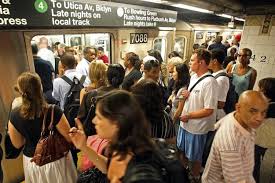
Women boarding a subway train
nydailynews.com

These are number that anyone who advocates for gender equality should take notice.  The greater female share of the urban population does not account for the divide.  "Women form a disproportionate share of low-wage and hourly workers in the U.S. and across most industries, they earn less on the dollar than men."  This hourly wage disparity means that women are held hostage to public transit, unable to afford a car.  In a single-vehicle household, women frequently sacrifice automobile access in order to allow their partner to commute to a better-paying job.

Elderly women waiting for a bus
harp.com

Here is another fact: "Not only do women represent greater shares of transit riders, but also take more transit trips:  As the primary caretakers in most households with  children nationwide, women tag o extra stops to their commutes for shopping, picking kids up for day care or school, to taking them to the doctor."

Given the above points, transit is extremely critical to women of color because the pay disparity is even greater.  Laura Bliss writes, Compared with white women, they are also more likely to live in poverty-and are more likely to serve as their household's primary breadwinner." A Stanford University study plotted the numbers: "As a percentage of all the trips (across modes) made in U.S. metro areas, roughly 7.2 percent of public transit trips are made by black women, compare to 5.8 for black men.  Asian women make up 4.4 percent of urban transit trips, versus 1.9 by Asian men.  Latino women make up 3.8 percent, compared to 2.7 for Latino men." (http://www.genderedinnovations.stanford.edu)

Lextran bus stop
Lexington, Kentucky
yelp.com
Here is another piece of information, "Yet hundreds of thousands of no-car households live outside of transit's reach-and millions of people who do live near bus stop and train stations still struggle to connect to well-paying jobs."  This is particularly true in the Southern United States, where the greatest share of American women of color reside.  In a similar vein, "...women of color disproportionately live in communities that lack access to critical health care-including reproductive health care."  Their children's schools frequently receive less investment than those in Caucasian neighborhoods.  Truthfully speaking, with the confirmation of Betsy DeVos to head the U.S. Department of Education yours truly does not expect to see any new education investment in minority neighborhoods.  Women in minority communities are more prone to impact of a warmer climate.  Thus, the world-wide march brought millions into the streets to give voice to all these issues.

Pico Metro Station
Los Angeles, California
en.wikipedia.org
Laura Bliss offers, "To close these gaps, higher-quality, affordable buses and trains are a critical part of the equation."  Public transportation gives women access to better-paying jobs, education opportunities, and health care.  Blogger does not need to repeat that more efficient and affordable public transit reduces harmful emissions, especially in neighborhoods greatly affect by road and industrial pollution-no coincidence minority communities.  A bonus, public transportation does not require a license or identification, and the fare is typically lower than other forms for transportation, particularly if you factor in pedestrian and bicycle infrastructure.

Typical bus stop in Los Angeles, California
commons.wikimedia.org
Allocating public dollars on all manner of public transportation makes sense, for women and everyone: "The American Public Transportation Association estimates that every $1 invested in public transportation generates $4 in economic returns and that every $1 billion invested bolsters and creates more than 50,000 jobs." (http://www.apta.com)

Despite all the positives that public transit offers many women, there is a certain discomfort that accompanies it.  Unfortunately, gender- and race-base harassment is outrageous common on trains and buses.  Undocumented immigrant and Muslim women are the frequent targets because of the increased hostility and physical harm thanks to increased racist rhetoric in the public discourse.  Buses and train cars are approached with extra caution.

Women only subway car
Mirena Rhee Photography Project
Osaka, Japan
dimmer light.com
Be that as it may, not many American transit agencies have created services specific to the needs of women-i.e. safe measures, route planning, or a block of seats for nursing mothers.    This past November, a few cities had ballot measures to expand transit networks, highlighting the national trend of declining funding for transit.  The recession has also impacted public transportation: forcing networks to eliminate routes, cut service hours, and increase fares.  Laura Bliss writes, "The insolvent Highway Trust Fund has already made federal transit subsidies increasingly scarce."

It is unlikely that the situation will improve.  The Hill reports, that if President Donald Trump's first budget follows the Heritage Foundation's blueprint for federal spending cuts, large sums of the annual transit spending could disappear. (http://www.origin-nyi.thehill.com)  This includes $2.2 billion for major expansions, $510 million for community-centered transportation grants, and $153 million for the Washington D.C. Metro, already dealing with a perilous budget crisis.  One of the unknowns is newly install Secretary of Transportation Elaine Chao and what she will do with the DOT's budget, however Ms. Bliss points out, "...she worked with the Heritage Foundation for years.  And the Trump campaign's $1 trillion infrastructure plan-if it ever sees the light of day in Congress-would barely boost transit investments, let along in communities that need them the most."

Former-President Barack Obama
huffintonpost.com
Public transportation, like the economy, global warming, immigration, and health care, affects and belongs to women.  Ms. Bliss writes, "And it is ripe for a groundswell of intersectional feminist support: the kind of feminism that recognizes the divergent experiences of women of color-and queer women, trans women, Muslim women, women with disabilities, immigrant women-and fight for all, even when the stakes are lower for some."

Although women use public transportation in greater numbers, most American women, especially Caucasian women, still have access to an automobile and they vote.  Voting is an act in the interest of the greater public good.  We vote with the idea that we are making our communities, cities, states, and country a better place.  Yet, when it comes to voting on spending increases on public transportation, we suddenly become selfish voters.  We do not want to see our taxes increase to pay for a subway expansion.  This kind of thinking does an injustice to our neighbors in communities that rely on public transportation to get to work and school.  We want to be more ecologically conscious but how does that square with voting against a ballot measure designed to mitigate traffic congestion.  We want to say that we pro-economic growth but how is that possible when a woman cannot get to the store to do her weekly grocery shopping when she has to wait an hour for the bus?  Public health is also placed in jeopardy when we take the short-term view of increased spending on public transportation.  In essence, public transportation is a feminist issue.


Monday, February 6, 2017

Going Downtown


Grand Park from the Stanley Mosk Courthouse
Los Angeles, California
Hello Everyone:

Blogger was becoming quite annoyed with the way human typist was saving all these photographs on the trusty iPhone.  Blogger's biggest complaint was that they were taking up too much valuable memory.  As part of human typist's goals for the year, she promised to share some of the pictures and send the rest into Google photo archives.  Here are the images from human typist's jury duty day.


Enjoying a relatively nice day in the park

The weather was mostly cooperative, albeit cold.  Human typist is such a delicate creature that she freezes when the temperature drops below 70 degrees.


Spectacular
Love this picture of the park fountain with two Los Angeles landmarks in the background: the Dorothy Chandler Pavilion, designed by Welton Becket (1962-4) and the Department of Water and Power Building, designed by the firm Albert C. Martin and Associates (1965)


A direct line to City Hall


Lunch al fresco 


A few of Blogger's fellow prospective jurors wondering how much longer will they have to remain in judicial purgatory.


George Washington was said to have never told a lie.  A few alternative facts maybe but never a lie.


Christopher Columbus

"In 1492, Christopher Columbus sailed the ocean blue" and landed in the Dominican Republic, a wee bit south of North America.


The view from the top step of Los Angeles City Hall

Another day, another picture.  This one was taken from the public entrance to Los Angeles's City Hall.  Over to the left is the Walt Disney Concert Hall by Frank Gehry (2003)


The Downtown Los Angeles Historic Core

Historic Broadway in Downtown Los Angeles with the Bradbury Building (home to our friends at the Los Angeles Conservancy) on the left hand side and the Million Dollar Theater on the right hand side.


The only way to the top

The entrance to Angel's Flight


Downtown without a skyscraper or two?  Never

One of the two California Plaza towers by Arthur Ericsson Architects and AC Martin Partners (1990)


Wednesday, February 1, 2017

Blogger Candidate Forum: The Consequence Of Being A Sanctuary City

http:/www.citylab.com


No Ban protests at Pittsburgh International Airport
Pittsburgh, Pennsylvania
post-gazette.com
Hello Everyone:

It is time for the weekly edition of Blogger Candidate Forum.  Hot on the heels of the #NoBanNoWall airport protests, we are going to take a look at how the city Pittsburgh, Pennsylvania is welcoming immigrants and refugees from the countries named in that ill-conceived executive order and the perils of being a sanctuary city in the Rust Belt.  In today's issue of CityLab (http://www.citylab.com), Brentin Mock presents an interview with Pittsburgh Mayor Bill Peduto on why he joined the protests and what it means to be a sanctuary city in the face of defunding from Washington D.C. in his article "Pittsburgh Mayor: 'We Follow the  Constitution, Not Executive Orders,'" 

Pittsburgh International Airport
Pittsburgh, Pennsylvania
popcitymedia.com
Pittsburgh International Airport is not an easy place to get to: no direct rail lines and the 17-mile cab or Uber ride from downtown can run as much as 50 dollars.  Yet, about 200 people made their way, over the weekend, to participate in the nationwide airport protests in response to President Donald Trump's ill conceived executive order banning travelers from Yemen, Somalia, Syria, Iraq, Iran, Libya, and 
Sudan.  Standing with the protestors was Mayor Peduto, sharing their message: "Yinz are welcome here."

Pittsburgh is still in recovery from decades one depopulation and the end of the once powerful steel industry.  In recent years, the city was remade itself as a place that welcomes newcomers.  Pittsburgh has accepted thousands of refugees, including over 200 years last year.  Many of the new arrivals  come from the now banned nations.  Pittsburgh is also home to thousands immigrants at the University of Pittsburgh and Carnegie-Mellon.  Graduates of these fine institutions are rapidly remaining in the city to work in tech companies such as Google and Uber, which have been instrumental in the city's technology and innovation makeover.

Pittsburgh, Pennsylvania
lonelyplanet.com
CityLab spoke with Mayor Peduto, on Monday January 30, 2017, about his support of Pittsburgh as place that welcomes all immigrants and the role sanctuary cities plan to play in resisting the new administration.  Below are excerpts from that interview.

CL: As we speak, the #DeleteUber movement is taking off among people upset that Uber appeared to undermine a cab strike at New York's JFK airport.  They're also objecting to Uber's CEO Travis Kalanick's relationship with Donald Trump.  Given Uber's considerable investments in the city, what's your position here?

BP: I sent their CEO a very stern text (Brentin Mock did see the text and assures readers it was stern) on Saturday night and I expressed my great disappointment not only on behalf of the city of Pittsburgh, but for every city on earth...It was a complete disregard for the people who helped Uber climb the laded including their own tech workers, their drivers...and their clientele.

It also disregards the fact that Uber operates, in cities, and no cities support [Trump's immigration] policies.  Uber is working against the very model that their business is created upon, which is urban transportation.

I know that Travis Kalanick stated he is going to bring [this] up on Friday at this business meting with the president, and I would hope he take the position of calling for the rescinding of these executive orders...

Taxi strike at John F. Kennedy Airport
New York
usatoday.com
 CL: Are you concerned about the possible consequences of Kalanick taking your rebuke personally?

BP: If Uber were to something like leave Pittsburgh over this, there are autonomous vehicle companies that would line up to come in...But really it's a question of the partnership they are trying to create with Pittsburgh.  Partnership is based upon a two-way street...

CL: Why is it important that you and the city of Pittsburgh be visible in these nationwide airport protests?

BP: The reason people go to protests is that they feel they have to do something...The protest itself becomes a civic action and there needs to be a way of telling people or letting them know that it does matter.  So my role is as much to march with them as its is to say "Thank you," to the people taking time out of their weekend to do something...I've never lived during a time when something like this happen, where blatant disregard for the Constitution has been taken on through executive order...It's important that people understand that their actions will change this country over the next four years.

Penn Circle
Pittsburgh, Pennsylvania
post-gazette.com
CL: Pittsburgh has been working to establish itself as a welcoming for immigrants from Middle East, South America, and beyond.  How is this compromised by Trump's latest action?

BP: We walk the line on sanctuary statues.  When it come to policing and how we handle people who are undocumented, the city does follow with strict adherence to what most sanctuary cities do...

We have rules in place with our police that prohibits any legal activity by the federal government from being administered by Pittsburgh police...in the realm of just trying to round up people or going after suspicious people or detaining people, we follow the Constitutions not executive orders.

On the question of whether the federal government or the president has the power to commandeer local law enforcement, the answer is no.  This was proved recently when Washington passed background checks for purchasing guns and required local law enforcement to background checks.  Writing for the majority was Antonin Scalia, who clearly stated that federal government does not have that power to commandeer local law enforcement....

Anti-Trump protests
Pittsburgh, Pennsylvania
pittnews.com
CL: In terms of Trump's executive orders, cities like New York and L.A. can afford, in some ways to be more defiant than a Rust Belt city that may be recovering from population and industry losses.  How should smaller cities proceed with walking the line of being welcoming, but avoiding potential penalties?

BP: First, there's been precedent in the courts that when the federal government has attempted to bully local governments by threatening their federal funds.  It has had limited success...It would really only come down to public law enforcement, and the only federal funds we receive through is a COPS grant.  At best we get $2 million in law enforcement grants...It averages out to around $800,000 annually.  ["Ed. Note: law enforcement funds were exempted from Trump's executive order threatening to freeze federal funds for sanctuary cities."]

So, we're not really that worried about it. We'll go to court about it, with the other cities...There's been a lot of communication with mayors all over the country, through the U.S. Conference of Mayors and the National League of Cities.  We're putting together a game plan that includes creating a legal defense trust fund...

2016 Pennsylvania electoral map
billypenn.com
CL: voters in Rust Belt states like Pennsylvania helped elect Trump-a lot of them did so because they feared immigrants were taking jobs from working-class whites.  Are concerned about widening political polarization or furthering fracturing relationship between the city and the state?

BP:  On a personal level, no.  The real question is how does this change the governance that we're seeing, where cities are becoming the center of political activity?  Whether it is on immigration, or climate change, or addressing inequity, cities are at forefront of creating the change...

CL: But there are consequences to that, right?  Allegheny County was a blue island stranded in Western Pennsylvania in last November's election.  When the state makes decisions about how to distribute resources, are you worried about further isolating the city politically?

BP:  I guess after going through the state budget crisis a few years ago when they weren't able to pass a budget for over a year, you saw that it really affected a lot of the health and human services that are administered through through the county.  But when it came down to the city, the biggest impact was on grants for development...the state was more directly involved at least financially with the county than with the city.

However, just as it is unconstitutional for the federal government to make policy for local government, it is not so for the state.  The state can commander local law enforcement...Cities exist at the right of the state.  So the state government has an incredibly powerful role in the administration of cities even though they may be limited in the finances...And I do believe that once these executive orders different discussion, because the legal rights are different than what they're to do in Washington.