Wednesday, February 17, 2016

Why We Need Historic Districts, A Follow Up

http://www.freep.com/story/opinion/editorials.2016/02/09/leave-michigans-historic-distrcts-alone/80022168


East Ferry Avenue Historic District
Detroit, Michigan
en.wikipedia.org
Hello Everyone:

'Tis the season for politics and all things politico are on Blogger's agenda.  In this case, a follow up to a story a recent story, "Historic Preservation As A Tool For Good" (Feb. 8, 2016)  on a pair of bills before the Michigan State Legislature-HB 5232 and SB 720-that would eliminate historic district status for neighborhoods throughout the states.  Representative Chris Afendoulis, a Republican from Grand Rapids and sponsor of the bill, calls it A modest target little bill.  Today, we follow up on the story with opinion article from the Editorial Board of the Detroit Free Press titled "Leave Michigan's historic districts alone."  The Editorial Board does not support the bills and would like to seem them die in committee.  Let us find out what the Free Press has to say on the matter.

Broadway Avenue Historic District
Detroit, Michigan
en.wikipedia.org

This "modest targeted little bill" would affect 78 cities in Michigan that have at least one historic district.  Historic preservationists "estimate 20,000 homes lie within such districts."  Taken in context to a state with a population of 9,909,877 people (http://www.quickfacts.census.gov) that is not a lot.  Not exactly a modest proposalThe bill was introduced in the statehouse in Lansing on January 23, 2016 would, according to Nancy Finegood of the Michigan Preservation Network:

...result in a lot of districts being eliminated and municipalities simply can't afford to go about all these steps in setting up districts...It would be a huge hindrance in maintaining and creating historic districts. (http://www.freep.com; Jan. 30, 2016; accessed Feb.17, 2016)

Rep. Afendoulis (R-Grand Rapids Township) counters,

Our bill to modernize a law written 45 years strikes the right balance between protecting private property owners' rights and historic preservation...This will help many communities maintain their historic identity, while ensuring private property owners have a greater voice. (Ibid)

Honolulu House
Marshall Historic District
Marshall, Michigan
michigan.gov
The bill is currently in committee and essentially take apart the historic district system, first implemented in 1970.  The Editorial Board writes, "If these bills become law, any neighborhood currently designated a historic district would lose that status after 10 years.  In the system envisioned by the bills' authors, residents of current historic districts would have to reapply every 10 years, earning approval  from both a majority of homeowners,  but also a majority of voters in a city-wide election."  Not very efficient is it?

No, in fact Amy Elliot Bragg, the president of Preservation Detroit told the newspaper that the proposed legislation is,

...actually about making it so difficult to establish a historic district that nobody in their sane mind would do it.  In a February 6, 2016 article by John Gallagher, "Bills threaten local historic districts in Michigan," Suzanne Schulz, planning director for the city of Grand Rapids said,

You're always trying to stabilize these areas and provide some level of confidence for the homeowners and business owners that when they invest in an area, their investment will be preserved.  (Ibid; Feb. 6, 2016)

Highland Park Historic District
Highland Park, Michigan
mibungalow.com
 
You may wondering, "Don't homeowners have a say in whether or not their neighborhoods should be designated or not?" Yes, typically they do however, as the Editorial Board observes, "..when coupled with the eventual elimination of historic districts sans a city-wide vote--a tremendously and costly burden for historic district homeowners--the end result would likely be a state free of historic districts."  Further, "Historic district status preserves the unique char of our oldest neighborhoods, ensures that significant historic homes and buildings can't be demolished or renovated past recognition, and bars new construction inconsistent with the neighborhood's character.

In an interview with John Gallagher, Rep. Afendoulis called his proposal ...a common sense way to address these concerns.  Rep. Afendoulis also told Mr. Gallgher that he acted out of concern for property rights, citing that residents of historic districts cannot remodel their homes because of restrictions in PA169, which created historic districts in 1970.  His bill would loosen the requirements, imposed by historic districts, that homeowners must maintain the historic fabric of the neighborhood.  Further, it would take power away from historic commissions and put it in the hands of local politicians who could freely disregard historic stands for any reason. (Ibid)

Leland Historic District
a.k.a. Fishtown
Leelanau County, Michigan
alma.com
However, residents of historic district do benefit from higher property values more than residents of non-designated neighborhoods.  Case in point, historic districts in Rep. Afendoulis's constituency-Grand Rapids Heritage Hill-Detroit's Indian Village and Lafayette Park are among the most stable communities in these cities.  In short, there is a cost to every benefit.

Accord to Amy Elliot Bragg, the proposed initiative would,

...make the local legislative body the repository of authority in a historic district, a process...could be burdensome in a city like Detroit, where there are more than a hundred historic districts.

The Detroit City Council recently passed a resolution formally condemning Rep. Afendoulis's bill.

Yorktown Historic District
Detroit, Michigan
free.com

Rep. Chris Afendoulis says he is troubled by the way new historic district boundaries are drawn, some homeowners become part of such district without their consent or knowledge, or are not duly informed during the home purchase that the property is subject to restrictions.  It seems a little hard to believe that the above situation frequently arises.  Blogger agrees with the suggestion of the  Free Press Editorial Board for kinder legislative remedy that would provide resolution while leaving Michigan's state historic district in place.  Ms. Bragg said,

...that the process neighborhoods pursue to achieve historic district status is prolonged and requires community input and approval--and some neighborhoods with historic significance choose not to pursue or complete the process.

Remember, preservation is voluntary.

The Editorial Board believes that "...there's the hypocrisy inherent in this proposed legislation.  While claiming concern with individual property owners' rights.  Afendoulis and his cohorts would trample the significant efforts individual property owners have undertaken to win historic for their communities."

No doubt there will be more to say on the subject, especially in this election year.  Keep your eyes out for more information on this blog and in Blogger's social media pages.


Tuesday, February 16, 2016

Blogger Candidate Forum: Hillary Clinton


Map of Presidential Primaries and Caucuses 2016 by month
frontloading.blogspot.com
Hello Everyone:

It is Presidential Primary season in the United States.  The primaries and caucuses are that quadrennial exercise that decides who will be the Democratic and Republican flag bearers in the November 8, 2016 General Elections.  For those you, like Blogger who live in California, we go to the polls on June 7, 2016.  (http://www.sos.ca.gov)  For everyone else, unless you live in: Iowa, New Hampshire, South Carolina, and Nevada, please check with your Secretary of State's website for more information.  In the spirit of keeping all of you informed, Blogger would like to begin a weekly multi-part series on each of the nominee candidates's positions on issues that have direct bearing on our cities like: the environment, criminal justice reform, health care education, and the economy.  With that in mind, yours truly would like to begin with the Blue Team (Democrats). First up, Madame Secretary Hillary Clinton.

Hillary Clinton
tvguide.com
Hillary Clinton has been a practicing attorney, activists, law professor, served as first lady of the United States and the State of Arkansas, and Secretary of State in the first President Obama Administration.  Ms. Clinton is also a polarizing figure who has come under fire for her handling possibly classified emails during her tenure as Secretary of State and her response to her husband, former President Bill Clinton, extramarital affairs. While yours truly firmly believes that Ms. Clinton must fully address these issues as long as she is a candidate, this is not the space to do so right now, Blogger would prefer to summarize Ms. Clinton's positions on certain issues.  Let us begin with climate change and clean energy.

Wind Farm
Brazos, Texas
en.wikipedia.org
Climate Change and Clean Energy

Clean air and clean water are not privileges, they are rights.  Critical to American progress is sustainable, dependable, renewable energy sources.  Hillary Clinton pledges to make the United States the "clean energy superpower of the 21st century." (http://www.hillaryclinton.com)  In order to accomplish this task, Ms. Clinton has laid out the following goals: generate enough renewable energy to power every American home by installing half a billion solar panels by the end of her first term.  Reduce energy waste in schools, homes, hospitals, and offices and "make American manufacturing the cleanest most efficient in the world."  (Ibid)  Third, reduce oil consumption by a third through cleaner fuels and more efficient vehicles and boilers.  Ambitious plan.

Criminal Justice
criminlajustice.com
Criminal Justice Reform

We live in the era mass incarcerations, private private prison, and mandatory minimum sentences that, at times, do not fit the crime.  Although the United States accounts for 5 percent of the world's population, we incarcerate 25 percent of the global prison population. (Ibid)  Statistically, African American men and boys are more likely to be stopped by police, convicted of crimes, and receive longer sentences than their Caucasian counterparts.  This is not right.  As president, Ms. Clinton has pledged to "End the era of mass incarceration, reform mandatory minimum sentences, and end private prisons.  Encourage the use of smart strategies-like police body camera-and end racial profiling to rebuild trust between law enforcement and communities.  Help formerly incarcerated individuals successfully re-enter society." (Ibid)

"The economy in 50 words or less"
motherjones.com

The Economy

Although reports say that the American economy is improving, many are still finding it difficult to make ends meet.  As president, Hillary Clinton intends to "Give working families a raise, and tax relief that helps them manage rising costs."  Ms. Clinton has pledged to create well-paying jobs and increase take home pay through infrastructure investment, clean energy, scientific, and medical research that promotes a stronger economy and growth.  Finally, as president, Ms. Clinton has promised to close the cooperate tax loopholes that allow the more fortunate to get away with paying less than their fair share.

No guns
truebluewomen.org

Gun violence prevention

The Second Amendment to the Bill of Rights guarantees the right of every American to bear arms.  However, does that include the severely mentally ill, individuals with a history of violent crimes, or terrorists?  Hillary Clinton has long argued for sensible gun control.  Therefore, if elected, Ms. Clinton will: increase background checks on the pool of potential gun owners and close loopholes in the current system.  Insist on accountability for irresponsible dealers and manufacturers.  Finally, work to keep weapons out of the hands of terrorists, domestic abusers, violent criminals, and the severely mentally ill.


Prescription: Health Care Reform
envisageinternational.com

Health Care Reform

As the First Lady of the United States, Hillary Clinton championed health care reform.  Although it was defeated, Ms. Clinton continues to advocate for health care reform.  As president, she will continue the Affordable Health Care Act (Obamacare), building on it to  alleviate consumer out-of-pocket expenses.  In the interest of full disclosure, yours truly has medical insure through ACA.  Ms. Clinton promises to toughen up on rising prescription drug prices, holding the pharmaceutical companies accountable so they make their money through research, not increasing the costs.  Finally, protecting a woman's access to reproductive health care.

Passport immigration stamp
sayanythingblog.com
Immigration

The United States has had a prickly relationship with immigrants.  In this election cycle, immigration is absolutely one of the hot button issues of this election.  The system is broken and it is in serious need of repair. Thus, as president, Ms. Clinton pledges to enact "comprehensive immigration reform to create a pathway to citizenship, keep families together and close private immigrant detention centers.  Defend President Obama's executive actions to provide deportation relief for DREAMers and parents of Americans and lawful residents, and extend those actions to additional persons with sympathetic cases if Congress refuses to act."


Freeway
beabudgeting.com
Infrastructure

Safe and strong bridges and roads are the backbone of the American economy.  They help bring goods and services to the market place, transport people from one point to another, and are the primary mechanism for a prosperous future.  As president, Hillary Clinton promises to increase federal investment by $275 billion over a five year period.  "Create a $25 billion infrastructure bank to support critical infrastructure improvements.  Harness public and private capital to fix and build new roads and bridges, expand public transportation, give every American access to broadband internet..."

Construction workers
levick.com


Labor

Labor unions are an integral part of the American workforce.  They represent the interests of a broad spectrum of workers ranging from the working class (those who work with their hands) to teachers and flight attendants.  Hillary Clinton pledges to "Strengthen unions and protect worker bargaining power.  Raise the minimum wage and strengthen overtime rules.  Support working families through equal pay, paid family leave, earned sick days, fair schedules, and quality affordable child care."

Racial Justice Sunday
incarceratewordelca.blogspot.com

Racial justice

We live in the time of #BlackLivesMatter.  As a nation, we cannot continue to tell ourselves we live in a post-racial society because we have an African American president.  Racial justice will be another key issue in this election year.  If you want further proof, look at all the controversy surrounding BeyoncĂ©'s segment at the 50th Super Bowl Half Time show.  To address this matter, Hillary Clinton intends to: "End the era of mass incarceration.  Protect immigrants' rights and keep families together.  Defend every American's right to vote."


American farm house
Melissa Johnson/Flickr
theatlantic.com
Rural communities

With so much emphasis on expanding urban centers, it is easy to forget that the United States is composed of rural communities from sea to shining sea.  These communities suffered greatly during The Recession and are still struggling to recover.  As president, Hillary Clinton will: "Strengthen rural economies by investing in infrastructure and expanding access to credit and venture capital. Rain agricultural production and profitability for family farms.  Promote clean energy leadership and collaborative stewardship."


Butcher shop
forbes.com
Small businesses

Small businesses are a vital part of a community.  They provide a sense of continuity and build relationships between the owners, workers, and patrons.  Historic preservationists (including yours truly) have long advocated the need to small business as part of what makes a community attractive and desirable.  However, owning and operating a small business can be a daunting task.  Hillary Clinton proposes launching an national initiative to break through the bureaucracy holding back small businesses.  "Provide targeted tax relief for small businesses and simplify tax filing.  Give small businesses-in particular, minority and women-owned business-more access to financing and new markets they need to grow."

These are just some of the issues that former Secretary of State Hillary Clinton has taken a position. (http://www.hillaryclinton.com)  Yours truly urges each and every one of you to go to the candidates's websites and study the issues.  Blogger is refraining from an opinion on the candidates and their platforms until the series is completed.  Next Tuesday we will look at Vermont Senator Bernie Sanders.  Of course, Blogger's final word will be spoken at the ballot box.  


Wednesday, February 10, 2016

A Cup Of Long Beach History

http://lbpost.com/place.2000007921-remains-of-victorian-styles-home-found-in-roof-of-koffee-pot-cafe#.vpaDycMX0Ql.gmail


Koffee Pot Cafe
Long Beach, California
lbpost.com

Hello Everyone:

Let yours truly start with an apology about not posting yesterday.  Unfortunately, Blogger had to deal with an incredibly rude person who soured Blogger's session.  Yours truly has a multi-part Presidential Election post planned for the coming weeks.  It should be an exciting series.  Now onto today's subject: architectural remains found in the roof of a cafe.

Blogger would like to thank Sara Delgadillo Cruz for sending the article "Remain of Victorian-Style Home Found in Roof of Koffee Pot Cafe," by Jason Ruiz, for the Long Beach Post.  The story is from two years ago but it is a nice story about a cafe that was once designated for demolition, then save by the discovery of a Victorian-style house in the roof.  Blogger was quite surprised by this and thought it would be a great story.

The Hot Cha/Koffee Pot Cafe c.1980
Photograph courtesy of California Crazy
Jim Heimann and Rip Georges
Long Beach, California
la.curbed.com
The Koffee Pot Cafe was once considered a public nuisance, by the city of Long Beach, if the the owners did not rehabilitate the building considered "substandard" for landmark status. (http://www.presstelegram.com)  However, thanks to the non-profit organization We Are The Next (http://www.wearethenext.org) the beloved cafe lives to pour another hot cup of coffee.  The Long Beach, California-based organization spearheaded efforts to save the now 84-year-old percolator-shaped coffee emporium.  Their initiative was given an extra shot of espresso by the discovery of the remains of a Victorian-style home on the roof.

The Koffee Pot, also known as the Hot-Cha Cafe, is one of the last remaining examples of programmatic architecture.  Work on the rehabilitation project began in the Summer of 2015, when the WATN team shepherded the current owners, Long Beach Development LLC through the City of Long Beach Cultural Heritage Commission application process.  Once approval was secured, the owners began work on the exterior, restoring it to its former caffeinated glory. (Ibid)  The project has been extremely challenging but worthwhile and yielded plenty of surprises.

Full view of Victorian-era house inside the cafe
wearethenext.org

The remains of the house were unearthed by organization and their partners Salvage Division and Pro Enterprises.  Jason Ruiz writes, "The foundation of the  building located at 951 East Fourth Street seems to have been built on the skeleton of an old home, meaning the Koffee Pot's-originally known as Hot Cha-may date back to the early 1900s or earlier according to We Are The Next Executive Director Kate Rispoli."

In a statement released by WATN, Ms. Rispoli said,

We are all baffled by this incredible find...Reintroducing this unique artifact as a fixture in the building moving forward will provide a sense of place and history and will return a lost gem to Long Beach.

Rainbow colored shingles
wearethenext.org
We Are The Next acted as the applicant's representative to the Cultural Heritage Commission, created a detailed preservation plan for the exterior, acted as construction managements, and did community outreach. (Ibid)  This was similar to the work the organization did when rescued the Southern Pacific Railroad Depot and the original Taco Bell (Taco Bell Numero Uno) from demolition.  In the case of the train depot, WATN was able to relocate Long Beach's last remaining train station from its location on Magnolia to the future Willow Springs Park.  Taco Bell Numero Uno was also relocated to a temporary site in Irvine, California and is currently waiting for a permanent location.

The underside of the roof gable
wearethenext.org

The preservation team believes that the rainbow-colored shingles were originally exposed in the cafe "...because the roof rafters that now support the coffee spout were painted to match the home's rainbow layout, which would've only been visible to patrons on the inside."  The spout was added in 1932 but the house's address, located on part of the site, dates back to the twenties.  The statement goes onto say,

Builders of the Hot Cha CafĂ© most likely used the frame o the existing residence as the frame for the restaurant to save costs during the Great Depression...The reason for retaining the upper portion of the home's primary façade is unknown.

The false ceiling that kept the rainbow shingles hidden from view is believed to have been installed after 1932.  The Long Beach Development LLC is planning to work with future tenants of the building to remove the false ceiling and once again expose the turn of the twentieth century architecture.  The cafe has been home to a variety of businesses since being vacated in 2010, the most recent business was a medical marijuana dispensary.  During the eighties, it was a barbershop, and before that a coffee emporium.  One potential future inhabitant could include the resurrection of the Koffee Pot, one cup at a time.


Monday, February 8, 2016

Historic Preservation As A Tool For Good

http://www.citylab.com


Mcintire Historic District
Salem, Massachusetts
salemweb.com
Hello Everyone:

Historic preservation is a tool that can be used for purposes of good or bad.  As a tool for good, it can be used to safeguard the long-term historic-cultural legacy of a place against the caprices of private interests.  As a tool for bad, it is a bludgeon used for protecting the interests of homeowners.  Some buildings-like: churches, museums, libraries, civic, and cultural buildings-naturally lend themselves to historic preservation.  Historic preservation ensures that these resources survive economic disasters, irresponsible managers, and trends.  By contrast, houses are not always the best candidates for preservation.  Kriston Capps writes in his CityLab article, "Why Historic Preservation Districts Should Be a Thing of the Past," "Houses, on the other hand are often poor candidates for historic preservation."  This sounds harsh to people who, like Mr. Capps, love residential architecture.  Historic homes can carry cultural and historic weight.  However, houses are privately owned and owners frequently argue, "it's my house and I can do what I want with it."  Houses are a source of wealth and when historic districts are established, it is a way to protect that source of culture, architecture, and history.  Sometimes they buttress wealth, status, and power.

The Kellogg House
Photography by Brandon Bartoszek/Flickr
Grand Rapids, Michigan
citylab.com
Republican are advancing historic districts in the Midwest

We are in, what Blogger calls "the silly season," the Presidential election cycle.  Both the Republican and Democratic parties seemed more emboldened, proposing whatever policy initiatives will make them attractive to voters.  In the Midwestern United States, the Republican party is waging combat against historic preservation.  "What do you mean?" you may ask.  Why target historic preservation for anything? Recently, "conservative lawmakers in Michigan proposed an amendment to the state's 1970 Local Historic Districts Act, the law that provides for establishing historic districts."  The amendment would make it more difficult to establish historic district and add a "sunset" clause that would make historic designation lapse every ten years.

Milwaukee Avenue Historic District
Photograph by Tony Webster
Minneapolis, Minnesota
flickr.com
The ominous specter of a "sunset" clause has historic preservation "surfing apoplectic."  The Michigan Historic Preservation Network issued a statement,

Local historic districts are the only way or communities to manage and protect their historic assets and 78 communities to date have chosen to enact ordinances to protect their assets at the local, under current state law..." (http://www.mhpn.org)

Michigan lawmakers may have been inspired by lawmakers in Wisconsin, "where Republic legislator proposed a bill in December that would prevent municipalities from designating a property as historic over the consent of its owner."  The proposed bill faced considerable blowback across the state, forcing lawmakers to soften its language.  The alleged purpose of the bill is to expand property rights in Wisconsin.  Wisconsin Republican State Senator Frank Lasee somewhat petulantly said in a statement,

Milwaukee Avenue in the Seward Historic District
Minneapolis, Minnesota
streets.mn
How would feel if you woke up one day and found your house subject to 40 pages of rules and regulations?...Burdensome regulations that require you to get permission from a government committee to improve your house, get approval for paint color, or the style and brand of windows you buy.

Obviously Mr. Lasee has never perused the volumes of zoning laws and building codes in his district.

Republican State Representative Chris Afendoulis echoed this sentiment.  In a statement to The Grand Rapids Press, Mr. Afendoulis said "...that the bill would give homeowners more say in the materials they use in home-construction projects."  I just want people to have a little more say over their property, said Mr. Afendoulis.  Yours truly supposes that someone forgot to tell Messrs. Lasee and Afendoulis that historic preservation is voluntary.

Broadway Avenue Historic District
Detroit, Michigan
en.wikipedia.org
Kriston Capps writes, "Preservationists in Michigan are raising the right questions about the push from conservative state lawmakers there. (For example: 'Why would the State impose a sunset clause on local decisions?') The property-owners' rights frame embraced by the GOP reads like an effort to make it easier for homeowners to add a chintzy garage to a Craftsman home." (never, never, never)  To be certain, the preservation of history and culture is not a value that Midwestern Republicans cherish.  However, the arguments opposed to the initiative are not solely based in aesthetics.  Essentially, both sides are arguing in favor of homeowners's financial interests.

In a rebuttal to all the legislative whining over protecting homeowners's rights, Dawn McCarthy, the president of the Milwaukee Preservation Alliance (http://www.milwaukeepreservationalliance.org), said the following at a hearing on the matter:

Regulating historic landmarks and districts does more than provide economic and cultural value.  It protects a property owner's investment...It prevents your neighbor from demolishing or inappropriately altering his historic home and thus the fabric of the historic district that give your property value.

Charleston Historic District
Charleston, South Carolina
forbes.com
Currently,, there are about 2,300 historic districts in the United States, most are are based on "authenticating the assets of single-family homeowners."  Mr. Capps rightly observes that "Neither property-rights advocates nor preservationists are asking the more fundamental questions about whether insisting on single-family zoning-even for the most gorgeous houses in the nation-is a fair and just thing to do."

Charleston is a model for how not to do historic preservation

A rendering of a modern architecture center for Clemson University
Brad Cloepfill for Allied Works Architecture
Charleston, South Carolina
postandcourier.com
Robert Behre, the architecture critic for The Post and Courier (http://www.postandcourier.com), has reported from the frontline of the historic preservation combat zone in Charleston, South Carolina.  Mr. Behre writes about the broad issues of modernism versus traditionalism; housing and affordability.  Since 2012, Mr. Behre has written about efforts by Clemson University to build an architecture center designed  by Brad Cloepfill of Allied Works in Portland, Oregon.  This is the second scheme for Clemson following the scuttled architecture center, designed in 2005 by Boston's Kennedy & Violich.  In both cases, the neighborhood preservationists were successful in preventing the building from going up.  Most recently, in late 2014 after receiving final approval for the design, Clemson was forced to abandon its plan, goaded by a lawsuit brought by two historic preservation groups and neighborhood organizations.

Downtown Charleston Historic District
Charleston, South Carolina
wentworthmansion.com

Charleston has the oldest historic district in the United States, and modernist endeavors clash with historic preservation in the city in the same way that polka dots clash with checked patterns.  Thus, the hallmark historic charm of the city is a powerful economic engine.  Last year, The New York Times, put the matter in a different way.  The booming port and manufacturing sector, coupled with that southern charm, has turned Charleston into a growing metropolitan area with a growing population.  However, as Mr. Capps observes, "...Charleston isn't growing at all: Historic downtown, where density hasn't budged, has seen real estate prices skyrocket."  For example, in suburban Mount Pleasant, civic authorities enacted a "growth" plan in late 2015 that actually altered zoning laws, orienting them for less-dense housing-partly because a developer put up a large multi-residence building.

Rainbow Row Historic Charleston
Charleston, South Carolina
andrewpinckeyinn.com
  Kriston Capps laments the architecture, falling victim "...to a powerful sense of entitlement among homeowners nurtured by a historic district designation."  Yet, the situation in Mount Pleasant is dire.  Charleston is simply unable to continue to allow single family homeowners to act as is their neighborhoods are that precious.  Mr. Behre reported that Charleston is changing its architectural review process, which would make it easier for more ambitious growth. Not every Charleston resident is anti-growth, in fact, there is a genuine interest in architecture that is not just for show.  Be that as it may, the same arguments being used to thwart the new architecture center is being employed to scuttle affordable housing and that is the problem.  "The result is a Charleston elite of increasingly wealth downtown residents, and an affordable housing crisis for everybody else."

Green Bay Road Historic District
Thiensville, Wisconsin
en.wikipedia.org
The question is not just aesthetic-it's constitutional

Bottom line, no one wants to see a beautiful Georgian home razed and replaced by some bland boring box of an apartment building.  Do you really want to flatten a classic Queen Anne and put up some characterless condominium?  Yours truly did not think so.  Just the opposite, people want to live in beautiful historic homes or, at least, near them for work, the schools, amenities, safety, and the property values that historic district earn.  That said, historic district can also be an obstacle to this access, wielded like a cudgel in the name of preserving the historic fabric of a neighborhood.  The results are pockets of extremely segregated wealth and access-regardless if the homes are historic or those dreadful McMansions.  This is a terrible use of historic preservation.

Kristin Capps writes, "That case against historic districting is similar to the case against protectionists single-family zoning anywhere."  This makes it a constitutional issues.  Last year, the United States Supreme Court rendered a decision on "disparate impact," meaning that "wealthy communities cannot keep affordable housing out because wealthy residents that they're better off without it."  The federal Affordable Furthering Fair Housing rule specifically states that "cities and neighborhood cant use single-family zoning to keep affordable housing at bay."

As cities deal with the increasing national housing crisis, the market and need for building more densely will grow, seeping into the historic districts.  Historic preservation can be a tool to alleviate this crisis: protecting precious community resources not a tool for protecting private assets.  Regardless of how you vote during the primaries and general election, one thing you should keep in mind is that historic preservation is for everyone, not for the wealthy few.

Wednesday, February 3, 2016

Follow Up To "Shedding Light On Hidden History"

http://www.nytimes.com/2013/12/19/nyregion/while-renaming-a-plaza-talk-of-fusing-traffic-islands-to-make-a-park.html?_r=1


Map of Little Syria
arabamericanmuseum.org

Hello Everyone:

Today yours truly has a follow up to a story that Blogger posted last week on the Washington Street Historical Society's effort to gain recognition for the Little Syria community, "Shedding Light On Hidden History" (01/27/16).  Blogger sent an email to Todd Fine, the director of Project Khalid and president of the Washington Street Historical Society. (http://www.savewashingtonstreet.org)  Mr. Fine is spearheading the campaign to preserve the community's history.  In his reply, Mr. Fine expressed his frustration over the National September 11 Memorial and Museum's attempts to exclude any mention of Little Syria and mentioned efforts to install a public art piece, dedicated to Little Syria.  Mr. Fine also sent a link to an article, published in the New York Times a little over two years ago.  The article, "As Plaza Is Named for Champion of Downtown, Talk of a New Park," by David W. Dunlap.  The article looks at how the Hugh L. Carey Brooklyn-Battery became a green space, something long advocated by the Downtown Alliance.  it also discusses the ongoing initiative of the Washington Street Historical Society to gain recognition for this immigrant community.

Elizabeth H. Berger
nytimes.com
 The late Elizabeth H. Berger, who passed away in Autumn 2013, was the president of the Downtown Alliance (http://www.downtownny.com) and champion of her Lower Manhattan community.  At a ceremony in December 2013, the Hugh L. Carey Tunnel was renamed in her honor.  At the ceremony, William T. Castro, the commissioner of Manhattan parks, looked to the future in which there would be not two plazas but one big one.  His listeners understood what Mr. Castro meant.  Mr. Dunlap writes, "The parks department is taking very seriously an idea-long advocated by Ms. Berger and the Downtown Alliance-to fuse the Edgar and Trinity Place traffic islands into a single park by rerouting a tunnel exit lane that divides them.  (It is the triangular Edgar Street island that is now formally known as Elizabeth Berger Plaza.)"

National September 11 Memorial and Museum Pavilion
Manhattan, New York
911memorial.org

William Bernstein, then-acting president and chief executive of the alliance added,

You could have Lower Manhattan's biggest open space north of Bowling Green and south of the 9/11 Memorial...necklace of green space, upward from the Battery.

In 2009, Ms. Berger and other supporters proposed "...rerouting the tunnel exit joining the two small islands-currently maintained as landscaped open spaces under the parks department's Greenstreets program-to create a more engaging, usable and parklike open space with square."  The renaming ceremony were encouraged when Mr. Castro publicly acknowledged George P. Vellnakis, the landscape architect with the parks agency, for drawing up the preliminary plans for the new park  Mr. Dunlap noted, "The agency has $2.5 million to cover the project."

Elizabeth H. Berger Plaza naming ceremony
Photograph by David W. Dunlap
nytimes.com

At the time, the Transportation Department issued a statement saying that it was

looking into a traffic analysis that will study the effects of rerouting traffic around the new proposed space.

Further, Mr. Bernstein could not speculate, at the time, of how the incoming administration of Mayor-elect Bill de Blasio would address the proposal.  Regardless, Lower Manhattan was on the radar of then-chairperson of Mr. de Blasio's transition team, Carl Weisbod, former prudent of the Downtown Alliance.  Anthony e. Shorris, then-designated first deputy mayor, served as consultant for the alliance in 2003.  The Downtown Alliance manages the Downtown-Lower Manhattan Business Improvement District.  In 2009, the BID issued a report, "Five Principles for Greenwich South," which focused on "...a trapezium-shaped area on the west side that includes much of what was once an Arab-American neighborhood called Little Syria."

"The Syrian Colony, Washington Street"
Lower Manhattan
nytimes.com
The story of Little Syria, its residents and many of its small business is sadly like that of other immigrant communities in the United States.  The residents and business were displaced and scattered by the construction of the Brooklyn-Battery Tunnel in the post-World War II period.  According to the alliance, the tunnel brought the noise and pollution of cars to the community.  It created a network of traffic island, one of which is bounded by Edgar Street, allegedly the shortest in New York City.  The island stretches about 100 feet, from Trinity Place in Greenwich Village.  The alliance has proposed a more welcoming, engaging pedestrian environment for the area.

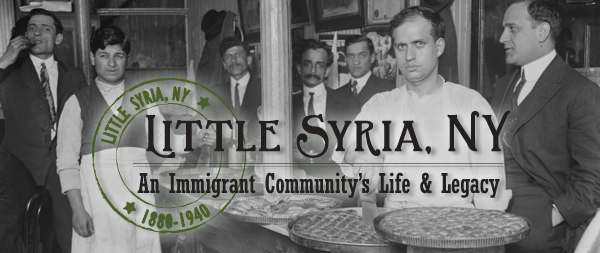
"Little Syria, NY An Immigrant's Community Life & Legacy"
arabamericanmuseum.org 
In 2013, the Washington Street Historical Society sponsored the repair and repainting of park bench in the Edgar Street Greenstreet, damaged in the wake of Hurricane Sandy.  Plaques were attached to the benches, commemorating historical Syrian- and Lebanese-American figures .  One plaque quotes poet and writer Khalil Gibran. Those are the sons of my homeland, who are born in cottages, and die in palaces.

The plaques and a sign identifying community history was unveiled in October 2013.  Todd Fine, the president of the WSHS enthused that the event ...brought together a beautiful rainbow of people who embody what made the Washington Street neighborhood so great.  However, Mr. Fine said he was quite insulted that Little Syria's advocates were not invited to the plaza renaming ceremony, nor consulted on the renaming of the Edgar Street Greenstreet.  Mr. Fine told Mr. Dunlap, We have put into that park.

Berger Plaza today
tribecatrib.com
At the ceremony, Ms. Berger's husband Frederick Kaufman gushed, I couldn't imagine a more fitting tribute to Elizabeth H. Berger than Elizabeth H. Berger Plaza.  Fitting indeed.  Perhaps what would be more fitting is a public art installation commemorating Little Syria.  Blogger understands and accepts that current events and politics dictate that anything that puts the Middle East in a positive light be disregarded, shunted aside, in favor of more negative narrative.  However, Blogger asks you to set aside your assumptions and consider this American community as positive for Lower Manhattan.  The people who lived and thrived in Little Syria came here, built homes and businesses.  They sent children to school, established institutions, worked hard, and made something of themselves.  Their story is no different than any other immigrant community throughout the United States and the rest of the world.  Little Syria deserves its place in the sun.

Tuesday, February 2, 2016

Income Inequality And Affordable Housing

http://www.citylab.com


New housing construction
Eugene Chan/Flickr
citylab.com
Hello Everyone:

The American Presidential Election season is upon us and one of the key issues that both the Republican and Democratic parties will absolutely need to address is income inequality.  Specifically, income inequality and affordable housing.  As each of the nominee candidates begins to articulate their positions on the subject, Tanvi Misra recently reported in CityLab on a new Brookings Institute Report which concluded that income disparities are rising in American urban centers.  Her article, "The Direct Link Between Income Inequality and Affordable Housing," looks where the disparities are occurring and how it affects affordable housing.  Each of the nominee candidates would be best advised to give this subject serious consideration and formulate policy proposals that will meaningfully address income inequality.


Bronxdale Houses
Bebeto Matthews/AP
nydailynews.com
Tanvi Misra writes, "Income inequality is one way to measure the economic disparities between the rich and the poor."  The schism tends to be more pronounced within urban areas, compared with the nation overall. It also continues to increase in both cities and metropolitan areas throughout the country, according to a new Brookings Institute analysis, "City and metropolitan inequality on the rise, driven by declining incomes," authored by Alan Berube and Natalie Holmes.  (http://www.brookings.edu, date accessed Feb. 2, 2016)

Mr. Berube and Ms. Holmes summarized their conclusions:

Inequality is indeed high and rising in most places, with the Great Recession and subsequent lackluster recovery exacerbating already significant gaps between rich and poor households.  Yet the magnitude of inequality, its source, and its trajectory vary markedly across the national landscape.

Boston Waterfront
Boston, Massachusetts
bostonrealestate.net
Alan Berube and Natalie Holmes calculated this gap by using the "95/20" ration, which divides household incomes that barely qualifies for the top five percent by one that makes less than 80 percent.

The 95/20 ratio has risen since 2007

In the United States, 95/20 ratio has increased from 8.5, in 2007, to 9.3 in 2014.  In short, "a household at the 95th income percentile made 9.3 times that of one at the 20th."  However 57 out of the 100 largest metropolitan areas in the nation witnessed their 95/20 ratio significantly increase during the same seven year period.  For example, in Bridgeport, Connecticut, the 95/20 ration experienced a 5.7 point increase between 2007 and 2014-the highest in the country.

"Inequality is higher today in most metropolitan areas than in 2007"
Source: Brookings Institute analysis of American Community Survey data
citylab.com
Alan Berube and Natalie Holmes offer this explanation:

Most metro areas experienced increases because top incomes were stable or declined modestly over this period, while incomes near the bottom dropped substantially.  Indeed, double-digit slides in the 20th percentile incomes were quite common across large metro areas.  High-income households earned significantly less in 2014 than in 2007 in 33 of the 100 largest metro areas, but the same was true for low-income households in fully 81 of those metro areas.

The map on the left, from Brookings, showing the 58 metropolitan areas statistically substantial changes in income inequality 2007-14.

Cities tend to mirror trends in inequality as the metropolitan regions they are in.  The Brookings report found that 29 out of 36 cities where the gap between rich and poor increased were located in metropolitans areas that also experienced a growth in their 95/20 ratio.  Mid-sized cities like: New Haven, New Orleans, Boise, and Cincinnati experienced greater increases because the income for low-income households fell by more than an alarming 25 percent.  Only Denver and El Paso experienced an earnings growth in the bottom 20th percentile between 2007 and 2014.

The relationship between inequality and affordable housing

"In More Unequal Cities,
Housing is Less Affordable for Low-Income Households"
Source: Brookings Institute analysis of American Community Survey data
citylab.com


Now we can answer the question of how does income inequality relate to affordable housing.  To find out how the two relate, Mr. Berube and Ms. Holmes used census housing data to calculate the annual rent for housing at the 20th percentile of cost distribution in each city.  This figure was compared to the annual income of the bottom 20th percentile of households in each city.  One example is Washington D.C., "...the annual rent for such a rental unit was $10,286 (or $857 a month) and the annual income for low-earning households was $21,230."  Therefore, the annual rent for an affordable apartment in Washington D.C. was "...48 percent of the annual income of a household that would potentially benefit from cheap housing."

For cities with higher inequality rates, this percentage was typically higher-i.e. low-income households have a harder time affording a place to live in these cities.  Blogger knows what you all are thinking, if it is too expensive for low income households to live in a place like Washington D.C,, why not move to a more affordable place?  As we all know, easier said than done.  New Orleans and Miami, where the 95/20 ratio  was a sky high 10.8 and 10.2 respectively, the lowest income earners paid up to 70 percent of their income in rent.  The map above, left illustrates the relationship between inequality and rent.

Cincinnati, Ohio skyline
joeyblsphotography.com
Tank Misra writes, "It's important to note that in some cities-Cincinnati, for instance-the rent burdening percentage is high even though housing there is not as expensive as elsewhere, because of extremely low incomes of the bottom 20th percentile of households."  In Washington D.C,, while the incomes of the lower strata may higher in comparison to other cities, so too are the housing costs.  San Francisco, on the other hand, is everyone's favorite example of lack of affordable housing but surprisingly does not have have the highest rent burden percentage (although it is 54 percent), even though its 95/20 ratio is one of the highest at 14.5 percent.  At the risk of sounding like one of those people who always say, "it's not as bad as it looks, let Ms. Misra explain, "This rent-burdening percentage isn't as high as might be expected because the income of the lowest earners, at $26,400 is much higher than it is in other cities with high inequality."

Alan Berube and Natalie Holmes explain San Francisco:

That housing appears more affordable to the poor in these cities does not, however, confirm that they necessarily have sufficient affordable housing.  There may be many lower-income households who would like to live in those cities, perhaps to be closer to jobs, transit, or other key services and amenities, but simply do not earn enough to afford rents there.

Now that the process of picking a new president has begun, Blogger urges everyone to go to the candidates's websites and study where each candidate stands on income inequality.  Income inequality and affordable housing will be among the key issues of the 2016 Presidential Election cycle and how each candidate responds will be crucial to dealing with this challenge.


Monday, February 1, 2016

Moving America Forward

http://www.citylab.com


Historic locomotive
Photograph by Tony Hisgett/Flickr
citylab.com
Hello Everyone:

A week, new month, hopefully no more beloved rockstars dropping dead.  Really, David Bowie, Paul Kantner, Glenn Frey, Lemmy Kilmister, enough already.  Speaking of enough already, let us move on to today's subject of the link between cities and and innovation.

Historically, cities have been rich mixture of people and economic activity.  This potent mixture has produced a wealth of innovation.  Density is the catalyst for innovation-putting people and ideas together, combining and recombining ideas in new and exciting ways.  In an article for CityLab, "The Historic Link Between Cities and Innovation," Richard Florida focuses on transportation-in all its forms-as a mechanism for increasing the circulation of ideas.

Downtown San Francisco
tophdgallery.com
A new study, titled Dense Enough To Be Brilliant: Patents, Urbanization, and Transportation in Nineteenth Century America, by Boston University economist and doctoral candidate Elisabeth Ruth Perlman examines the link between innovation, urbanization, and transportation.  (eh.net)  Mr. Florida writes, "...the ways that urbanization and transportation spurred American innovation in the late 18th and 19th centuries."  Specifically, Ms. Perlman studied at the period between 1790 and 1900.  He continues, "According economists and economic historians such as David Landes and Joel Mokyr, this was perhaps the most inventive period in American history, beginning just after the American Revolution and running through the Civil War and the Industrial Revolution."  This was the period when the United States moved away from a rural to urban nation.  At the beginning of the study period, just "...5 percent of Americans lived in urban areas...By 1900, urbanites were 40 percent of the population...," based on U.S. figures.  To give you all an idea of the magnitude of this spike, New York City's population, in 1790, was 33,000 people.  By 1900, it grew to over 3.4 million people-a 10,000 percent increase. (http://www.census.gov)

"Patents Issued, Total Population, and
Percent of US Near Rail or Transportation"
citylab.com
To understand the connection between cities, transportation, and innovation, Ms. Perlman's study incorporated a number of unique data sets.  She began with detailed information on over 700,000 patents-which stood in for innovations-for all American counties during the study period.  While they may be imperfect, Mr. Florida adds as an aside, "Patent are the most accessible written records of innovation activity:...economists and social scientists have long used them to study the dynamics of technological change and innovation."  Ms. Perlman compared this to information accessible means of transportation and distance to major ports; and key words used in patent descriptions, which allowed her to analyze the "...effects of local transportation on the speed of innovative activity.

The chart above left demonstrates the connection between innovation, population, and transportation. During the timeline, the number of patents and the total population trended upward, overall, perhaps more acutely around the 1850s, coinciding with the increase in access to railroads.  Mr. Florida writes, "Urban historians have long identified the role of new transportation systems like canals and railroads in spurring urban development..."  However, Ms. Perlman's paper found the connection between these innovations and innovation.  She found that the opening of a canna in a county was positively associated with an increase in patent activity.  Further, 20 years after the arrival of a railroad, counties saw the number of patents double per capita.  "in fact, the study finds that 8 percent of the increase in 19th century patents was the result of the spread of transportation."

"Patents per 10,000 people"
Pre-Civil War United States
citylab.com
The following two maps illustrate the link between innovation and transportation systems by plotting the number of patents per 10,000 people, drawing attention to major railroad lines.  Focus your attention on how innovation clusters along major lines.

The first map on the left is of the United States in 1840.  Innovation activity is clustered on the more industrialized New England and Northeastern states, spreading out along rail lines into the Great Lakes region the Midwest, and the more agrarian South.


"Patents per 10,000 people"
Untied States 1860
architexturez.com
The map on the left is the United States on the cusp of the Civil War.  While the same basic trend continues, we see that innovation hotspots are present along canal lines (shown in blue) and railroads (shown in red).  Twenty years hence, while patents continued to be concentrated in the same Northeast and New England regions, they expanded farther into the Midwestern and Western states like: California, Arizona, New Mexico and Southern states such as: Florida, Texas, and Louisiana saw upswings in innovation.


"index of Concentration by Year"
newsflow24.com

If you look at the chart on the left, "index of Concentration by Year," what we see is a steady decline in geographic concentration of patents during the 19th century.  It seems counterintuitive to the concept of innovation clustering.  We can conclude that this decline in geographic concentration of patents was the result of transportation, which enabled innovation to move out from its East Coast source and create new clusters in rapidly growing parts of the country.

In general. Elisabeth Ruth Perlman found transportation "...to be a key determinant of innovation in rapidly industrializing and urbanizing America."  However, the instrument implemented to make this happen is far more fascinating and more important, to understanding innovation.  Ms. Perlman's analysis demonstrated that innovation is not just a product of population nor access to larger markets via train, although both are important but not the sole necessities.    Rather, it is more subtle.  Ms. Perlman explained in an email to Richard Florida.

If transportation simply runs through a place, it doesn't do any good unless it also forms a nexus around which agglomeration occur.  This is shown in the different effects estimated in the North and South.

Austin skyline at night
Austin, Texas
sparefoot.com

Elisabeth Ruth Perlman went on to study the link between new forms of transportation and the flow of information.  To understand how it worked, Ms. Perlman followed "...the spread of key words and phrases in more than 700,000 patents to determine how quickly a new idea or technology spread into an area, and to what degree new forms of transportation contributed to this expansion."  Mr. Florida expressed surprise that Ms. Perlman found "...that transportation doesn't see to be encouraging more references to new technologies."  Rather, regions newly connected to transportation incorporated technology more slowly than previously.

Be that as it may, advances in transportation help stimulate the type of urban environment that can accelerate the arrival and growth of innovation.  Ms. Perlman wrote,

Because transportation encourages urbanization...it encourages patenting in many ways.  Urban areas allow for greater specialization, which might encourage patenting by giving people intros areas better access to the bureaucracy (e.g. lawyer, machinists, craftspeople) or by encouraging innovation directly.

Perhaps the most important take away is the way in which urban centers and advances in transportation speed up the movement of goods, people, and in particular ideas.  Moreover, these advances are just the result of history.  Richard Florida writes, "While the car facilitated the spread of innovation to suburban nerdistans in the 11970s, '80s, and '90s, the past decade or so has seen innovation and high-tech startup companies move back to urban centers near transit line where people and ideas can connect more efficiently."  Elisabeth Ruth Perlman's research demonstrates the importance of urban areas, transportation, and connectivity in moving American innovation forward throughout its history.